How to Invoice International Clients (Currency, Fees and Payment Methods)
 By Suraj Rao10 min read
What You'll Learn
- Agree the invoice currency, who pays transfer fees and the payment method in the contract, before you send the first international invoice.
- Billing in your own currency moves exchange-rate risk to the client, while billing in theirs makes paying easier, so price in a buffer if you take the risk.
- Cross-border invoices often need extra details, such as the client's VAT number, a reverse-charge note and full international bank details, so check the tax rules on both sides.

To invoice international clients, agree three things before you start: the currency you'll bill in, who pays the transfer and exchange fees, and how the client will pay. Then send an invoice with full details for both businesses, any tax ID or VAT note the rules require, the amount in the agreed currency, and international bank details.
Most problems with clients abroad come from leaving one of those three open. The client pays in the wrong currency, a bank in the middle takes a fee, and you receive less than you invoiced, a month later than you expected.
This guide covers which currency to bill in, how to handle exchange-rate risk, transfer fees and who pays them, the common payment methods, tax and VAT basics, what to put on the invoice, and payment terms that work across borders.
Which currency should you bill in?
Bill in the currency that makes paying easiest for your client, unless the exchange-rate risk is too much for you to carry. In practice, there are three options:
| Option | Who carries the exchange-rate risk | Good for | Watch out for |
|---|---|---|---|
| Your own currency | The client | Small or one-off jobs; when your costs are all in your currency | Some clients can't easily pay in a foreign currency, which slows payment |
| The client's currency | You | Larger clients, retainers, and clients whose finance teams only pay locally | Your income moves with the exchange rate |
| A major third currency (often USD or EUR) | Both, partly | Clients in countries with volatile currencies; global platforms | Two conversions can mean two sets of fees |
A few rules of thumb:
- Large companies often prefer, or insist on, paying in their own currency. Fighting it slows every invoice.
- Small clients and individuals may be fine paying in yours, especially through a money transfer service.
- Retainers are easier in the client's currency, because the monthly amount stays the same for them.
Whatever you choose, put it in the contract and show the currency code (USD, EUR, GBP) next to every amount on the invoice. A "$" alone can mean US, Canadian, Australian or several other dollars.
How to handle exchange-rate risk
If you bill in the client's currency, the amount you receive in your own currency changes with the exchange rate between the invoice date and the payment date.
Worked example
You're based in the UK and invoice a US client $4,000 on net 30 terms.
- On the invoice date, $1 buys £0.78, so the invoice is worth £3,120.
- By the time the client pays, the rate has moved to £0.75, so you receive £3,000, before any fees.
- You've lost £120 (about 4%) without doing anything wrong.
The rates here are made up to show the math. The rate could just as easily move in your favor.
Ways to reduce the risk
- Add a buffer to prices quoted in the client's currency, for example by rounding up when you convert your rate.
- Use shorter payment terms, such as net 15 instead of net 30, so there's less time for the rate to move.
- Take a deposit at the start of larger projects.
- Review your rates in the client's currency every 6 or 12 months, and agree in the contract when you'll do it.
- Hold the money in that currency if your bank or a money transfer service lets you, and convert when the rate suits you.
Transfer fees and who pays them
International payments can lose money in three places:
- The sender's bank fee for sending the payment.
- Intermediary (correspondent) bank fees, taken by banks in the middle of an international transfer.
- The receiving bank's fee, plus the exchange-rate margin: the gap between the rate you get and the mid-market rate.
On international wire transfers sent through the SWIFT network, the sender usually chooses one of three fee options:
| Option | Who pays the fees | What you receive |
|---|---|---|
| OUR | The sender pays all fees | Usually the full invoice amount, though some receiving banks still charge |
| SHA (shared) | Each side pays its own bank's fees | The invoice amount less your bank's fee and any intermediary fees |
| BEN | You, the recipient, pay all fees | The invoice amount less all fees |
SHA is a common default, which is why international invoices often arrive a little short.
How to agree who pays
Decide it in the contract, then repeat it on the invoice:
All bank and transfer fees are payable by the client.
Please send payment with charges set to OUR, so the full amount of
[USD 4,000.00] reaches our account.
If a client won't cover fees, build the expected cost into your price instead. And if a payment arrives short, decide in advance whether you'll absorb small differences or invoice the gap on the next bill, and say which in your terms.
Payment methods for international clients
Here are the common ways clients abroad pay, described neutrally. Fees and availability change, and depend on the countries involved, so check each provider's current pricing for your route.
| Method | How it works | Typical strengths | Typical drawbacks |
|---|---|---|---|
| International bank transfer (SWIFT wire) | Client sends money from their bank to yours using your IBAN or account number and SWIFT/BIC code | Every business can do it; good for large amounts | Can take several days; fees on both ends and in the middle |
| Local transfer in a regional system (for example SEPA within the euro area) | Client pays in euros to a euro account using an IBAN | Usually cheaper and faster than a wire | Only works within that system and currency |
| Money transfer services (such as Wise) | You get local account details in the client's currency; the client pays them like a domestic transfer | The client pays locally; conversion is often cheaper than a bank's | You need an account with the service; limits and features vary by country |
| Card payment | Client pays by card through a payment processor | Fast and familiar for the client | Processing fees, plus cross-border and currency fees |
| Online payment platforms (such as PayPal) | Client pays from their account on the platform | Quick for small amounts and individuals | Fees and currency conversion can add up |
For most freelancers and agencies, the cheapest setup for regular international clients is local account details in the client's currency, so the client pays as if you were a local supplier. For large, occasional invoices, a bank wire with fees set to OUR is fine.
Whichever method you offer, put every detail the client needs on the invoice, so their accounts team doesn't have to email you.
Tax and VAT basics for international invoices
Tax on cross-border services depends on where you are, where the client is, whether they're a business or a consumer, and what you sell. A few common patterns:
- Selling services between EU businesses: you usually don't charge VAT to a business customer in another EU country; the customer accounts for it under the reverse charge in their own country. There are exceptions. See the EU's guide to VAT on cross-border services.
- Selling services from the UK: for most business-to-business services, the place of supply is where the customer belongs, so many services to overseas business clients fall outside UK VAT. HMRC's VAT Notice 741A on the place of supply of services explains the rules and the exceptions.
- Working for US clients from outside the US: a US client may ask you to fill in IRS Form W-8BEN, which you give to the client (the payer), not the IRS. The IRS explains who needs Form W-8BEN.
- Selling to consumers abroad often follows different rules from selling to businesses, so don't assume the reverse charge applies.
When the reverse charge applies, the invoice usually needs the client's VAT number and a note such as "Reverse charge". Ask your accountant for the exact wording your country requires.
This section is general information, not tax advice. Rules change, and the details depend on your situation, so check with a tax adviser in your country before you send your first cross-border invoice.
What to put on an international invoice
Start with everything a normal invoice needs (our guide on how to write an invoice lists every field), then add the international details:
- Both businesses' full legal names and addresses, including country.
- Tax IDs: your tax or VAT number, and the client's VAT number if the reverse charge applies.
- The currency code next to every amount (EUR 2,400.00, not 2,400).
- A tax note, such as "Reverse charge" or "Outside the scope of UK VAT", if your adviser confirms it applies.
- Dates written unambiguously. 06/11/2026 means 6 November in the UK and June 11 in the US. Write "6 November 2026".
- Full bank details: account name, bank name and address, IBAN or account number, SWIFT/BIC code, and any local routing code.
- Who pays transfer fees, and the fee option to use.
- Payment terms and the actual due date.
- A payment reference, usually the invoice number.
- The client's purchase order number, if they use one.
Sample payment section
Amount due: EUR 2,400.00
Due date: 6 December 2026 (Net 30)
VAT: Reverse charge. Customer VAT number: [DE123456789]

Pay by bank transfer to:
Account name: [Your business name]
Bank: [Bank name, bank address]
IBAN: [IBAN]
SWIFT/BIC: [BIC]
Reference: INV-0057

All bank charges are payable by the client (fee option OUR).
The VAT number and bank details are placeholders. Only include the reverse-charge line if it applies to you.
Payment terms for international clients
International payments take longer to arrive and longer to chase, so the terms matter more.
- Keep terms short where you can. Net 15 leaves less room for currency moves than net 30. If a large client insists on net 30 or longer, see our guide to net 30 payment terms for ways to soften the wait.
- Ask for a deposit on new clients or big projects, especially before you've been paid by them once.
- Allow for transfer time. A wire can take several working days, so a client who pays on the due date may still land late in your account. Say whether the due date means "sent by" or "received by".
- Send reminders in good time. A reminder a few days before the due date helps clients schedule international payments. Our payment reminder email templates cover every stage.
Invoicing international clients in Tristiks Grow
Tristiks Grow is built for client work in more than one currency. You save each client's currency, hourly rate, tax rate and payment terms on their profile, and invoice them in that currency. Invoices are built from your tracked hours and expenses, carry your branding, and are emailed with a secure link where the client can view the invoice and download the PDF.
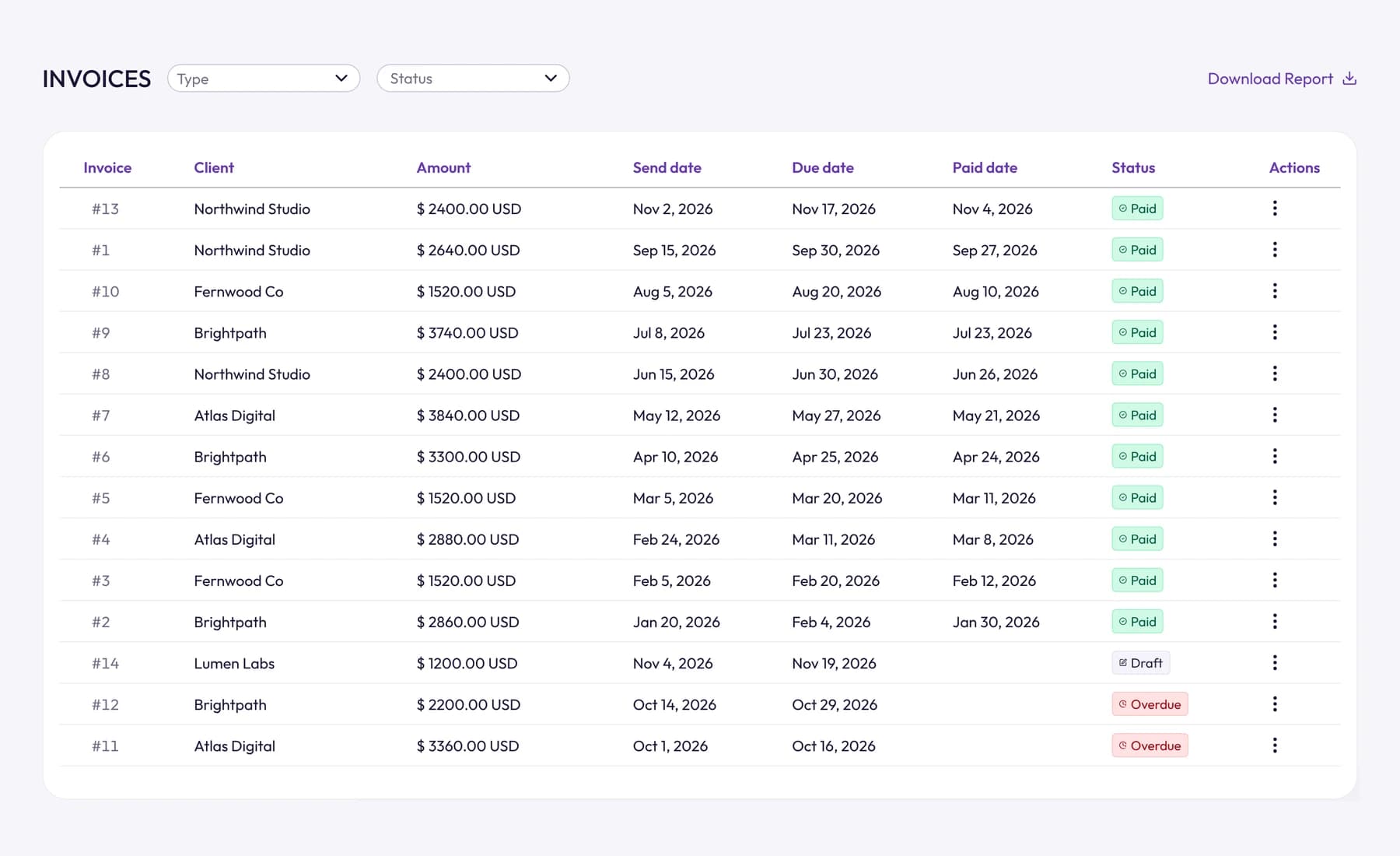
Clients pay by bank transfer or any other method you agree, and you mark the invoice paid in one click when the money arrives. Card payments through Stripe and PayPal are coming soon, so for now, put your bank details on the invoice. On the dashboard, paid and unpaid amounts from invoices in other currencies are converted into the currency you choose, so you can see your year in one number.
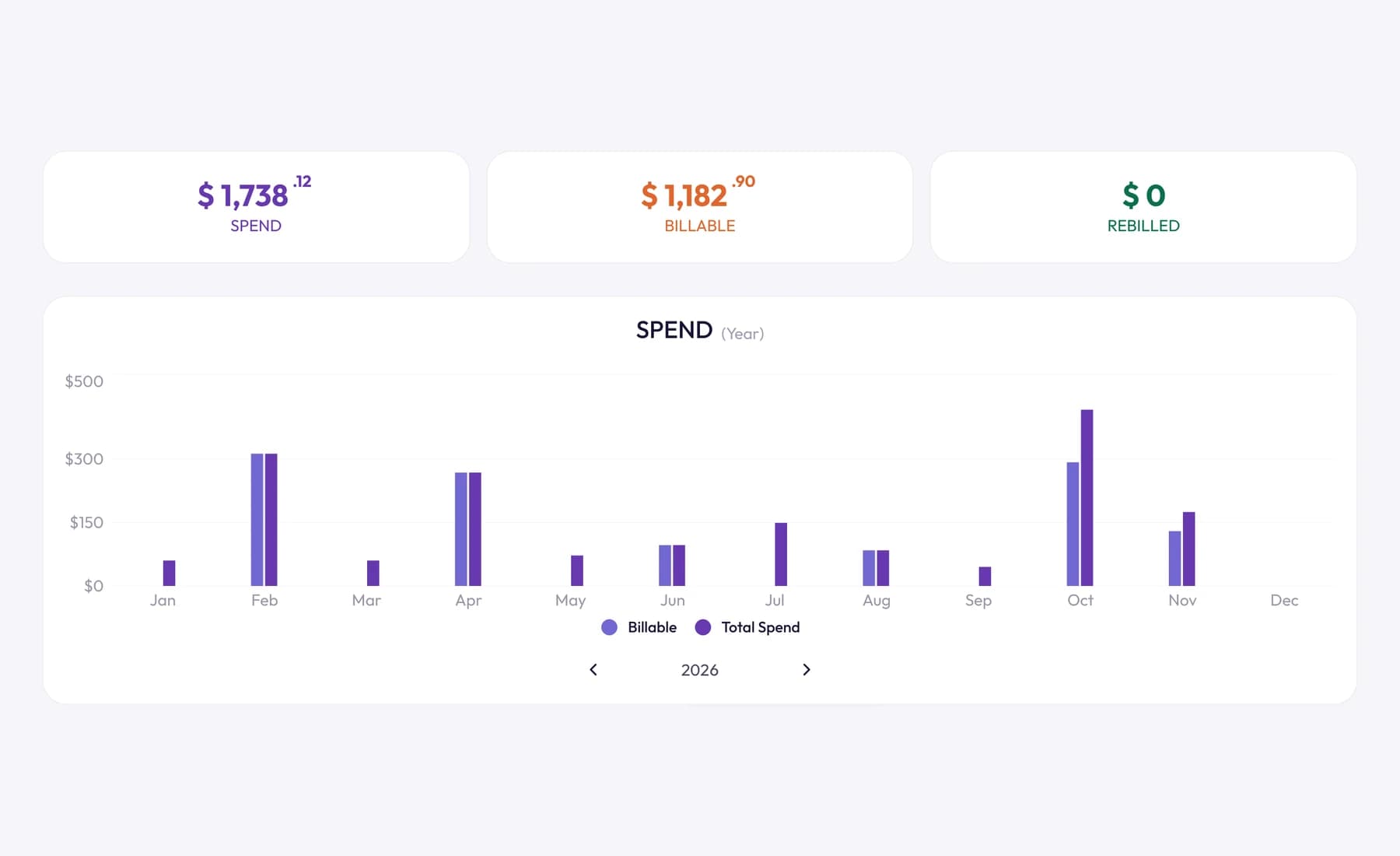
Costs work the same way. With expense tracking, you record each expense in the currency you paid, totals convert at the rate for the day you spent it, and billable expenses can go on the client's next invoice with your markup.
See the whole flow on our invoicing software page.
Frequently asked questions
What currency should I invoice an international client in?
Use the currency you agreed in the contract. If you haven't agreed one, the client's currency usually gets you paid faster, while your own currency protects you from exchange-rate changes. Always show the currency code next to each amount.
Who pays the fees on an international transfer?
Whoever the contract says. Without an agreement, fees are often shared, so you receive less than you invoiced. To get the full amount, state on the invoice that all charges are payable by the client and ask them to send the transfer with fees set to OUR.
Do I charge VAT to a client in another country?
Often not, for business-to-business services, because the client may account for the tax under the reverse charge or the service may fall outside your country's VAT. It depends on where you both are and what you sell, so check your tax authority's guidance or ask an adviser.
What is the cheapest way to get paid by international clients?
For regular clients, receiving money into local account details in the client's currency is often cheaper than an international wire, because the client makes a domestic transfer. Compare providers' current fees and exchange rates for your specific route before choosing.
Wrap up
Invoicing international clients comes down to agreeing the currency, the fees and the payment method up front, then putting every detail on the invoice so paying you is easy.
To invoice each client in their own currency and track what's paid across all of them, try Tristiks Grow invoicing free for 14 days, no card needed.
Category: Payments
Suraj Rao
Suraj Rao is the founder of Tristiks, the team behind Tristiks Grow and its desktop time tracker OneTrack. He writes about time tracking, client work and getting paid, and about DevOps, cloud and AI from years of building software.