Net 30 Payment Terms: What They Mean and When to Use Them
 By Suraj Rao8 min read
What You'll Learn
- Net 30 means the full invoice amount is due 30 calendar days after the invoice date, unless your contract says the clock starts somewhere else.
- Shorter terms like net 15 help your cash flow, while net 30 is the norm many business clients expect, so agree the terms in the contract before the work starts.
- Write both the terms and the actual due date on every invoice, and follow up on a set schedule the moment a net 30 invoice goes overdue.
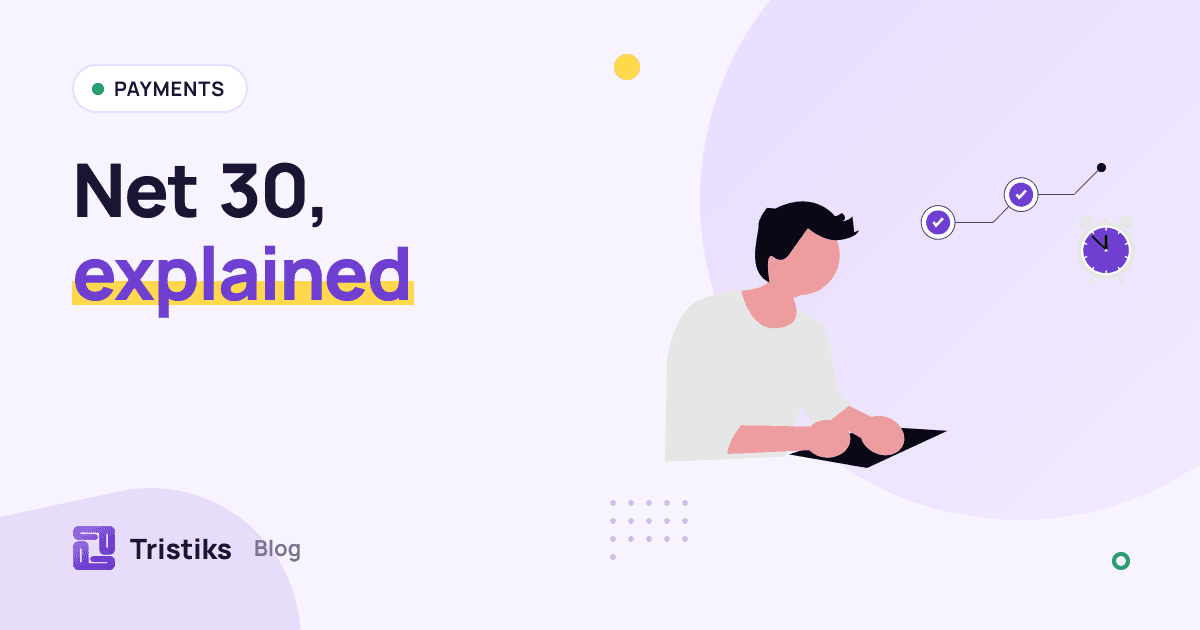
Net 30 is a payment term that means the client must pay the full ("net") amount of an invoice within 30 days. The 30 days are calendar days, usually counted from the invoice date, so an invoice dated 6 November on net 30 terms is due on 6 December.
It's one of the most common payment terms in business-to-business work, and many larger companies set their payment runs around it.
This post explains how the net 30 due date is counted, how net 30 compares with net 15, net 60, due on receipt and 2/10 net 30, when net 30 payment terms make sense for a small business, how to write them on an invoice, and what to do when they're missed.
What does net 30 mean?
Net 30 means payment of the invoice total is due 30 days after the invoice date. "Net" refers to the total after any agreed discounts or credits, and "30" is the number of days the client has to pay.
How the net 30 due date is counted
Unless your contract says otherwise, count 30 calendar days from the invoice date. Weekends and public holidays count.
| Invoice date | Net 30 due date | Note |
|---|---|---|
| 1 October 2026 | 31 October 2026 | A 31-day month: due on the 31st |
| 6 November 2026 | 6 December 2026 | Falls on a Sunday |
| 15 January 2027 | 14 February 2027 | |
| 1 February 2027 | 3 March 2027 | February is short, so it rolls into March |
A few things change the count:
- The start point. Some contracts start the clock when the client receives the invoice, or when the work is delivered, if that's later. Say which one in your contract.
- Weekends and holidays. A due date on a Sunday doesn't move automatically, but many clients pay on the next working day. If that matters to you, pick a due date that falls on a weekday.
- "Net 30 EOM". This means 30 days after the end of the month in which the invoice is dated. An invoice dated 6 November on net 30 EOM is due on 30 December, not 6 December.
The simplest fix for all of this: write the actual due date on the invoice. Then nobody has to count.
Net 30 vs other payment terms
Net 30 is one of several standard terms. Here's how the common ones compare:
| Term | What it means | Due date for an invoice dated 6 November | Common for |
|---|---|---|---|
| Due on receipt | Pay as soon as the invoice arrives | 6 November | Small jobs, new clients, consumers |
| Net 7 | Pay within 7 days | 13 November | Freelancers, short projects |
| Net 15 | Pay within 15 days | 21 November | Freelancers and small agencies |
| Net 30 | Pay within 30 days | 6 December | Most business clients |
| Net 60 | Pay within 60 days | 5 January | Large companies, long supply chains |
| Net 30 EOM | 30 days after the end of the invoice month | 30 December | Clients with monthly payment runs |
| 2/10 net 30 | 2% off if paid within 10 days, otherwise full amount in 30 | 16 November (discount) or 6 December | Encouraging early payment |
What 2/10 net 30 means
2/10 net 30 is net 30 with an early-payment discount: the client can take 2% off if they pay within 10 days, or pay the full amount by day 30.
Worked example on a $5,000 invoice:
- Paid within 10 days: $5,000 × 0.98 = $4,900.
- Paid between day 11 and day 30: $5,000.
The discount costs you $100. In return, you get the money 20 days sooner. For the client, that's a strong incentive. Spread over a year, giving up 2% to be paid 20 days early works out at roughly 37% a year (2 ÷ 98 × 365 ÷ 20), which is why finance teams often take the discount. Offer it only if faster cash is worth that much to you.
Pros and cons of net 30 for small businesses
| Pros | Cons |
|---|---|
| It's what many business clients expect, so it's easy to agree | You wait a month or more for money you've already earned |
| It fits many companies' monthly payment runs | You're effectively lending the client money for 30 days |
| It looks professional and reduces friction in procurement | A late payment on top of net 30 can mean 45 to 60 days without cash |
| It gives clients time to review and approve the invoice | It's harder on cash flow if one or two clients are most of your income |
When net 30 makes sense
- Your client is an established business with a finance team and a payment run.
- You have enough savings or steady income to cover a month's gap.
- The client won't sign shorter terms, and the work is worth the wait.
When to choose something shorter
- You're a freelancer or small studio and cash flow is tight.
- The client is new and you don't know their payment record.
- The project is small, or the client is an individual rather than a business.
You can also take the risk out of longer terms with a deposit up front (for example, 30% to 50% on signing), milestone invoices on long projects, or monthly billing on retainers instead of one large invoice at the end.
Is there a legal limit on payment terms?
In some places, yes. In the EU, the Late Payment Directive generally caps business-to-business payment terms at 60 days unless the contract expressly agrees otherwise and the terms aren't grossly unfair, with a 30-day default when no term is set, according to the EU's summary of the late payment rules. The rules are under revision, so check for changes.
In the UK, if no payment date is agreed, a business payment is late 30 days after the customer receives the invoice or the work is delivered, whichever is later, according to the UK government's late payment guidance.
In the US and many other countries, payment terms between businesses are mostly a matter of contract. This is general information, not legal advice; check the rules where you and your client are.
How to write net 30 on an invoice
Put the payment terms near the total, and always include the actual due date. Here's wording you can copy:
Payment terms: Net 30
Due date: 6 December 2026
Please pay by bank transfer to [account name, bank, account number or IBAN],
using invoice number INV-0042 as the reference.
With an early-payment discount:
Payment terms: 2/10 net 30
Pay $4,900.00 by 16 November 2026 (2% early-payment discount),
or $5,000.00 by 6 December 2026.
Two rules that save you trouble:
- Agree the terms before the work starts. Put them in your proposal or contract, so the invoice only repeats what the client already signed. Our free invoice template has a place for both the terms and the due date.
- Keep terms consistent per client. If one client is on net 15 and another on net 30, store that on each client's record so you don't have to remember it.
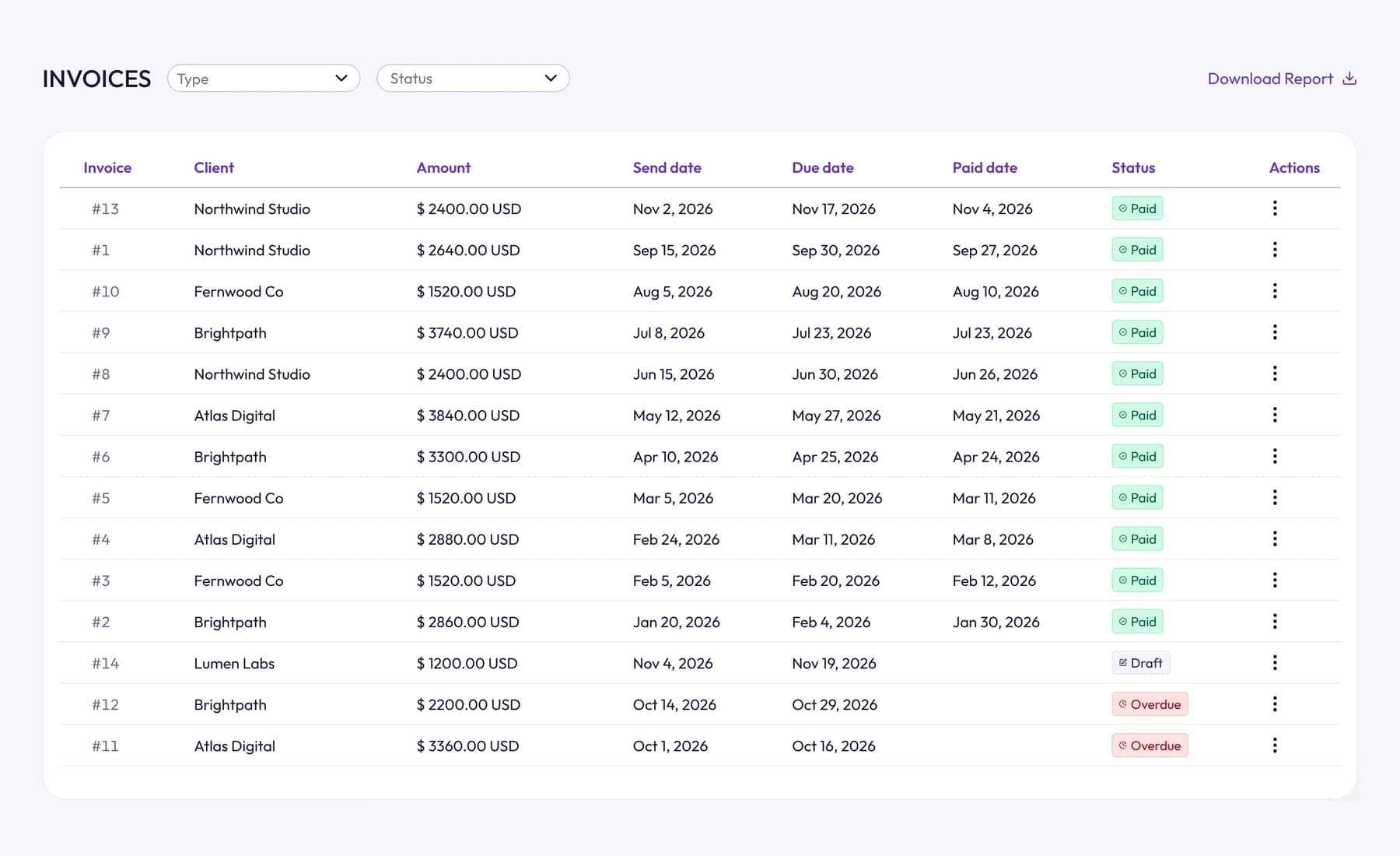
In Tristiks Grow, you can save each client's payment terms on their profile, and every invoice shows its due date. The invoice list shows which invoices are paid, due or overdue at a glance.
For every other field an invoice needs, see our step-by-step guide on how to write an invoice.
What to do when net 30 terms are missed
A missed due date is usually an admin problem, not a refusal to pay. Work through these steps in order:
- On the due date, send a short, friendly reminder with the invoice link and payment details.
- At 7 days overdue, check the invoice reached the right person and ask whether anything is holding it up.
- At 14 days overdue, ask for a specific payment date, and consider a phone call.
- At 30 days overdue, escalate to the client's accounts team, and mention any late fee that's in your contract.
- After that, send a final notice that states what happens next, such as pausing work.
Copy the wording for each stage from our payment reminder email templates.
If you'd rather not send these by hand, Tristiks Grow invoicing can email clients automatically 3 days before the due date, on the day, and 7, 14 and 30 days after it, for whichever reminders you switch on.
Frequently asked questions
Does net 30 include weekends?
Yes. Net 30 counts calendar days, so weekends and public holidays are included. If the 30th day falls on a weekend, the due date stays the same unless your contract says otherwise, though many clients pay on the next working day.
When does net 30 start?
Usually on the invoice date. Some contracts start it when the invoice is received or when the work is delivered, so state the start point in your contract and write the exact due date on the invoice.
Is net 30 the same as 30 days from the end of the month?
No. That's "net 30 EOM", which gives the client 30 days from the end of the month the invoice is dated in. On an invoice dated early in the month, it can add almost a month to the wait.
What happens if a client doesn't pay a net 30 invoice?
Follow up with reminders on a set schedule, then call. If it's still unpaid, you can apply any late fee in your contract, pause work, use a collection service or make a formal claim, depending on where you are.
Wrap up
Net 30 means paid in full within 30 days of the invoice date. Agree it in the contract, write the real due date on the invoice, and follow up the day it's missed.
To set terms per client and let reminders handle the chasing, try Tristiks Grow invoicing free for 14 days.
Category: Payments
Suraj Rao
Suraj Rao is the founder of Tristiks, the team behind Tristiks Grow and its desktop time tracker OneTrack. He writes about time tracking, client work and getting paid, and about DevOps, cloud and AI from years of building software.