Payment Reminder Email Templates: From Polite Nudge to Final Notice
 By Suraj Rao9 min read
What You'll Learn
- A payment reminder email works best as part of a fixed schedule: a few days before the due date, on the day, then 7, 14 and 30 days late, and a final notice.
- Each reminder should name the invoice, the amount and the due date, and get a little firmer, never ruder.
- Mention late fees only if they're in your contract, and pick up the phone once an invoice is two weeks overdue with no reply.
A payment reminder email is a short, polite message that tells a client an invoice is coming due or is overdue, and makes it easy for them to pay. The best ones name the invoice, the amount and the due date, link to the invoice, and get gradually firmer the longer the bill stays unpaid.
Most late invoices aren't a sign of a bad client. The invoice landed in the wrong inbox, missed a payment run or got buried. A clear reminder, sent at the right time, fixes most of them without any awkwardness.
Below you'll find a reminder schedule, a copy-and-paste template for each stage (with subject lines), tone tips, how to handle late fees, when to call instead, and how to automate the whole thing.
A payment reminder schedule that works
Send reminders on a fixed schedule, not when you happen to remember. A schedule keeps you consistent, and clients learn that your due dates mean something.
| When | Stage | Tone | Goal |
|---|---|---|---|
| 3 days before the due date | Friendly heads-up | Warm | Make sure the invoice is in the payment run |
| On the due date | Due today | Friendly, direct | Prompt payment today |
| 7 days late | First overdue reminder | Polite, clear | Find out if something's wrong |
| 14 days late | Second overdue reminder | Firm | Get a payment date |
| 30 days late | Third overdue reminder | Firm, formal | Escalate within the client's company |
| 45 days or more late | Final notice | Formal | State what happens next |
Adjust the gaps to your payment terms. On net 7 terms, you might send the final notice at 21 days. On net 60, you can space them out a little more. If your terms aren't set yet, our guide to net 30 payment terms explains the common options.
Payment reminder email templates
Copy these, swap the details in square brackets, and send. Each one includes a subject line, because that's what decides whether the email gets opened.
1. Before the due date: friendly heads-up
Send this 3 days before the invoice is due. It isn't chasing; it's helping the client pay on time.
Subject: Invoice [INV-0042] due on [6 December]

Hi [First name],

Just a quick heads-up that invoice [INV-0042] for [£2,900.10] is due on [6 December].

You can view and download it here: [link to invoice]

If it's already in your payment run, thank you, and please ignore this.

Best,
[Your name]
2. On the due date: due today
Short and direct. No apology needed.
Subject: Invoice [INV-0042] is due today

Hi [First name],

A reminder that invoice [INV-0042] for [£2,900.10] is due today, [6 December].

Here's the invoice again: [link to invoice]
Payment details: [bank name, account name, account number or IBAN, reference INV-0042]

Thanks,
[Your name]
3. 7 days overdue: first follow-up
Assume an honest mistake, and ask if anything is holding it up. This is where you often discover the invoice went to the wrong person.
Subject: Invoice [INV-0042] is now 7 days overdue

Hi [First name],

I haven't seen payment for invoice [INV-0042] yet. It was due on [6 December] for [£2,900.10].

Could you check whether it's been processed? If anything on the invoice needs changing, or it should go to someone else, let me know and I'll sort it out today.

Invoice: [link to invoice]

Thanks,
[Your name]
4. 14 days overdue: ask for a date
Firmer. Ask a direct question that needs an answer: when will it be paid?
Subject: Second reminder: invoice [INV-0042], 14 days overdue

Hi [First name],

Invoice [INV-0042] for [£2,900.10] is now two weeks past its due date of [6 December], and I haven't had a reply to my last email.

Could you let me know the date you expect to pay it? If there's a problem with the invoice or the work, I'd rather hear about it now so we can fix it.

Invoice: [link to invoice]
Payment details: [bank details and reference]

Best regards,
[Your name]
5. 30 days overdue: escalate
Copy in the person who handles payments, or your contact's manager if you know them. Keep it factual.
Subject: Overdue: invoice [INV-0042], 30 days past due

Hi [First name],

I'm following up again on invoice [INV-0042] for [£2,900.10], which was due on [6 December] and is now 30 days overdue. I've sent reminders on [13 December] and [20 December].

I've copied [Accounts contact] so this can reach the right person.

Please pay the full amount by [date, 7 days from today], or reply with a payment date. As set out in our agreement dated [date], [late fee terms] apply to overdue invoices.

Invoice: [link to invoice]

Regards,
[Your name]
Leave out the late-fee sentence if your contract doesn't include one.
6. Final notice
This is the last email before you take another step, such as pausing work, using a collection service or making a formal claim. Only state consequences you're actually willing to follow through on.
Subject: Final notice: invoice [INV-0042]

Hi [First name],

This is a final notice for invoice [INV-0042] for [£2,900.10], due on [6 December] and now [45] days overdue. I've contacted you about it on [dates].

If I don't receive payment or a confirmed payment date by [date], I will [pause all work on the project / pass the debt to a collection service / start a formal claim].

I'd much rather settle this directly. If there's an issue I don't know about, please call me on [phone number] this week.

Invoice: [link to invoice]
Payment details: [bank details and reference]

Regards,
[Your name]
[Business name]
Bonus: thank-you after payment
Not a reminder, but worth sending, especially after a late payment. It resets the relationship.
Subject: Payment received for invoice [INV-0042], thank you

Hi [First name],

Payment for invoice [INV-0042] has arrived. Thanks for sorting it out.

Looking forward to the next stage of the project.

Best,
[Your name]
Tone tips for a payment reminder email
The aim is to get paid and keep the client. These habits help with both:
- Lead with the facts. Invoice number, amount, due date and link in the first two lines. Busy people skim.
- Make paying easy. Put the link and the payment details in every email, so nobody has to dig up the original.
- Assume good faith early. The first two reminders should read as if the delay is a mix-up, because it usually is.
- Get firmer, not ruder. Move from "just a heads-up" to "please pay by [date]". Never use sarcasm, capitals or guilt.
- Ask questions that need an answer. "When can I expect payment?" gets a reply; "Just checking in" often doesn't.
- Reply in the same thread. One thread per invoice gives the client, and you, the full history.
- Keep it short. Every template above fits on a phone screen.
When to add a late fee
Only mention a late fee if it's in your contract or the client agreed to it in writing before the work started. Adding one after the fact rarely gets paid and often costs you the client.
If you do have a late-fee clause:
- State it on the invoice itself, next to the payment terms.
- Mention it first in the 30-day reminder, not earlier.
- Quote the exact terms from the agreement rather than paraphrasing.
Some countries give businesses a statutory right to charge interest on late payments from other businesses, even without a clause. In the UK, for example, you can claim interest at 8% plus the Bank of England base rate on late commercial payments, as explained in the UK government's guidance on late payment interest. Rules differ by country and don't usually cover consumers, so check what applies to you. This is general information, not legal advice.
If you're writing a contract now, our free contract template includes payment terms you can adapt.
When to call instead of email
Email is fine for the first two reminders. After that, a phone call often does more than another message.
Call when:
- The invoice is 14 days overdue and you've had no reply. Your emails might be going to spam or to someone who's left.
- The amount is large relative to your income, or the client is a big share of your work.
- You've had a vague reply twice, such as "I'll chase it" with no date.
- You're about to send a final notice. Give them one honest chance to explain first.
Keep the call short and friendly: "I'm calling about invoice 42. It's 14 days overdue and I wanted to check there's nothing wrong with it. When can I expect payment?" Then confirm whatever you agree in a short email.
How to automate payment reminders
Writing these emails by hand works for a few clients. Past that, reminders get forgotten, which is exactly when invoices slip.
In Tristiks Grow, you can switch on any of five automatic payment reminders in Settings: 3 days before the due date, on the due date, and 7, 14 and 30 days after it. Clients are emailed only for the reminders you turn on, and you're told each time one goes out. Each invoice is sent with a secure link where the client can view it and download the PDF.
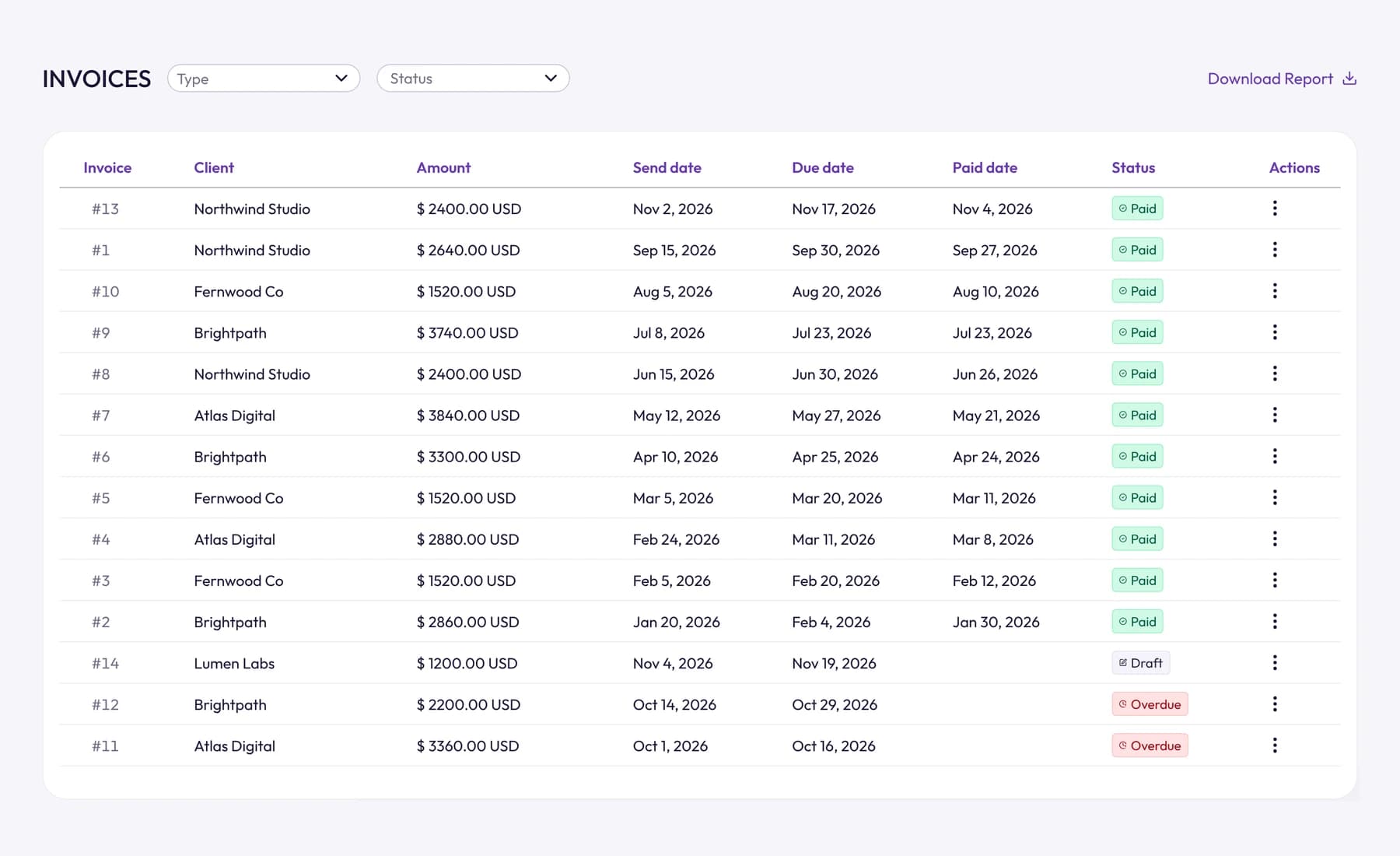
When the client pays by bank transfer or any other way, you mark the invoice paid in one click. Reminders follow up only until it's paid. Card payments through Stripe and PayPal are coming soon.
For retainers and monthly fees, recurring invoices go out on their own schedule, and each one can be followed by the same reminders. See the full setup on our invoicing software page.
Automatic reminders cover the routine stages. Keep the 30-day escalation, the phone call and the final notice personal: those are judgment calls.
Before you send any reminder: a quick checklist
Late payments are sometimes caused by the invoice itself. Before the first overdue reminder, check:
- The invoice went to the person who approves payments, not just your project contact.
- It has a purchase order number, if the client uses them.
- The due date is written as a date, not just "Net 30".
- The bank details are complete and correct.
- The line items are clear enough to approve without questions.
If any of these is missing, fix the invoice and resend it with an apology rather than a reminder. Our guide on how to write an invoice covers every field.
Frequently asked questions
How do you politely remind someone to pay an invoice?
Keep it short, factual and friendly: name the invoice, the amount and the due date, include a link to the invoice and your payment details, and assume it's an oversight. A line like "If it's already in your payment run, please ignore this" keeps the tone light.
How soon after the due date should I send a reminder?
Send a reminder on the due date itself, then again at 7 days overdue. Waiting longer than a week makes the invoice easier to forget, and the client may already have closed that month's payment run.
How many payment reminders should I send?
Usually four to six over about six weeks: one before the due date, one on it, then at 7, 14 and 30 days late, followed by a final notice if needed. After that, a phone call or a formal step is more useful than another email.
What should I write in the subject line of a payment reminder?
Include the invoice number and its status, such as "Invoice INV-0042 is due today" or "Invoice INV-0042 is now 7 days overdue". A clear subject makes the email easy to find and hard to ignore.
Is it okay to charge a late fee?
Yes, if your contract or a written agreement with the client includes one. Mention it on the invoice and in later reminders. Some countries also allow statutory interest on late business payments, so check your local rules.
Wrap up
Pick a schedule, copy the templates above, and send each reminder on time. Consistency gets you paid faster than any clever wording.
To stop sending them by hand, set up automatic reminders with Tristiks Grow invoicing, free for 14 days with no card needed.
Category: Payments
Suraj Rao
Suraj Rao is the founder of Tristiks, the team behind Tristiks Grow and its desktop time tracker OneTrack. He writes about time tracking, client work and getting paid, and about DevOps, cloud and AI from years of building software.