1099-K vs 1099-NEC: What Freelancers Need to Know
 By Suraj Rao7 min read
What You'll Learn
- A client who pays you directly (check, bank transfer, ACH) sends a 1099-NEC; a payment platform such as PayPal or Stripe sends a 1099-K for payments that ran through it.
- The One Big Beautiful Bill Act raised the 1099-NEC threshold from $600 to $2,000 for payments made in 2026, and restored the 1099-K threshold to over $20,000 and more than 200 transactions.
- You owe tax on all your income whether or not a form arrives. Reconcile forms against your own invoice records so nothing is missed or counted twice.
Form 1099-NEC reports what a business paid you directly for your services, such as by check, bank transfer or ACH. Form 1099-K reports payments that went through a card processor or a payment platform such as PayPal, Stripe or a freelance marketplace. A client who pays you by card or PayPal shouldn't also send a 1099-NEC for the same money, because the platform reports it instead.
Both thresholds changed under the One Big Beautiful Bill Act of 2025. A client only has to send a 1099-NEC if they paid you $2,000 or more in a year, starting with payments made in 2026 (it was $600). Payment platforms only have to send a 1099-K for third-party network payments when you received over $20,000 across more than 200 transactions, the old rule that was restored after several years of planned cuts.
Neither form changes what you owe. You report all your self-employment income on Schedule C, whether you get a form or not. This guide explains both forms, what the new thresholds mean for freelancers and how to reconcile them with your own records. It's general information, not tax advice; check the IRS pages linked below or a tax professional for your situation.
1099-NEC vs 1099-K at a glance
| Form 1099-NEC | Form 1099-K | |
|---|---|---|
| Who sends it | Your client (a business) | A payment processor, payment app or marketplace |
| What it reports | Payments for your services made directly: check, bank transfer, ACH, cash | Payments that went through the platform: cards, PayPal, Stripe, marketplace payouts |
| Threshold | $2,000 or more in a year, for payments made in 2026 onward ($600 before) | Third-party network payments: over $20,000 and more than 200 transactions. Card payments: any amount |
| Based on | What the client paid you | Gross payments through the platform, before fees and refunds |
| Due to you by | January 31 | January 31 |
| You need to give | A Form W-9 to the client | Your tax details to the platform |
Sources: the IRS page on Form 1099-NEC, the IRS guide to understanding your Form 1099-K, and CPA Practice Advisor's summary of the 2025 law.
Form 1099-NEC: when a client pays you directly
A business sends a 1099-NEC when it pays a non-employee, such as a freelancer, contractor or sole proprietor, for services in the course of its business. The client sends a copy to you and one to the IRS.
What changed: for payments made in 2025 and earlier, the threshold was $600. For payments made in 2026, it's $2,000, and from 2027 it's adjusted for inflation each year. So the 1099-NECs you get in January 2027, covering 2026, will only come from clients who paid you $2,000 or more.
What that means in practice:
- You'll get fewer 1099-NECs. A client who paid you for one $1,500 project in 2026 doesn't have to send one.
- The income is still taxable. The threshold is a reporting rule for the payer, not an exemption for you.
- Clients will still ask for a W-9. Give it to them at onboarding. If a client doesn't have your taxpayer ID, they may have to withhold 24% of payments as backup withholding.
- Personal clients don't send one. If an individual pays you for something personal, like a family portrait, they don't issue a 1099-NEC at all.
If you hire subcontractors, the same rule now applies to you as the payer. Our guide to hiring your first subcontractor covers W-9s and contractor paperwork.
Form 1099-K: when a platform processes the payment
Payment settlement entities send 1099-Ks: card processors, payment apps and marketplaces that pay you. Think Stripe, PayPal, Square, Venmo for business payments, or a freelance marketplace that pays out your earnings.
What changed: the American Rescue Plan Act of 2021 would have dropped the third-party network threshold to $600, and the IRS phased that in ($5,000 for 2024, $2,500 planned for 2025). The 2025 law reversed it, restoring the original rule: a 1099-K for third-party network payments is only required when you receive over $20,000 and more than 200 transactions in a year. The threshold isn't indexed for inflation.
Two exceptions worth knowing:
- Card payments have no threshold. If you take payments as a merchant through a card processor, they're reportable regardless of amount.
- Some states use lower thresholds. Your state may require a 1099-K at a lower amount than the federal rule. You may receive a form even if you're under $20,000.
A 1099-K shows gross payments. Platform fees, refunds and chargebacks aren't taken off. You deduct fees as a business expense and account for refunds on your return, so don't panic when the 1099-K figure is higher than what reached your bank.
The double-reporting problem
The IRS instructions say payments made by card or through third-party networks shouldn't go on a 1099-NEC, because the platform reports them on a 1099-K. In practice, clients don't always follow that. A client who paid your invoice through PayPal might still send you a 1099-NEC for the full amount, and PayPal might include it on your 1099-K.
If you add up the forms, that income is counted twice. To avoid paying tax on money you received once:
- Start from your own records, not the forms. Your total income is what you invoiced and were paid, by client.
- Match each form to payments. For each 1099-NEC, check how that client actually paid you. For each 1099-K, list which clients' payments it includes.
- Report income once. If the same payment shows on both forms, report it once and keep your reconciliation with your tax records in case the IRS asks.
- Ask the client to correct it if a 1099-NEC includes payments made by card or PayPal. A corrected form is the cleanest fix.
A worked example
Maria, freelance designer, 2026

Client A paid $14,000 by bank transfer        -> 1099-NEC: $14,000
Client B paid $1,800 by bank transfer         -> no form (under $2,000)
Client C paid $9,500 through PayPal (60 txns) -> 1099-NEC: $9,500 (sent in error)
Stripe card payments from 40 clients: $22,000 -> 1099-K: $22,000 gross
Client C's PayPal payments                     -> no 1099-K (under 200 transactions)

Forms total:          $14,000 + $9,500 + $22,000   = $45,500
Actual gross income:  $14,000 + $1,800 + $9,500 + $22,000 = $47,300
Adding up the forms misses Client B's $1,800, which had no form but is still income, and gets Client C right only by luck: the 1099-NEC shouldn't have been sent, and if PayPal had also reported it on a 1099-K, it would have been counted twice. Maria's invoice records give the right answer: $47,300.
What to do through the year
You can't control what forms arrive, but you can make January easy.
- Send a W-9 at onboarding, with your contract and first invoice. Our client onboarding checklist includes it.
- Record how each invoice was paid. Bank transfer, card, PayPal or marketplace. That's what tells you which form to expect.
- Keep platform fees as expenses. Card and PayPal fees are deductible; see our list of freelance tax deductions.
- Pay estimated tax each quarter. Forms arrive after the year ends, but tax is due four times during it. Our guide to quarterly estimated taxes covers the dates and how much to set aside.
- Reconcile in January. Run your income by client for the year, then tick off each form as it arrives. Our year-end review lists the other reports to run at the same time.
If you work through a marketplace, your payouts usually come with a 1099-K rather than 1099-NECs from each client. Our post on moving clients off Upwork or Fiverr covers how that changes when clients pay you directly.
How Tristiks Grow helps
Tristiks Grow keeps the record you reconcile against:
- Invoices by client, with send date, due date, paid date and status, so your income for the year is one filtered list.
- CSV export of invoices and expenses, to add a payment-method column, match forms or hand to your tax preparer.
- Expenses with receipts, including platform fees, so they're ready to deduct.
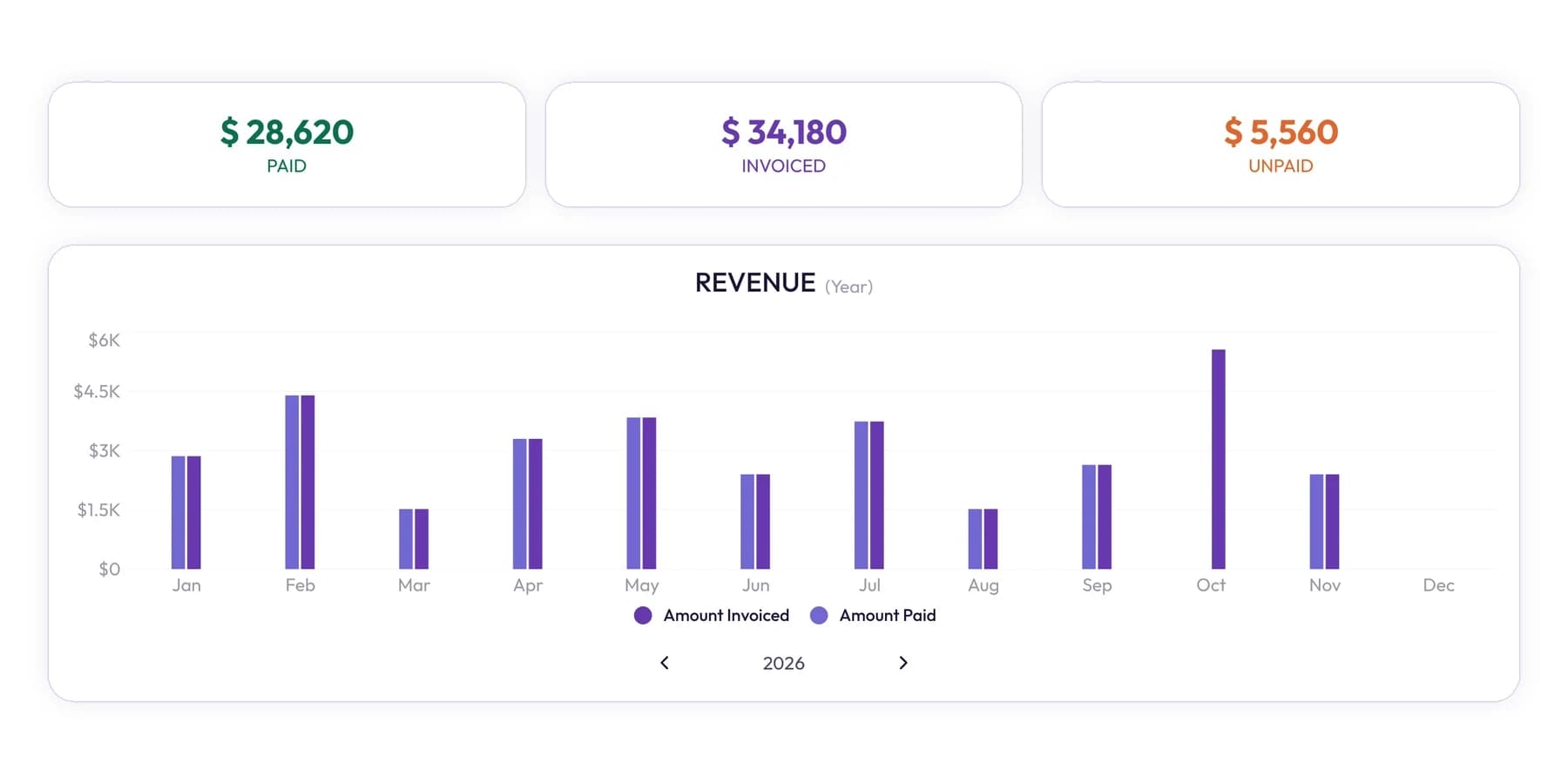
- A finances view of what's been invoiced, paid and is still unpaid this year.
See invoicing software for how invoices and payments are tracked.
Frequently asked questions
Do I have to report income if I didn't get a 1099?
Yes. All self-employment income is taxable whether or not anyone sends a form. The thresholds only decide who has to file a form, not what's taxable.
I got a 1099-K for personal payments. What now?
Payments from friends and family, or reimbursements for shared costs, aren't income. If they appear on a 1099-K, keep records showing what they were, and report them as the IRS instructions for Form 1099-K describe so they aren't taxed.
Does the $2,000 threshold apply to my 2025 taxes?
No. It applies to payments made in 2026 and later. Clients still had to send 1099-NECs for 2025 payments of $600 or more, due in January 2026.
What's the difference between a 1099-NEC and a 1099-MISC?
The 1099-NEC is for pay for services by non-employees. The 1099-MISC covers other payments, such as rent or prizes. The same $2,000 threshold applies to most 1099-MISC payments from 2026.
Wrap up
Clients send 1099-NECs for direct payments of $2,000 or more from 2026; platforms send 1099-Ks for over $20,000 and 200 transactions, or for any card payments. Forms are a cross-check, not your income figure. Keep your own invoice records by client and payment method, reconcile in January, and report each dollar once.
To keep every invoice, payment date and expense in one place for tax time, try Tristiks Grow free for 14 days.
Category: Payments
Suraj Rao
Suraj Rao is the founder of Tristiks, the team behind Tristiks Grow and its desktop time tracker OneTrack. He writes about time tracking, client work and getting paid, and about DevOps, cloud and AI from years of building software.