What to Do When a Client Won't Pay (Step by Step)
 By Suraj Rao10 min read
What You'll Learn
- Most unpaid invoices are late, not lost: escalate in order, from checking the invoice arrived to a phone call, pausing work and a dated final demand.
- The law is often on your side: UK businesses can claim statutory interest and fixed compensation, EU rules work similarly, India's MSMED Act sets a 45-day limit, and New York and Illinois require written contracts and timely pay.
- Small claims court is cheap and doesn't need a lawyer for modest amounts. If you do write a debt off, learn from it: deposits, milestones and clear terms prevent most of these.
When a client won't pay, escalate in steps and keep a written record of each one: confirm the invoice arrived and is correct, send a polite reminder, call, pause further work, send a final demand with a deadline, add the late fees or statutory interest you're entitled to, offer a payment plan, and only then go to mediation, a collections agency or small claims court. Most invoices get paid at one of the early steps. The later ones exist for the few that don't.
Late payment is common: QuickBooks' 2026 late payments report found 59% of US small businesses had invoices overdue by 30 days or more, and our roundup of freelance statistics has more figures like it. This guide gives you a ten-step plan, what the law allows in the US, UK, EU and India, scripts for each stage and how to stop it happening again. It's general information, not legal advice; for a large sum, talk to a lawyer where you are.
Before you escalate: is it late or is it lost?
A client who hasn't paid yet isn't the same as one who won't. Before you treat it as a dispute, answer three questions:
- Did the invoice reach the right person? Large clients often route invoices to an accounts payable inbox, need a purchase order number, or need you set up as a supplier first.
- Is anything wrong with it? A missing tax ID, the wrong legal name or a rate that doesn't match the contract will stall it in their system.
- Is the client disputing the work? "We're not happy with the deliverable" is a different conversation from silence. Our guide to handling difficult clients covers that one.
If your invoice tool shows whether the invoice was opened, check that first. An unopened invoice is a delivery problem, not a payment one.
The 10-step escalation plan
| Step | When | What you do |
|---|---|---|
| 1 | Before the due date | Friendly heads-up that payment is due |
| 2 | 1 to 3 days late | Polite reminder with the invoice attached |
| 3 | 7 days late | Firmer reminder; ask when they'll pay |
| 4 | 14 days late | Phone or video call |
| 5 | 14 to 21 days late | Pause further work, as your contract allows |
| 6 | 30 days late | Final demand with a deadline and next steps |
| 7 | 30+ days late | Add late fees or statutory interest |
| 8 | Any time after step 6 | Offer a payment plan or settlement |
| 9 | 45 to 60 days late | Mediation, ombudsman or collections agency |
| 10 | 60+ days late | Small claims court, or write it off |
The timings are a guide. Shorten them for a new client or a large amount, lengthen them for a long-standing client with a good record.
Steps 1 to 3: reminders
Reminders do most of the work. Keep them short, attach the invoice, and make paying easy with the amount, due date and payment details in the email itself. Our payment reminder email templates cover each stage from a polite nudge to a firm follow-up. Automate the early ones so you never have to decide whether it's "too soon" to ask.
Step 4: call
After two or three emails, pick up the phone. A call gets you an answer that an email can be ignored into avoiding. Keep it factual:
"Hi Sam, I'm calling about invoice 1042 for $3,200, which was due on the 3rd. I want to check it reached the right person and find out when I can expect payment."
Then stop talking. Write down what they said, and confirm it by email afterwards: "Thanks for the call. As discussed, you'll pay invoice 1042 by Friday the 21st."
Step 5: pause work
If you're still working for the client, stop starting new work until the overdue invoice is paid. Check your contract first: a clause that lets you suspend work when invoices are overdue makes this a process, not a threat. If you don't have one, our guide to what a freelance contract should include covers it.
"I've paused work on the next phase until invoice 1042 is settled. As soon as it's paid, I'll pick up where we left off."
If your contract says ownership of the work transfers on payment, don't hand over final files or source code until you're paid.
Step 6: final demand
A final demand is a formal letter or email that states the debt, gives a deadline (often 7 or 14 days) and says what you'll do if it isn't paid. In England and Wales, if the client is a sole trader, the Pre-Action Protocol for Debt Claims requires a letter before claim with specific information and 30 days to respond before you go to court.
Subject: Final notice: invoice 1042, $3,200, overdue since 3 March
Dear Sam,
Invoice 1042 for $3,200, issued on 3 February for the website redesign under our agreement of 10 January, was due on 3 March and remains unpaid despite my reminders on 4, 10 and 17 March and our call on 18 March.
Please pay the full amount by 7 April. If it isn't paid by then, I'll add the late-payment interest our contract allows and begin a claim in small claims court without further notice.
Payment details are on the attached invoice. If there's a problem I'm not aware of, reply to this email before 7 April.
Send it in writing and keep a copy. Only state consequences you'll actually carry out.
Step 7: late fees and statutory interest
If your contract or invoice terms set a late fee, apply it now. Our guide to late fees on invoices covers what to charge and how to word it. In some places, the law gives you interest even if your contract doesn't:
- UK: For business-to-business invoices, the Late Payment of Commercial Debts (Interest) Act 1998 lets you claim simple interest at 8% above the Bank of England base rate, plus fixed compensation of £40 for debts under £1,000, £70 up to £9,999.99 and £100 for £10,000 or more. A Late Payments Bill introduced in May 2026 would add a 60-day maximum payment term and stronger enforcement; check its progress.
- EU: The Late Payment Directive gives businesses a right to interest of at least 8 points above the European Central Bank rate and €40 fixed compensation, applied through each country's law.
- India: Under the MSMED Act, buyers must pay registered micro and small enterprises within the agreed term, and no later than 45 days. Late payments carry compound interest at three times the RBI bank rate, and you can refer the case to your state's Micro and Small Enterprises Facilitation Council (iPleaders explains the process).
- US: There's no general federal right to interest on late invoices; it depends on your contract and state law. Some places protect freelancers directly: New York State's Freelance Isn't Free Act covers work of $800 or more and requires a written contract and timely payment, and Illinois's Freelance Worker Protection Act does the same for $500 or more over 120 days. New York City has had its own version since 2017.
Step 8: offer a payment plan
A client who's short of cash may pay in instalments if you offer. Put the plan in writing: amounts, dates and what happens if a payment is missed (usually, the full balance becomes due). Getting 100% over three months beats a fight over 100% now. If the client disputes part of the work, a settlement for part of the amount, in writing, can be worth more than your time pursuing the rest.
Step 9: mediation, ombudsman or collections
- Mediation: a neutral person helps you agree. Often cheaper than court.
- Official help: in the UK, the Small Business Commissioner handles complaints from small businesses about late payment by larger ones. In India, the MSE Facilitation Council hears delayed-payment cases.
- Collections agency: usually takes a percentage of what it recovers, and its letters can end the relationship. Use it when you've stopped expecting more work from the client.
Step 10: small claims court, or write it off
Small claims courts handle modest debts quickly, usually without a lawyer.
- US: limits vary by state, from a few thousand dollars to over $20,000. Nolo lists each state's limit.
- England and Wales: you can claim up to £100,000 online through Money Claim Online; claims up to £10,000 are usually handled on the small claims track.
Bring the contract, the invoice, proof of delivery and every reminder. Winning gets you a judgment; collecting on it can take more steps if the client still won't pay.
Sometimes the honest answer is to write it off: the amount is small, the client has disappeared or the business has closed. Before you do, know the tax effect. In the US, if you report on a cash basis, an unpaid invoice was never counted as income, so there's nothing to deduct. If you use accrual accounting, you may be able to deduct it as a bad debt. Ask your accountant.
How to stop it happening again
Most unpaid invoices can be prevented before the work starts:
- Take a deposit. Our guide to how much deposit to ask for covers amounts by project size.
- Bill in milestones on longer projects, so you're never owed more than one stage.
- Agree terms in writing: payment term, late fee, suspension and ownership-on-payment clauses. Shorter terms help; our post on Net 30 payment terms explains the trade-offs.
- Watch for warning signs like haggling over the deposit or vague answers about who approves invoices. See our list of client red flags.
- Invoice promptly, the day work is delivered, not at month end.
- Keep a buffer. One late client shouldn't decide whether you can pay rent. Our freelance cash flow guide covers how much to keep.
And if a client is late every time, it may be time to part ways politely.
How Tristiks Grow helps
Tristiks Grow handles the early steps for you, so you only step in when it matters:
- Automatic payment reminders 3 days before the due date, on the day, and 7, 14 and 30 days after. Clients only get the ones you switch on.
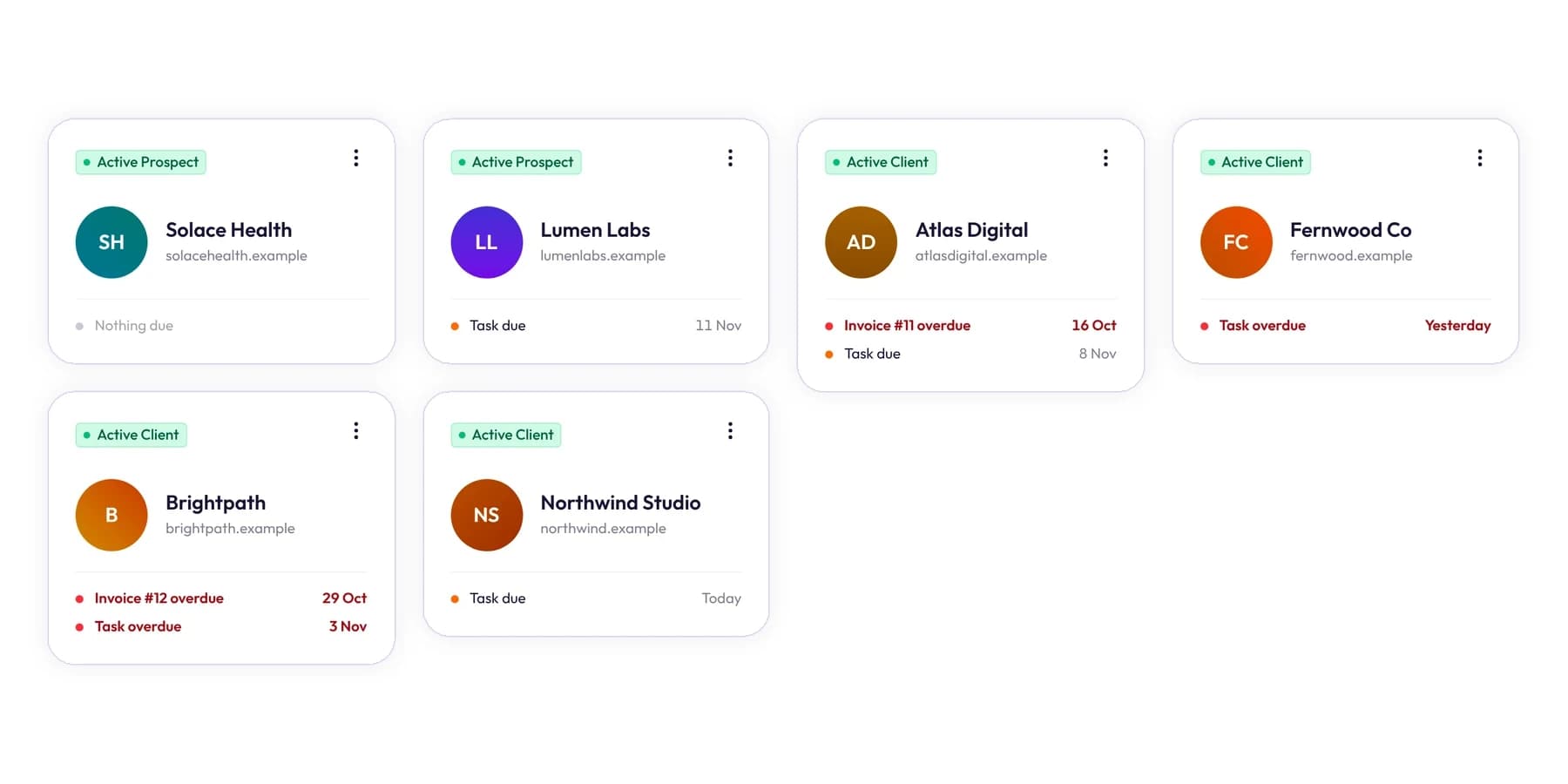
- Paid, due and overdue at a glance, across every client, with each overdue invoice flagged on the client's card.
- Invoices built from tracked time, so you have a dated record of the work behind each invoice if it's ever disputed.
- Proposals and contracts signed online, with the signed version locked, so your terms are on record before the work starts.
See how reminders work on our invoicing software page.
Frequently asked questions
How long should I wait before chasing an unpaid invoice?
Send a friendly reminder a day or two after the due date. Waiting weeks makes the conversation harder and signals that late is fine.
Can I charge interest if my contract doesn't mention it?
In the UK and EU, statutory interest applies to business-to-business invoices unless your contract sets a different, adequate remedy. In India, the MSMED Act applies to registered micro and small enterprises. In the US, it depends on your contract and state law, so put a late fee in your terms.
Can I take down a website or work I delivered?
Only if your contract allows it, and even then it can backfire legally. Pausing new work and holding back final files until payment is safer when your contract says ownership transfers on payment.
Is it worth going to court over a small invoice?
Compare the amount with the filing fee and the hours it takes. Small claims fees are usually modest, and a court claim often prompts payment before the hearing. For very small amounts, writing it off and moving on can be the better use of your time.
Wrap up
An unpaid invoice is usually a process problem before it becomes a legal one. Check it arrived, remind on a schedule, call, pause work and send a dated final demand before you reach for interest, collections or court. Then fix the cause: deposits, milestones, written terms and automatic reminders.
To send reminders automatically and see every overdue invoice in one place, try Tristiks Grow free for 14 days.
Category: Payments
Suraj Rao
Suraj Rao is the founder of Tristiks, the team behind Tristiks Grow and its desktop time tracker OneTrack. He writes about time tracking, client work and getting paid, and about DevOps, cloud and AI from years of building software.