Freelance Cash Flow: How to Survive Uneven Months
 By Suraj Rao11 min read
What You'll Learn
- Cash flow is about timing, not profit: a good year can still leave you short in March if the money for February's work arrives in April.
- A buffer of a few months' costs, plus a fixed monthly salary drawn from it, turns uneven income into a steady paycheck.
- Deposits, shorter terms, recurring work and a 12-week cash forecast reduce how often you need the buffer at all.

Freelance income doesn't arrive in neat monthly amounts. One month three invoices land in the same week. The next, a client pays 40 days late and a project slips, and you're watching the bank balance instead of doing the work.
You're not alone in that. In an Experian survey of 503 gig workers in May 2026, more than 80% said their income is unpredictable, and nearly 3 in 4 reported income swings of 25% or more (Experian). Late payment adds to it: 32% of UK freelancers had a client payment delayed in the previous 12 months, according to IPSE's Q1 2024 Freelancer Confidence Index (IPSE).
This guide covers the difference between cash flow and income, how big a buffer you need, how to pay yourself a steady salary from uneven income, five ways to get paid sooner, how recurring work smooths the curve, a 12-week cash forecast template with a worked example, and what to do in a thin month.
Cash flow is about timing, not income
Income is what you earn. Cash flow is when it reaches your bank account.
Say you finish a $6,000 project in February and invoice it on 28 February with net 30 terms. It's due on 30 March. If the client pays two weeks late, the money arrives in mid-April. Your February was a great month on paper and an empty one in the bank, and your rent was due on 1 March either way.
Three things widen that gap:
- Payment terms. Net 30 means at least 30 days between invoice and cash. Our guide to net 30 payment terms compares the common options.
- Billing timing. Invoicing at the end of a project, instead of in stages, pushes all the cash to the end.
- Late payment. Every day late is a day you fund the client's business.
You can't remove the gap, but you can make it smaller and build a cushion for what's left.
Step 1: Know your monthly number
Before you can plan, you need one figure: what you need each month for the business and your life to keep running. Call it your baseline.
Baseline = what you pay yourself each month + monthly business costsKeep tax out of the baseline and handle it separately (more on that below).
Worked example. A freelance designer needs $4,000 a month to live on. Their business costs (software, insurance, phone, accounting) come to about $600 a month.
Baseline = $4,000 + $600 = $4,600 a monthThat $4,600 is the number every other step uses.
Step 2: Build a buffer
A buffer is cash that sits in the business account to cover thin months and late payments. It's what lets a client paying three weeks late be an annoyance instead of a crisis.
For a sense of how thin most cushions are: the JPMorgan Chase Institute's 2016 study of about 597,000 US small businesses found the median one held enough cash to cover 27 days of outflows if no money came in (JPMorgan Chase Institute). That's less than one month.
How big should yours be?
A common approach is to hold a number of months of your baseline. Choose it by how uneven your income is:
| Your situation | Buffer to aim for | At a $4,600 baseline |
|---|---|---|
| Mostly retainers, several steady clients | 2 months | $9,200 |
| A mix of retainers and projects | 3 months | $13,800 |
| Mostly projects, or one client is over half your income | 4 to 6 months | $18,400 to $27,600 |
This is a business buffer, separate from personal emergency savings.
You don't need a full buffer before you start the system below: in good months, what's left after salary and costs stays in the account and the buffer grows.
Step 3: Pay yourself a steady salary
This is the single most useful habit for uneven income. Instead of spending what arrives each month, you pay yourself the same amount every month from the business account, and the business account absorbs the swings.
A simple account setup
Many freelancers use three accounts:
- Business account. Every client payment lands here.
- Tax account. When a payment arrives, move your tax share here straight away. Don't touch it.
- Personal account. Once a month, on the same date, transfer your salary here from the business account.
What share to move for tax depends on where you live and how much you earn, so set it with an accountant. If you're in the US, see our guide to quarterly estimated taxes for the due dates. This is general information, not tax advice.
How to set your salary
Look at the last 12 months of client payments, after the tax share. Take the monthly average, subtract business costs and round down.
Worked example. The designer's payments over a year, after tax, were:
| Month | Paid in | Out (salary $4,000 + costs $600) | Business account at month end |
|---|---|---|---|
| Start | $6,000 | ||
| Jan | $3,000 | $4,600 | $4,400 |
| Feb | $7,500 | $4,600 | $7,300 |
| Mar | $4,200 | $4,600 | $6,900 |
| Apr | $2,000 | $4,600 | $4,300 |
| May | $8,800 | $4,600 | $8,500 |
| Jun | $5,500 | $4,600 | $9,400 |
| Jul | $1,500 | $4,600 | $6,300 |
| Aug | $3,800 | $4,600 | $5,500 |
| Sep | $9,200 | $4,600 | $10,100 |
| Oct | $6,000 | $4,600 | $11,500 |
| Nov | $4,500 | $4,600 | $11,400 |
| Dec | $2,500 | $4,600 | $9,300 |
The year brought in $58,500, an average of $4,875 a month. Subtract $600 of costs and you get $4,275, rounded down to a $4,000 salary. The rounding is what grows the buffer.
Look at what happened: payments ranged from $1,500 to $9,200, but the designer was paid $4,000 every single month. The account dipped to $4,300 in April and still never ran dry. Without the $6,000 starting buffer, January alone would have been $1,600 short.
When the buffer passes your target, you can raise the salary or pay yourself a bonus. When it falls below one month's baseline, lower the salary or bring in more work.
Step 4: Get paid sooner
The buffer handles the gap. These five habits make the gap smaller.
1. Take deposits
A deposit moves part of the payment to the start of the project. On a $6,000 project with a 50% deposit, $3,000 arrives before you begin, instead of all $6,000 a month after you finish. Our guide on how much deposit to ask for covers splits by project size and client risk.
2. Bill in stages
On longer projects, invoice at milestones or monthly instead of at the end. A three-month project billed monthly gets you paid two months earlier for the first two-thirds of the work.
3. Shorten your terms
Net 15 instead of net 30 is worth 15 days of cash on every invoice. New clients and smaller businesses usually accept shorter terms if they're in the proposal from the start.
4. Invoice the day the work is done
An invoice sent a week late is paid a week late. Invoice the day a milestone is approved, or on a fixed day each week.
5. Follow up on a schedule
A missed due date is usually an admin problem, so a polite reminder on the day often fixes it. Our payment reminder email templates give you the wording for each stage. If late payment keeps happening, a late fee written into your contract can help; see late fees on invoices for whether and how to charge one.
How much these change
Take that $6,000 project finished in February:
| Approach | When the money arrives |
|---|---|
| One invoice at the end, net 30, paid 2 weeks late | All $6,000 mid-April |
| One invoice at the end, net 15, paid on time | All $6,000 mid-March |
| 50% deposit at start (January), balance on net 15 | $3,000 in January, $3,000 mid-March |
Same project, same price: the last row puts half the money in your account about three months earlier.
Step 5: Add recurring work
Retainers and ongoing monthly work are the most direct cure for uneven months, because the same amount arrives on the same schedule. Even one retainer covering a third of your baseline changes how a thin month feels.
Bill retainers at the start of the month, on a fixed date. Our guide to retainers vs fixed-price projects covers pricing and terms.
A 12-week cash forecast
The buffer and salary handle the year. A forecast tells you about the next three months, while there's still time to act.
Each week, list the cash you expect in and out, and carry the balance forward.
The template
12-WEEK CASH FORECAST
Starting balance (business account): $_____
Minimum balance I want to keep:      $_____  (e.g. one month's baseline)

Week | Week starting | Expected in (client, invoice #) | Expected out (what) | Closing balance
1    |               |                                 |                     |
2    |               |                                 |                     |
...  |               |                                 |                     |
12   |               |                                 |                     |

Rules
- "In" = unpaid invoices by due date, moved one week later for any
  client who usually pays late. Count only money after the tax share.
- Don't count work that isn't invoiced or agreed yet.
- Update every Monday: move paid items, add new invoices, roll forward a week.
Worked example
The designer starts the quarter with $9,000 in the business account and wants to keep at least $4,600 (one month's baseline). Salary is paid in weeks 1, 5 and 9; costs are about $150 a week.
| Week | Expected in | Expected out | Closing balance |
|---|---|---|---|
| Start | $9,000 | ||
| 1 | $4,150 | $4,850 | |
| 2 | $3,200 (Client A) | $150 | $7,900 |
| 3 | $150 | $7,750 | |
| 4 | $150 | $7,600 | |
| 5 | $1,500 (Client B) | $4,150 | $4,950 |
| 6 | $150 | $4,800 | |
| 7 | $4,000 (Client C) | $150 | $8,650 |
| 8 | $150 | $8,500 | |
| 9 | $4,150 | $4,350 | |
| 10 | $2,400 (Client A) | $150 | $6,600 |
| 11 | $150 | $6,450 | |
| 12 | $3,000 (Client D) | $150 | $9,300 |
Week 9 falls below the $4,600 minimum. It's not a crisis, but now you see it eight weeks ahead. The designer can ask for a deposit on the next project, invoice Client A's next stage a week earlier, or check that Client C's week-7 payment is on track. Without a forecast, they'd find out in week 9.
What to do in a thin month
When the forecast or the bank balance says a month will be short, work through this list in order:
- Chase what you're owed. Check every unpaid invoice. A friendly call often moves a payment up a week.
- Invoice anything you can. Finished milestones, approved work, expenses not yet billed.
- Ask for deposits on new work. A signed project with a deposit is the fastest new cash.
- Contact past clients. A short note asking whether anything is on their list often turns up a small job.
- Pause spending you can pause. Software you don't use, subscriptions, non-urgent purchases.
- Lower your salary for a month, if the buffer is below target, rather than borrowing.
Don't drop your rate to win quick work: a thin-month discount tends to stay.
Where Tristiks Grow helps
Tristiks Grow isn't accounting software and doesn't connect to your bank, so your buffer, salary and forecast live in your own spreadsheet. It does handle the invoicing side of cash flow:
- Deposits and stages. Scheduled payments break a project into several payments, each with its own amount, send date and terms, so the balance invoice goes out on its date.
- Recurring invoices. Set a retainer invoice to repeat every week, every other week or every month, and Tristiks Grow sends each one on its date. See recurring invoice software.
- Reminders. Turn on payment reminders to email clients 3 days before the due date, on the day, and 7, 14 and 30 days after.
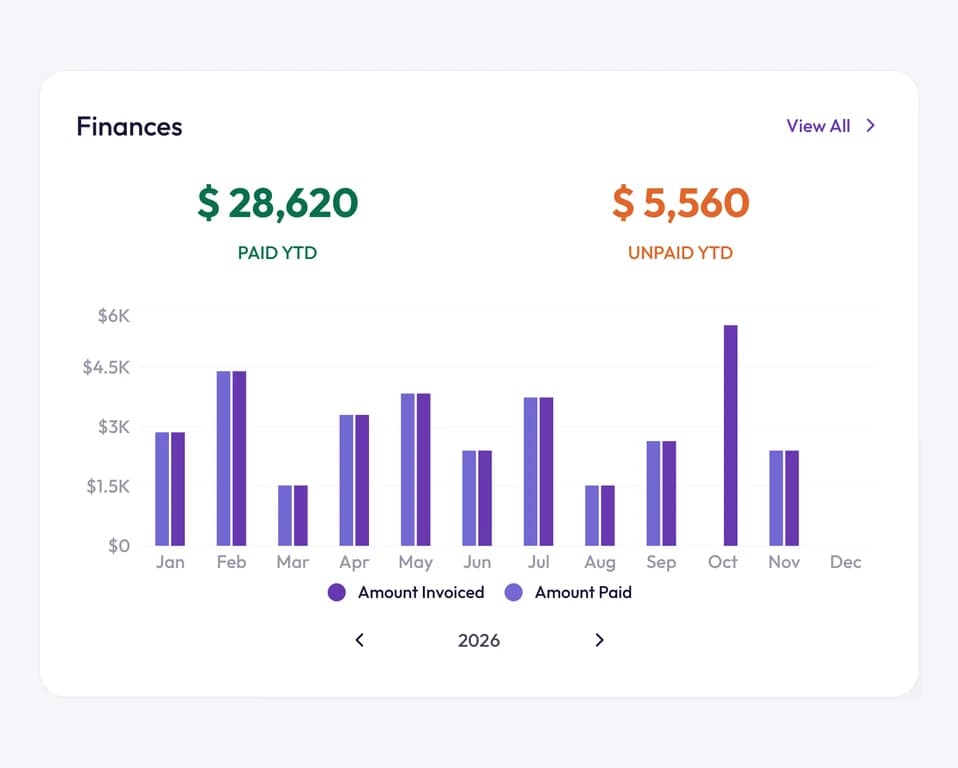
- What's paid and what's not. The invoice list shows what's paid, due and overdue, and the dashboard's finances card shows what you've been paid this year and what's still unpaid, with a chart of the year so far.
- Data for your forecast. Export your invoices as a CSV file with each invoice's client, currency, amount, send and due dates, status and paid date.
Each invoice is emailed with a secure link where the client can view it and download the PDF, and you mark it paid in one click when the money arrives.
Frequently asked questions
How much money should a freelancer keep in reserve?
Many aim for two to six months of their baseline (salary plus business costs), depending on how steady their income is. Fewer, larger clients and mostly project work point to the higher end. Keep it separate from money set aside for tax.
Should I pay myself a fixed salary as a freelancer?
For most people with uneven income, yes. A fixed monthly transfer based on your average income, rounded down, lets the business account absorb the swings and grows your buffer over time. Review it every few months.
How far ahead should a cash flow forecast go?
Twelve weeks is a practical length for most freelancers: long enough to spot a shortfall in time to act, short enough to fill in from invoices you've already sent. Update it once a week.
Wrap up
Uneven months are part of freelancing, but a cash crunch doesn't have to be. Know your baseline, build a buffer, pay yourself the same salary every month, and look 12 weeks ahead so a gap shows up while you can still fix it.
Then shrink the gap at the source with deposits, staged billing, shorter terms and recurring work. To schedule deposits, repeat retainers and let reminders follow up for you, try Tristiks Grow invoicing free for 14 days.
Category: Payments
Suraj Rao
Suraj Rao is the founder of Tristiks, the team behind Tristiks Grow and its desktop time tracker OneTrack. He writes about time tracking, client work and getting paid, and about DevOps, cloud and AI from years of building software.