Retainers vs. Fixed-Price Projects: Which Is Right for You?
 By Suraj Rao9 min read
What You'll Learn
- Fixed prices suit work with a clear scope and a clear end; retainers suit ongoing work where the client needs you every month.
- Price a retainer from the hours it really takes at your hourly rate, then write down what's included, what happens to unused hours and how overage is billed.
- Invoice fixed-price work as a deposit plus milestones and retainers in advance each month, and track time on both so you know which clients are profitable.

In the retainer vs fixed price choice, a retainer is a recurring fee, usually monthly, that a client pays for ongoing work or a reserved block of your time. A fixed-price project is one agreed fee for a defined result. Retainers suit steady, ongoing work; fixed prices suit projects with a clear scope and a clear finish line.
Most freelancers and agencies end up using both, often for the same client: a fixed-price project to build something, then a retainer to look after it.
This guide compares the two models (with hourly billing for context), shows which fits which kind of work, and walks through pricing a retainer, handling unused hours and invoicing each model.
The three pricing models at a glance
Hourly billing is here for context, since both other models are usually priced from an hourly rate.
| Hourly | Fixed price | Retainer | |
|---|---|---|---|
| What the client pays for | Hours worked | A defined deliverable | Ongoing work or reserved time |
| When you're paid | After the work, usually weekly or monthly | Deposit plus milestones | In advance, every month |
| Who carries the scope risk | The client | You | Shared, set by the agreement |
| Income predictability | Low | Medium, per project | High |
| Reward for working faster | None | You keep the difference | Some, on deliverable-based retainers |
| Best for | Unclear or changing work | Clear, one-off projects | Steady, recurring work |
What is a fixed-price project?
A fixed-price project is work you agree to deliver for a set fee, whatever it takes you. A website build for $8,000, a logo for $2,500, a code audit for $4,000.
The client knows the cost up front. If you estimate well and work efficiently, you earn more per hour than billing by the hour.
The catch is risk. If the project takes twice as long as you planned, you absorb the extra hours. That makes a tight scope essential: what's included, how many rounds of revisions and what counts as a change. Our guide to scope creep covers how to keep a fixed-price project from quietly growing.
What is a retainer?
A retainer is an ongoing agreement where the client pays a set fee each period, usually monthly, in exchange for your work or availability. There are three common kinds:
- Hours retainer: the client buys a block of hours each month, for example 20 hours of development.
- Deliverables retainer: the client pays for a set output each month, for example four blog posts and a monthly report.
- Availability retainer: the client pays to have you on call, with priority access, and work is billed on top or included up to a limit.
You get predictable income and fewer sales calls; the client gets a partner who knows their business.
Retainer vs fixed price: pros and cons
| Retainer | Fixed price | |
|---|---|---|
| Income | Steady and predictable each month | Lumpy: large payments, then gaps |
| Sales effort | One sale covers many months | A new sale for every project |
| Scope risk | Lower; work flexes month to month | Higher; overruns come out of your margin |
| Upside | Limited by the agreed fee or hours | High if you work efficiently |
| Client relationship | Long-term and close | Ends when the project ends |
| Admin | Monthly invoices, tracking used hours | Estimates, milestones, change requests |
| Main risk | Unused or overused hours, client dependence | Underestimating the work |
The right choice depends on the shape of the work.
Which model fits which kind of work
Ask two questions: is the scope clear, and does the work end?
| Kind of work | Clear scope? | Ends? | Best fit |
|---|---|---|---|
| Website or app build | Yes | Yes | Fixed price |
| Logo or brand identity | Yes | Yes | Fixed price |
| Ongoing SEO or content | Mostly | No | Deliverables retainer |
| Website maintenance and updates | No | No | Hours retainer |
| Monthly bookkeeping | Yes | No | Fixed monthly fee (retainer) |
| Strategy or advisory calls | No | No | Availability retainer |
| Bug fixing on an unfamiliar codebase | No | Yes | Hourly, then fixed once you know it |
| Discovery or research phase | Partly | Yes | Small fixed price |
A pattern that works well for agencies: start with a small fixed-price discovery, then a fixed-price build, then a retainer for support and improvements. The retainer turns a one-off client into steady income.
How to price a retainer
A retainer should be priced from the hours it really takes, not from what feels like a reasonable monthly number.
- Estimate the monthly hours. Look at similar clients, or at the time you tracked on this client's last project. Include calls, emails and reporting, which add up on retainers.
- Multiply by your hourly rate. If you haven't worked yours out, start with our guide on how to calculate your hourly rate.
- Decide on any commitment discount. Some freelancers give a small discount in exchange for a longer commitment, since it saves them sales time.
- Set a minimum term. Three months is a common minimum, so both sides have time to see results.
- Write down what's included. Hours or deliverables, response times, what's out of scope, and how extra work is billed.
A worked example
A developer estimates a client's maintenance retainer at 20 hours a month. Her rate is $100 an hour.
20 hours × $100 = $2,000 a monthShe adds two hours a month for the monthly check-in call and report, which she knows from her tracked time on similar clients:
22 hours × $100 = $2,200 a monthThe client signs a six-month retainer, and she offers a 5% discount for the commitment:
$2,200 × 0.95 = $2,090 a month, for 20 hours of work plus reportingExtra hours beyond the 20 are billed at her full $100 rate.
Rollover and unused hours
Unused hours are the most common source of retainer disputes, so decide the rule before the first month starts and put it in the contract.
Your options:
- Use it or lose it. Unused hours expire at the end of the month. This is fair when you've reserved time for the client and turned other work away.
- Limited rollover. Unused hours carry over to the next month only, or up to a cap, for example 25% of the monthly hours.
- Full rollover. Hours bank indefinitely. This turns the retainer into prepaid hourly work and can leave you owing a large block of time later. Use it with care.
Overage needs a rule too: either bill extra hours at your standard rate, or agree that work pauses at the limit until the client approves more.
A sample clause you can adapt (have it checked for your situation):
The monthly retainer covers up to 20 hours of work. Up to 5 unused hours
may roll over to the following month only; any other unused hours expire
at the end of the month. Hours beyond the monthly total, including any
rolled-over hours, are billed at $100 per hour, and only with the
client's written approval.
Whatever the rule, track every hour and send a short monthly summary of hours used. Our post on what to include in a freelance contract covers the rest of the agreement.
How to price a fixed-price project
Fixed prices start from hours too:
- Break the work into tasks and estimate the hours for each.
- Multiply by your hourly rate.
- Add a buffer for risk. The less clear the scope, the bigger the buffer.
- Limit revisions and say how changes are priced.
For example, a project estimated at 60 hours at $100 an hour is $6,000. With a 20% buffer, the fixed price is $7,200.
Then track time against the estimate as you go: if you're 70% through the budget and 40% through the work, you want to know now. In Tristiks Grow you give each project an estimated time and see the time tracked against it, so overruns show up early. See project time tracking for how it works.
Invoicing each model
Each model has its own invoicing rhythm.
Hourly work
Invoice from tracked hours, weekly or monthly, built from the timesheet so no hour is missed.
Fixed-price projects
Split the fee into payments: a deposit before you start, then milestones or a final payment on delivery. A 50% deposit and 50% on delivery is common for small projects; larger ones often use three or more milestones.
In Tristiks Grow, you can split one job into scheduled payments, each with its own amount, send date and terms, so the second invoice goes out without you remembering to send it.
Retainers
Invoice retainers in advance, at the start of each month, so you're paid for the time you've reserved. Bill any overage separately, after the month ends.
Since a retainer is the same invoice every month, it's the perfect job for recurring invoices. In Tristiks Grow you set an invoice to repeat weekly, every other week or monthly, and each one is sent on its date, with payment reminders following up on late ones if you turn them on. Our post introducing recurring invoices in Tristiks Grow walks through setting one up.
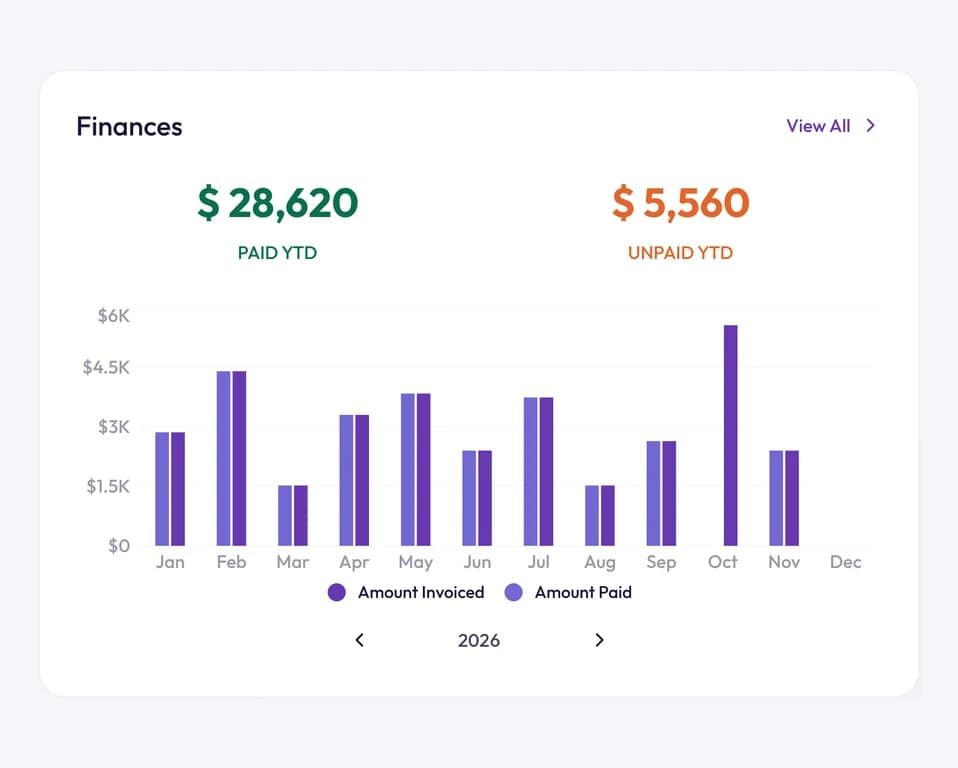
Retainers show up as a steady bar every month; fixed-price projects show up as spikes.
Frequently asked questions
What is a retainer fee?
A retainer fee is a recurring payment, usually monthly, that a client pays in advance for an agreed amount of ongoing work or for reserved access to your time. The agreement sets what's included, how unused hours are handled and how extra work is billed.
Is a retainer better than a fixed-price project?
Neither is better in general. Retainers give steadier income and longer relationships; fixed prices can earn more per hour on well-defined projects. Choose by the work: a clear, one-off deliverable suits a fixed price, and ongoing work suits a retainer.
What happens to unused retainer hours?
Whatever the contract says. The common options are that unused hours expire each month, roll over for one month or up to a cap, or bank indefinitely. Agree the rule in writing before the retainer starts.
Should retainers be paid in advance?
Usually, yes. A retainer reserves your time for the coming month, so invoicing at the start of the month is standard. Extra hours beyond the agreed amount are typically billed after the month ends.
Can I combine a fixed-price project with a retainer?
Yes, and it's a common path. Deliver the main project at a fixed price, then offer a retainer for maintenance, improvements or ongoing support. The client already trusts you, and you get steady income from work you know well.
Wrap up
Use fixed prices when the scope is clear and the work ends; use retainers when the client needs you every month. Price both from your hourly rate and your tracked hours, and write down the rules for scope, unused hours and overage.
When you're ready to bill a retainer, set it up once with recurring invoices in Tristiks Grow, or work out your rate first with the free hourly rate calculator.
Category: Client Management
Suraj Rao
Suraj Rao is the founder of Tristiks, the team behind Tristiks Grow and its desktop time tracker OneTrack. He writes about time tracking, client work and getting paid, and about DevOps, cloud and AI from years of building software.