How to Write a Project Proposal (Template + Examples)
 By Suraj Rao10 min read
What You'll Learn
- A project proposal needs eight sections: overview, goals, scope, deliverables, timeline, pricing, terms and next steps, and two or three pages is enough for most projects.
- Listing what's not included, and giving the proposal an expiry date, does more to protect your margin than any amount of persuasive writing.
- Follow up on day 3 and day 7, then let the signed proposal become your contract's scope and your first invoice.

To write a project proposal, restate the client's goal, define the scope and deliverables, set a timeline, price the work, state your terms and end with one clear next step. For most freelance and agency projects, two or three pages is enough, written for the person who will sign it.
A proposal isn't a brochure. It's a short document that answers the client's questions before they ask them: what will you do, by when, for how much, and what do I do next?
This guide covers how to write a project proposal section by section, with a short example for each, plus pricing options, what to leave out, how to follow up and what happens after the client says yes. There's a copy-ready template near the end.
Before you write: the discovery call
A good proposal is mostly written before you open a document. It comes from a 20 to 30 minute call where you ask questions and listen.
Ask:
- What are you trying to achieve, and how will you know it worked?
- Why now? What happens if this doesn't get done?
- What have you tried already?
- When does it need to be finished, and what's driving that date?
- What budget have you set aside, even roughly?
- Who else needs to approve this?
Write down the client's own words, especially for the first question. You'll use them in the overview, and clients notice when a proposal sounds like them.
If you can't get a budget range, offer two or three priced options instead of one number. More on that below.
The 8 sections of a project proposal
Here's what each section does, with a short example. The examples follow one project: a website redesign for a local physiotherapy clinic.
1. Overview
One paragraph that restates the problem and your solution. Lead with their goal, not your process.
Your current website brings in very few online bookings, and most new patients still call the front desk. You'd like a site that makes booking an appointment take under a minute on a phone. This proposal covers a redesign of your website with online booking, ready to launch in eight weeks.
2. Goals
Two to four measurable outcomes. These are what the client is really buying, and what you'll point back to at the end.
- Let patients book an appointment from any page in three taps or fewer.
- Reduce the number of "are you open?" calls by putting hours, location and services on every page.
- Make the site easy for your team to update without a developer.
3. Scope of work
What you'll do, and just as important, what you won't. Listing exclusions is the easiest way to prevent scope creep later.
Included: design and build of up to 8 pages; integration of your existing booking system; mobile and desktop layouts; basic on-page SEO; two rounds of revisions on the design.
Not included: copywriting, photography, a new booking system, ongoing maintenance after launch. We're happy to quote for any of these separately.
4. Deliverables
The concrete things the client receives. Be specific enough that both sides can tell when each one is done.
- Sitemap and wireframes for 8 pages
- Visual design for desktop and mobile
- The finished website, live on your domain
- A 30-minute training session and a short how-to guide for editing pages
5. Timeline
Milestones with dates or week numbers, plus what you need from the client and when. Client delays are the most common reason timelines slip, so make the dependency visible.
| Week | Milestone | Needs from you |
|---|---|---|
| 1 | Kickoff, sitemap and wireframes | Access to the current site and booking system |
| 2 to 3 | Visual design, two revision rounds | Feedback within 3 working days |
| 4 to 7 | Build and booking integration | Final copy and photos by week 4 |
| 8 | Testing, training and launch | Sign-off on the final site |
If feedback or content arrives late, the launch date moves by the same amount.
6. Pricing
A table with each item, its price and the total, plus how payment is split. Keep it scannable; the client will read this section first.
| Item | Price |
|---|---|
| Discovery, sitemap and wireframes | $1,200 |
| Visual design (desktop and mobile) | $2,400 |
| Build and booking integration | $3,600 |
| Training and launch | $600 |
| Total | $7,800 |
Payment: 40% ($3,120) to start, 30% ($2,340) when the design is approved, 30% ($2,340) on launch. Invoices are due within 14 days.
7. Terms
The short version of the rules: how many revisions, how changes are priced, when the client owns the work, how long the offer is valid. The full detail belongs in the contract, which is covered in our guide to what to include in a freelance contract.
Changes outside the scope above are quoted in writing before work starts. Ownership of the final website passes to you on final payment. This proposal is valid for 30 days.
8. Next steps
End with exactly what the client should do to say yes. One step is best.
To go ahead, sign this proposal below. I'll send the first invoice and a kickoff questionnaire the same day, and we can start on Monday 16 November.
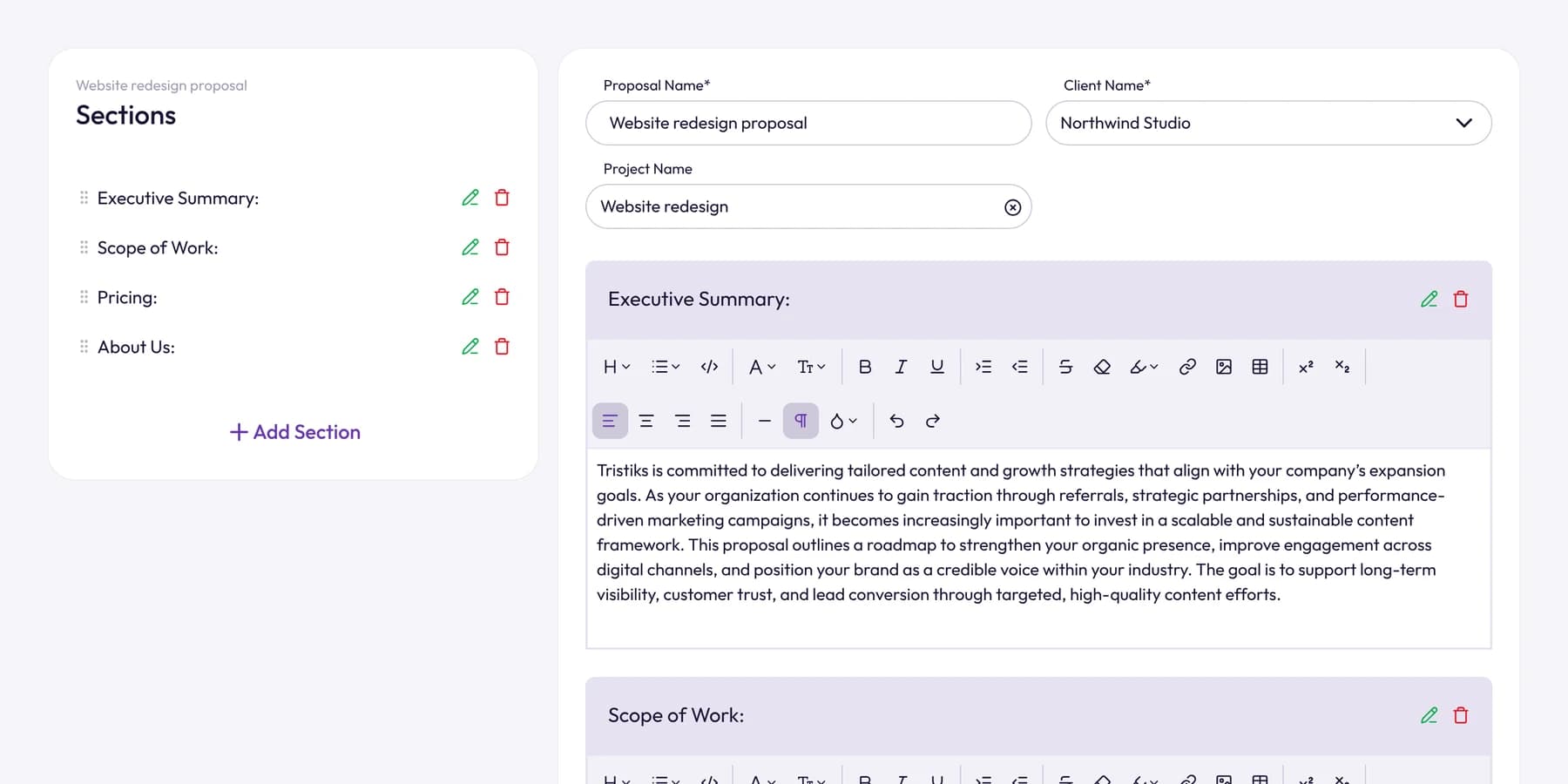
If you'd rather not build this from scratch, our free proposal template has the same structure in Word, and Tristiks Grow's proposal template starts you with an executive summary, scope of work, pricing and an "about us" section.
How to price a project proposal
How you price shapes how the project runs. Pick the model that matches how certain the scope is.
| Pricing model | Best when | Watch out for |
|---|---|---|
| Fixed price | The scope is clear and you've done similar work before | Scope creep eats your margin, so list exclusions |
| Hourly with an estimate | The scope will change, or it's hard to estimate | Clients worry about open-ended cost, so add a cap or a range |
| Tiered options | The client hasn't shared a budget | Too many options slow the decision; three is plenty |
| Retainer | Ongoing work every month | Agree what happens to unused hours |
| Milestone payments | Longer projects with clear stages | Tie each payment to something the client can see |
Tiered options: an example
Offering three options lets the client choose the budget instead of rejecting yours.
| Essential | Standard | Complete | |
|---|---|---|---|
| Pages | 5 | 8 | 12 |
| Online booking | Yes | Yes | Yes |
| Revision rounds | 1 | 2 | 3 |
| Copywriting | No | No | Yes |
| Price | $5,400 | $7,800 | $11,500 |
Put the option you'd most like to deliver in the middle, and make the gap between the tiers clear.
Whatever the model, base the numbers on your real hourly rate and a realistic estimate. Our guide to calculating your hourly rate shows the math, and retainers vs. fixed-price projects helps you choose between the two most common models.
What to leave out of a proposal
Shorter proposals get read. Cut:
- Long company history. One short "about us" paragraph and two relevant past projects are enough.
- Your process in detail. The client cares about outcomes and dates, not your seven-phase methodology.
- Jargon. Write "the site loads fast on phones", not "optimized Core Web Vitals across breakpoints".
- Every possible option. Three priced options at most.
- Legal small print. Summarize the key terms; the full detail goes in the contract.
- Vague promises. "We'll boost your online presence" can't be delivered or measured.
How to follow up on a proposal
A proposal that goes quiet often hasn't been rejected; the client just got busy. A polite follow-up schedule brings many of them back:
- Day 0: send the proposal with a short note.
- Day 3: check it arrived and offer a call.
- Day 7: ask if anything needs changing.
- Day before it expires: a final reminder.
Subject: Website proposal: any questions?

Hi Priya,

Just checking the proposal for the new clinic website reached you.
Happy to walk through it on a 15-minute call if that's easier.
Would Thursday or Friday afternoon work?

Thanks,
Suraj
Subject: Website proposal expires on 2 December
Hi Priya,
A quick note that the proposal I sent on 2 November is valid
until 2 December. If the timing or budget isn't right, I'm
happy to adjust the scope, or we can pick it up later in the year.
Thanks,
SurajKnowing when the client opened the proposal helps you time these. In Tristiks Grow, a proposal's status moves from sent to viewed when someone you sent it to opens it, so you know whether to ask "did it arrive?" or "any questions?".
From proposal to contract to invoice
Once the client says yes, the proposal becomes the foundation for everything after it:
- The contract points to the proposal for its scope, deliverables and price, so you don't write them twice.
- The first invoice uses the pricing table and payment schedule.
- Onboarding starts with the timeline and the "needs from you" list. Our client onboarding checklist picks up from here.
In Tristiks Grow, the client signs the proposal online by typing their name, the signed version is locked, and a contract can be linked to the proposal it follows. If you turn on one option before sending, a draft invoice with the same line items, taxes and total is created the moment the client signs. See how it works on our proposal and contract software page.
Project proposal template
Copy this skeleton and fill in the brackets.
[Project name]: proposal for [Client name]
Prepared by [Your name], [Date]. Valid until [Date + 30 days].

1. Overview
[The client's problem, in their words. Your solution in one sentence.
When it will be done.]

2. Goals
- [Measurable outcome 1]
- [Measurable outcome 2]

3. Scope of work
Included: [what you will do]
Not included: [what you won't do; offer to quote separately]

4. Deliverables
1. [Deliverable and how you'll know it's done]
2. [Deliverable]

5. Timeline
Week [x]: [milestone]. Needs from you: [input, by when]
Week [x]: [milestone]. Needs from you: [input, by when]

6. Pricing
[Item]: [price]
[Item]: [price]
Total: [total]
Payment: [deposit %] to start, [balance and when]. Due within [x] days.

7. Terms
[Revisions included. How changes are quoted. When ownership passes.]

8. Next steps
To go ahead, sign below. I'll [what happens next] by [date].
Frequently asked questions
What are the main parts of a project proposal?
A project proposal usually has eight parts: an overview, goals, scope of work, deliverables, a timeline, pricing, terms and next steps. The scope should say what's excluded as well as what's included.
How long should a project proposal be?
As short as it can be while answering the client's questions. Two or three pages is plenty for most freelance and agency projects; larger projects may need more detail in the scope and timeline, not more pages of background.
What is the difference between a proposal and a contract?
A proposal is an offer: what you'll do, when and for how much. A contract is the binding agreement that adds the rules, such as payment terms, ownership, confidentiality and termination. Many freelancers send the proposal first, then a contract that refers to it.
How do you follow up on a proposal without being pushy?
Check it arrived after about three days, ask whether anything needs changing after a week, and send one final note before it expires. Keep each message short and offer a call; after that, let it go and add the lead to your pipeline for later.
Wrap up
A project proposal that wins work is short, specific and easy to say yes to: the client's goal, a clear scope with exclusions, a dated timeline, a readable price and one next step.
For every other stage of working with a client, see our complete guide to client management.
Start from our free proposal template, or send your next proposal from Tristiks Grow and see the moment it's viewed and signed.
Category: Client Management
Suraj Rao
Suraj Rao is the founder of Tristiks, the team behind Tristiks Grow and its desktop time tracker OneTrack. He writes about time tracking, client work and getting paid, and about DevOps, cloud and AI from years of building software.