Freelance Contract: What to Include (+ Free Template)
 By Suraj Rao10 min read
What You'll Learn
- A freelance contract should cover twelve things: parties, scope, deliverables, timeline, payment terms, late fees, revisions, change requests, ownership, confidentiality, termination and liability.
- Point the contract at your proposal for the scope and price, so the details live in one place and can't contradict each other.
- In the US and many other countries an electronic signature is as valid as ink, so you can send, sign and store contracts online.
A freelance contract is a written agreement between you and a client that sets out the work, the price, the deadlines and what happens if something changes or goes wrong. At minimum, it should name both parties and cover the scope, payment terms, revisions, change requests, who owns the work, confidentiality and how either side can end the agreement.
You don't need a 30-page document. A clear, plain-English contract of three or four pages protects you better than a long one nobody reads.
This guide explains what to include in a freelance contract, clause by clause, with a plain-English example of each. Then it covers signing online and the most common mistakes. You can start from our free contract template.
This post is general information, not legal advice. Contract law differs by country and state, so have a lawyer where you work review your contract before you rely on it.
Why every freelance job needs a contract
A contract isn't a sign of distrust. It's a shared memory. Six weeks into a project, nobody remembers exactly what was said on the first call, and a written agreement settles the question without an argument.
It also makes you look like a business. Clients who hire freelancers regularly expect one, and a client who refuses to sign anything is telling you something useful before you've done any work.
Freelance contract checklist: the 12 clauses
Here's what a freelance contract should include, and the question each clause answers:
| Clause | The question it answers |
|---|---|
| Parties | Who is this agreement between? |
| Scope of work | What exactly will you do, and not do? |
| Deliverables and acceptance | What will the client receive, and when is it "done"? |
| Timeline | When is each part due, and what do you need from the client? |
| Payment terms | How much, when and how will you be paid? |
| Late fees | What happens if an invoice is paid late? |
| Revisions | How many rounds of changes are included? |
| Change requests | How is new work agreed and priced? |
| Intellectual property | Who owns the work, and from when? |
| Confidentiality | What must each side keep private? |
| Termination | How can either side end the agreement? |
| Liability | What's the most either side can claim if things go wrong? |
Most contracts also add a governing law clause (which country's or state's law applies) and say how disputes are handled. Those are the clauses a local lawyer can tailor best.
1. Parties
The full legal names and addresses of you (or your business) and the client, and the date the agreement starts. If you work through a company, the company signs, not you personally. It's also common to state that you're an independent contractor, not an employee.
This agreement is between the Designer, [your business name and address], and the Client, [client's legal name and address]. It starts on 16 November 2026. The Designer works as an independent contractor.
2. Scope of work
What you'll do, described clearly enough that an outsider could tell whether it was done. The simplest approach is to refer to the signed proposal, so the scope lives in one place. Our guide to writing a project proposal shows how to write a scope with exclusions.
The Designer will provide the services described in the proposal dated 2 November 2026, which forms part of this agreement. Anything not listed there is outside the scope.
3. Deliverables and acceptance
The things the client receives, and how they approve them. Without an acceptance rule, a project can stay "almost finished" for months.
The Client will review each deliverable within 5 working days. If the Client doesn't request changes within that time, the deliverable is accepted.
4. Timeline
Key dates, and the client's part in meeting them. Late content and slow feedback are the most common reasons deadlines slip, so tie your dates to theirs.
The Designer will deliver the final files by 15 January 2027, provided the Client supplies content and feedback by the dates in the proposal. If the Client's input is late, deadlines move by the same number of days.
5. Payment terms
The price, the payment schedule, when invoices are due, the currency and how to pay. A deposit protects you with new clients; many freelancers ask for a third or more of the fee up front.
The fee is $7,800, paid in three parts: 40% before work starts, 30% on design approval and 30% on delivery. Invoices are due within 14 days of the invoice date, in US dollars, by bank transfer.
If you're choosing between due dates, our guide to net 30 payment terms compares net 15, net 30 and due on receipt. Also say who pays for expenses such as fonts, stock images or travel, and whether they're billed at cost or with a markup.
6. Late fees
What happens when an invoice isn't paid on time. You can only charge a late fee if the contract says so, and some places limit how much interest you can charge, so check the rules where you work.
Invoices unpaid 30 days after the due date incur a late fee of 1.5% per month on the unpaid balance. The Designer may pause work while any invoice is more than 14 days overdue.
The right to pause work is often more effective than the fee itself. For the emails that come before either, see our payment reminder email templates.
7. Revisions
How many rounds of changes are included, and what a round is. "Unlimited revisions" is how a two-week project becomes a two-month one.
The fee includes two rounds of revisions on each deliverable. A round is one set of consolidated feedback from the Client. Further rounds are billed at $95 per hour.
8. Change requests
How new work gets added. This clause is your main defense against scope creep.
If the Client asks for work outside the scope, the Designer will send a written quote with the cost and any change to the timeline. Work on the change starts only after the Client approves the quote in writing.
9. Intellectual property
Who owns the finished work, and when ownership passes. A common, fair arrangement is that the client owns the final deliverables once they've paid in full, while you keep your own tools, templates and earlier work, plus the right to show the project in your portfolio.
On full payment, the Designer assigns to the Client all rights in the final deliverables. The Designer keeps ownership of pre-existing materials and general know-how, and may show the work in their portfolio unless the Client asks otherwise in writing.
Under US law, work by an independent contractor isn't automatically a "work made for hire" owned by the client. That applies only to certain kinds of work and only when both sides agree it in writing, as set out in the definition in the US Copyright Act. That's why most freelance contracts use an assignment clause like the one above.
10. Confidentiality
What each side must keep private, and for how long. Keep it mutual and specific.
Each party will keep the other's confidential information private and use it only for this project. This continues for two years after the agreement ends.
If the client sends their own non-disclosure agreement, read it for anything that would stop you working for other clients in the same industry.
11. Termination
How either side can end the agreement early, and what's owed when they do. A kill fee protects you when a client cancels after you've turned down other work.
Either party may end this agreement with 14 days' written notice. The Client will pay for all work done up to the end date, plus a cancellation fee of 25% of the remaining fee if the Client ends it without cause.
12. Liability
A cap on how much either side can claim if something goes wrong. Without one, a small project can carry an unlimited risk.
Except for breaches of confidentiality, neither party's total liability under this agreement will exceed the fees paid under it. Neither party is liable for indirect or consequential losses.
Liability, governing law and disputes are the clauses most worth having a lawyer review, because what's enforceable varies most by place.
Contract, proposal or statement of work: what goes where
Freelancers often blur these three. Here's a simple split that keeps each document short:
| Document | What it holds | How often it changes |
|---|---|---|
| Proposal | The client's goals, scope, deliverables, timeline and price | New one for each project |
| Contract | The rules: payment terms, revisions, changes, ownership, termination, liability | Rarely; reuse it for every client |
| Statement of work | The scope and price for one piece of work under an existing contract | New one for each project with a returning client |
For a one-off project, the contract plus the signed proposal is enough. For a returning client, sign one master contract once, then agree each new project with a short statement of work.
How to sign a freelance contract online
You don't need to print, sign and scan. In the US, federal law says a contract can't be denied legal effect just because it was signed electronically; see the ESIGN Act, 15 U.S.C. 7001. Many other countries have similar rules, with some exceptions for particular kinds of documents, so check yours.
A good online signing process should:
- send each signer a secure link, with nothing to install;
- record when the contract was sent, opened and signed;
- lock the signed version so nobody can edit it afterwards;
- keep the signed copy with the client's other records.
In Tristiks Grow, you send a contract from a template to one or more people at the client. Each gets a secure link to read it in their browser and signs by typing their name, without creating an account. You see when it was sent, when each person opened it and when it was signed, and the signed contract is locked. A contract can be linked to the proposal it follows, and you can import contracts signed elsewhere so every agreement lives with its client.
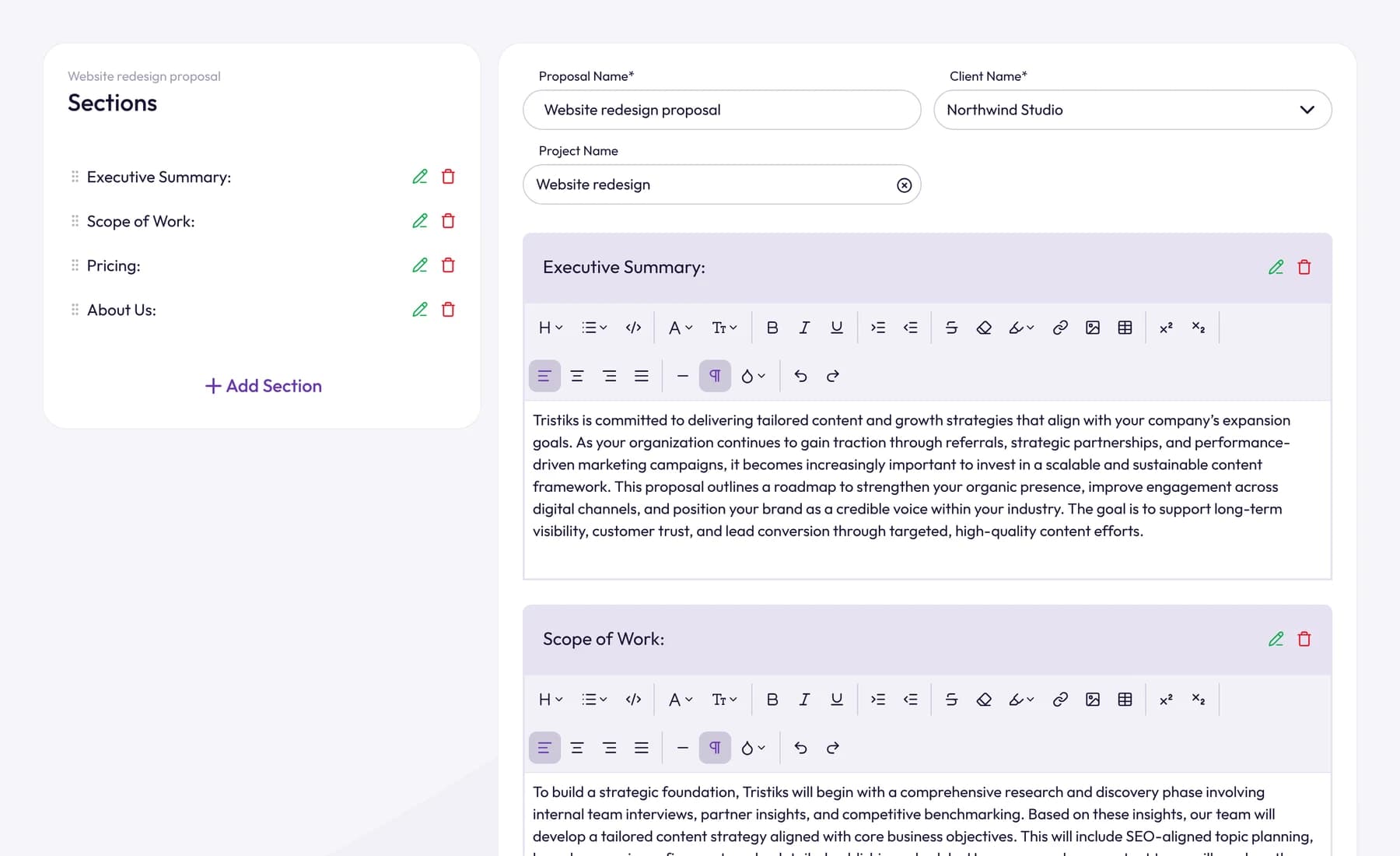
See how it works on our proposal and contract software page.
Common freelance contract mistakes
- Starting work before it's signed. "We'll sort the paperwork later" rarely happens.
- A vague scope. "Website design" can mean five pages or fifty. Refer to a detailed proposal.
- No deposit. A deposit filters out clients who aren't committed, and covers your first weeks.
- Unlimited revisions. Always set a number.
- Handing over ownership before payment. Make ownership pass on final payment.
- No way out. Without a termination clause, ending a bad project is far messier.
- Copying a contract from another country. Clauses on late fees, liability and governing law depend on local law.
- Never updating it. Review your contract once a year, and after any project that went wrong.
Using our free freelance contract template
Our free contract template is a plain-English services agreement in Word. It covers:
- parties and services;
- timeline;
- fees, payment and expenses;
- changes to the scope;
- ownership and confidentiality;
- ending the agreement, liability and governing law;
- signatures.
Fill in the details, attach or refer to your proposal for the scope, and have a lawyer review it once. After that, reuse it for every client. Once it's signed, our client onboarding checklist covers what to do next.
Frequently asked questions
What should be included in a freelance contract?
The parties, scope of work, deliverables, timeline, payment terms, late fees, revisions, how changes are handled, who owns the work, confidentiality, termination and limits on liability. Most contracts also state the governing law and how disputes are resolved.
Is a freelance contract legally binding?
A contract both sides have agreed to and signed can be legally binding, including one signed electronically. Whether a particular clause is enforceable depends on the law where you and your client are, so have a local lawyer review your template.
Should a freelancer ask for a deposit?
For new clients and project work, yes. Asking for part of the fee before work starts, such as a third or a half, covers your first weeks and shows the client is committed. For long projects, split the rest into payments at milestones.
Who owns the work in a freelance contract?
Whatever the contract says. A common arrangement is that the client owns the final deliverables once they've paid in full, while the freelancer keeps their own tools and earlier work and can show the project in a portfolio.
Can I use the same contract for every client?
Yes. Most freelancers use one master contract for the rules and a proposal or statement of work for each project's scope and price. Adjust the contract when a client or project carries unusual risk.
Wrap up
A freelance contract doesn't have to be long. It has to answer the questions that cause arguments later: what's included, what it costs, when it's due, what changes cost, who owns the work and how to end it.
The contract is one stage of the client lifecycle; our complete guide to client management covers the rest.
Download our free contract template to get started, or send your next contract from Tristiks Grow and get it signed online.
Category: Client Management
Suraj Rao
Suraj Rao is the founder of Tristiks, the team behind Tristiks Grow and its desktop time tracker OneTrack. He writes about time tracking, client work and getting paid, and about DevOps, cloud and AI from years of building software.