Late Fees on Invoices: Should You Charge Them? (+ Wording)
 By Suraj Rao11 min read
What You'll Learn
- A late fee is an extra charge for paying after the due date, either a flat amount or a percentage of the unpaid balance, such as 1.5% per month.
- You can usually only charge one if the client agreed to it before the work started, so put it in the contract first and repeat it on every invoice.
- Late fees work best as a clear expectation, not a punishment: many freelancers state one, rarely charge it, and offer an early-payment discount as the carrot.
A late fee is an extra charge a client pays when they settle an invoice after the due date. It's usually a flat amount, such as $50, or a percentage of the unpaid balance, such as 1.5% per month. You can generally charge one only if the client agreed to it before the work started.
Late fees sit in an awkward place. They protect your cash flow and make your due dates mean something. They can also annoy a good client over a payment that was late because their accounts team was on vacation.
This post covers the types of late fee with worked examples, whether they make clients pay faster, how to agree them in the contract, wording to copy, early-payment discounts as the alternative, when to waive a fee, and the legal picture in the US, UK, EU and India.
What is a late fee on an invoice?
A late fee is a charge for paying after the agreed due date. It's set out in your contract, repeated on the invoice and applied to the unpaid balance. The common types:
| Type | How it works | Example |
|---|---|---|
| Flat fee | One fixed charge once the invoice is late | $50 if unpaid 15 days after the due date |
| Monthly percentage | A percentage of the balance for each month it's unpaid | 1.5% per month on the unpaid balance |
| Interest | An annual rate, charged by the day | 12% a year, worked out daily |
| Statutory interest | A rate set by law, in some countries, for business-to-business debts | UK and EU late payment rules (see below) |
A flat fee is simple and suits small invoices. A percentage or interest grows with the debt and the delay, which suits larger invoices.
How to calculate a late fee: worked examples
All of these examples use the same hypothetical invoice: $4,000, due on 1 March.
A flat fee
Your contract says: "$50 if the invoice is unpaid 15 days after the due date."
If the client pays on 20 March, 19 days late, the fee applies once: $4,000 + $50 = $4,050, whether they pay on day 16 or day 60.
1.5% per month
It's a familiar rate in US contracts, and the one in the sample clause in our freelance contract guide. On $4,000:
- One month late: $4,000 × 0.015 = $60.
- Two months late (simple, on the original balance): $60 × 2 = $120.
- Two months late (compounded, where month 2 is charged on $4,060): $60 + ($4,060 × 0.015) = $60 + $60.90 = $120.90.
Over a year, 1.5% a month is 18% (1.5 × 12) before compounding. Keep that figure in mind, because legal limits are often yearly rates. Say in the contract whether the fee is simple or compounded; simple is easier to explain.
Daily interest at an annual rate
Your contract says: "Interest at 12% a year, calculated daily on the unpaid balance."
The formula is: balance × annual rate × days late ÷ 365.
If the client pays 20 days late: $4,000 × 0.12 × 20 ÷ 365 = $26.30.
Daily interest is the fairest option, because the client pays for exactly the time they kept your money, but it's the most fiddly to work out.
Comparing the options
Here's what each approach costs the client on the $4,000 invoice, paid 30 days late:
| Approach | Calculation | Late fee |
|---|---|---|
| Flat fee | Fixed | $50.00 |
| 1.5% per month | $4,000 × 0.015 | $60.00 |
| 12% a year, daily | $4,000 × 0.12 × 30 ÷ 365 | $39.45 |
Avoid large one-off percentages, such as 5% of the invoice: on a big invoice paid a few days late, they feel like a penalty.
Do late fees actually get clients to pay faster?
Sometimes, but not in the way most people hope. Late payment is common: UK government research by London Economics estimated that around 1.5 million businesses, roughly 28% of all UK businesses, are affected by late payments each year (Department for Business and Trade: late payments research). A late fee on its own doesn't fix that.
What a late-fee clause does well:
- It sets expectations. A client who signed a clause with a fee in it knows your due dates are real.
- It can help your invoice get prioritized. An accounts team juggling several bills has a reason to pay the one that costs money to delay.
What it doesn't do:
- It doesn't fix admin problems. An invoice sent to the wrong person or missing a purchase order number needs a correction and a reminder, not a fee.
- It doesn't move large clients much. Chasing $60 from a client worth $40,000 a year rarely makes sense.
- It can cost you the relationship. Charging a good client for a one-off delay can feel petty, and they may remember it at renewal time.
So a sensible middle path is to state the fee clearly and charge it rarely. The clause does most of its work just by existing. The right to pause work on overdue accounts is often more effective than the fee itself, as our guide to what to include in a freelance contract points out.
Agree the late fee in the contract first
A late fee that first appears on an overdue invoice rarely gets paid. Agree it in writing before the work starts, in your proposal or contract.
A good late-fee clause answers these questions:
- How much? A flat amount, a percentage or an annual rate, simple or compounded.
- When does it start? The day after the due date, or after a grace period such as 14 days.
- What does it apply to? The unpaid balance only.
- Is there a cap? "Up to the maximum allowed by law" keeps you within legal limits.
- What else happens? For example, the right to pause work while an invoice is overdue.
If you haven't chosen your payment terms yet, our guide to net 30 payment terms compares the common options. Our free contract template has a payment section you can adapt.
Late fee wording you can copy
Change the details in square brackets to match your contract.
For your contract
Late payment
Invoices are due [30] days after the invoice date. If an invoice is
unpaid [14] days after its due date, a late fee of [1.5]% per month
(simple interest) will be charged on the unpaid balance from the due
date until it is paid, up to the maximum allowed by law. The [Supplier]
may pause work while any invoice is more than [14] days overdue.
For a flat fee, replace the second sentence with: "A one-time late fee of [$50] will be added to any invoice unpaid [15] days after its due date."
For your invoice
Put one plain line next to the payment terms and the due date. Don't add a fee that isn't in your agreement.
Payment terms: Net 30. Due date: 31 March 2027.
Late payments incur a fee of 1.5% per month on the unpaid balance,
as set out in our agreement dated [date].
Our guide on how to write an invoice covers every other field the invoice needs.
For the reminder email
Don't mention the fee in the first friendly reminders. Raise it once the invoice is clearly overdue, usually at around 30 days:
Subject: Overdue: invoice [INV-0042], 30 days past due

Hi [First name],

Invoice [INV-0042] for [$4,000.00] was due on [1 March] and is now
30 days overdue. I've sent reminders on [8 March] and [15 March].

As set out in our agreement dated [date], a late fee of [1.5]% per
month applies to overdue balances. If the invoice is paid in full by
[date, 7 days from today], I'm happy to waive the fee this time.

Invoice: [link to invoice]
Payment details: [bank details and reference]

Regards,
[Your name]
If you do apply the fee, tell the client the exact amount and show the sum, for example $4,000 × 1.5% × 2 months = $120. For the earlier reminders, use our payment reminder email templates.
Using Tristiks Grow
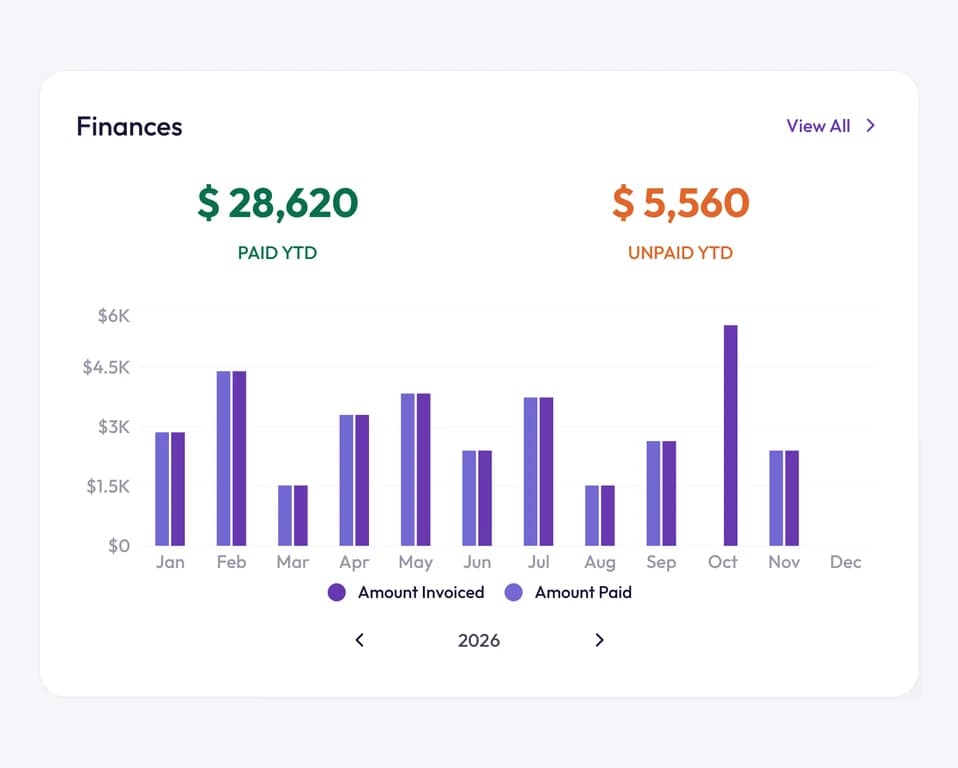
Tristiks Grow does not calculate or add late fees. If you apply one, you work it out and bill it yourself. When you create an invoice, you add the payment terms and a message, so you can write your late-fee line there in your own words. You can switch on automatic payment reminders that email the client 3 days before the due date, on the due date, and 7, 14 and 30 days after it, and you're told each time one goes out. Send the late-fee email yourself: charging or waiving a fee is a judgment call. See how it fits together on the invoicing software page.
The alternative: early-payment discounts
An early-payment discount is the carrot to a late fee's stick. The best-known version is 2/10 net 30: 2% off if paid within 10 days, otherwise the full amount is due in 30. Our guide explains how 2/10 net 30 works and what it really costs you.
On the $4,000 invoice:
| Early-payment discount (2/10 net 30) | Late fee (1.5% per month) | |
|---|---|---|
| Client pays early | $3,920 (you give up $80) | $4,000 |
| Client pays on time | $4,000 | $4,000 |
| Client pays a month late | $4,000 | $4,060 (if you charge it) |
| How it feels to the client | A reward | A penalty |
A discount costs you money every time it's taken, so offer it only if faster cash is worth that to you. Some businesses use both. Deposits, staged invoices and shorter terms for new clients also reduce the risk without a fee.
When to waive a late fee
Waiving a fee can do more for the relationship than charging it. Consider waiving when:
- It's the first time a reliable client has paid late.
- The delay was partly your fault, such as a missing purchase order number or wrong bank details.
- Waiving gets you paid now, as in the reminder above: "paid in full by [date] and I'll waive the fee."
Say so in writing, so it's clear the clause still stands:
I've waived the late fee on invoice [INV-0042] this time as a goodwill
gesture. The late payment terms in our agreement still apply to future
invoices. Thanks for sorting it out.
Don't keep waiving fees for a client who pays late every month. The better fix there is shorter terms, deposits or a frank conversation.
The legal picture: US, UK, EU and India
The rules depend on where you and your client are, and whether the client is a business or a consumer. This is a general overview, not legal advice: check with a lawyer or accountant where you are.
United States
There's no single national limit on late fees between businesses. Usury laws, which cap interest rates, are set state by state, and each state has its own threshold and penalties, as the American Bar Association explains.
As one example, Washington's general usury limit is the higher of 12% a year or four percentage points above the 26-week Treasury bill rate, with exceptions, according to the Washington State Department of Financial Institutions. So 1.5% a month (18% a year) isn't safe everywhere, especially with consumers.
United Kingdom
Under the Late Payment of Commercial Debts (Interest) Act 1998, a business can claim interest on late payments from another business at 8% plus the Bank of England base rate, as set out in the UK government's guidance on charging interest. The base rate used is fixed for six-month periods, and the interest is simple, not compounded.
You can also claim a fixed sum for recovery costs: £40 for debts under £1,000, £70 for £1,000 to £9,999.99 and £100 for £10,000 or more, according to the government's guidance on debt recovery costs and section 5A of the Act. This applies between businesses, not to consumers.
European Union
The Late Payment Directive (2011/7/EU) gives businesses a right to statutory interest on late payments in commercial transactions at the European Central Bank's reference rate plus at least 8 percentage points, plus at least €40 for recovery costs, as the European Commission's late payment page explains. It also generally limits business payment terms to 60 days unless expressly agreed otherwise, according to the EU's summary of the rules.
Each EU country puts the directive into its own law, and reforms have been debated since 2023, so check the current position. Our guide on how to invoice international clients covers other cross-border details.
India
Under the Micro, Small and Medium Enterprises Development (MSMED) Act, 2006, a buyer must pay a registered micro or small enterprise within the agreed period, which can't be more than 45 days from accepting the goods or services. If they pay late, they owe compound interest with monthly rests at three times the bank rate notified by the Reserve Bank of India, whatever the contract says, according to the Ministry of MSME's guide to the legal framework and its FAQs on delayed payments.
These protections apply to suppliers registered as micro or small enterprises (today, through Udyam registration), and courts have been considering how the timing of registration affects a claim.
Frequently asked questions
How much should I charge as a late fee?
There's no standard amount. A small flat fee suits smaller invoices, and a monthly percentage such as 1.5% suits larger ones. Check it against the legal limits where you and your client are.
Can I add a late fee if it isn't in my contract?
Usually not: a fee the client never agreed to is hard to collect. In some places, such as the UK and the EU, businesses can claim statutory interest on late business payments even without a clause, so check your local rules.
Does Tristiks Grow add late fees automatically?
No. Tristiks Grow doesn't calculate or add late fees. You can add your payment terms and a message to each invoice, including any late-fee line from your contract, and switch on automatic payment reminders before and after the due date.
Wrap up
A late fee works best as a clear, agreed expectation: written into the contract, repeated on the invoice and raised only when an invoice is properly overdue. Calculate it simply, waive it when that keeps a good client, and use deposits, shorter terms or an early-payment discount when they fit better.
To put clear terms on every invoice and let reminders handle the routine follow-ups, try Tristiks Grow invoicing free for 14 days.
Category: Payments
Suraj Rao
Suraj Rao is the founder of Tristiks, the team behind Tristiks Grow and its desktop time tracker OneTrack. He writes about time tracking, client work and getting paid, and about DevOps, cloud and AI from years of building software.