Year-End Review for Freelancers: 6 Reports to Run
 By Suraj Rao11 min read
What You'll Learn
- Six numbers tell you how your freelance year really went: revenue by client, effective hourly rate, utilization, unpaid invoices, expenses and estimates vs actual hours.
- Each one is simple arithmetic on records you already have, as long as your time, invoices and expenses were recorded during the year.
- The review pays off in January: use the answers to set new rates, update your contract, automate retainer invoices and pick goals you can measure.
December is when most freelancers finish client work and think about the holidays. It's also the best time to look back at the year as a business, while the numbers are fresh and before January fills your calendar.
You don't need an accountant for this, just six simple calculations on records you already keep: invoices, tracked time and expenses.
This post walks through the six reports. For each, you'll get why it matters, how to calculate it with a worked example and what to do with the answer. Then we'll cover what to set up for January, with a checklist you can copy.
Before you start: gather your data
Every report below draws on three records for 1 January to today:
- Invoices, with client, amount, due date, status and paid date.
- Tracked time, with client, project, length and whether it was billable.
- Expenses, with date, category, amount, client and receipt.
Put them in one spreadsheet, one tab each. If you use Tristiks Grow, you can download all three as CSV files: the time log (each entry's client, project, task, length, billable status and invoice number), expenses, and invoices (client, amount, send and due dates, status and paid date).
1. Revenue by client and client concentration
Why it matters. Total revenue tells you how the year went. Revenue by client tells you how risky next year is. If one client pays most of your bills, losing them isn't a bad month: it's a crisis.
How to calculate it. Add up what each client paid this year, then divide by your total revenue.
Client share = client's revenue / total revenue x 100Say you earned $96,000:
| Client | Revenue | Share |
|---|---|---|
| Client A (ongoing) | $57,600 | 60% |
| Client B (retainer) | $19,200 | 20% |
| Client C (two fixed-price projects) | $12,000 | 12.5% |
| Three small clients | $7,200 | 7.5% |
| Total | $96,000 | 100% |
Client A pays 60% of your income. If they stopped tomorrow, you'd lose $4,800 a month ($57,600 ÷ 12).
Count by invoice date or paid date, but use one basis throughout.
What to do with the answer. There's no official cut-off for "too dependent". A practical test: if your biggest client left, how many months could you cover from savings while you replaced them?
- One client above half your income: make a second anchor client a goal for next year, and build your savings buffer.
- A long tail of tiny clients: check whether each one is worth the admin. Report 2 will tell you.
In Tristiks Grow, each client's profile shows what they've paid and what's unpaid this year, with every invoice and its status.
2. Effective hourly rate by client and project
Why it matters. Retainers creep, fixed-price projects run long and "quick questions" add up. Your effective rate shows what each client actually pays for an hour of your time.
How to calculate it. Divide what a client paid by all the hours you spent on them, billable or not.
Effective hourly rate = revenue from client / total hours spent on client| Client | Revenue | Hours spent | Effective rate |
|---|---|---|---|
| Client A | $57,600 | 640 | $90 |
| Client B (retainer) | $19,200 | 300 | $64 |
| Client C (fixed price) | $12,000 | 100 | $120 |
| Three small clients | $7,200 | 80 | $90 |
| All clients | $96,000 | 1,120 | $85.71 |
Client B looks steady at $1,600 a month, but at 25 hours a month they pay $64 an hour. Client C earned you nearly twice that.
Do the same for projects: a $6,000 website that took 75 hours earned $80 an hour.
What to do with the answer. Compare each rate with the rate your business needs. Our guide on how to calculate your hourly rate works that out from your income goal and costs.
- Below target: raise the rate, cut the scope or cap the included hours. For Client B, that could be $1,600 for 18 hours, with extra hours billed at your rate. Our comparison of retainers vs fixed-price projects covers limits that hold.
- Well above target: that's the work to sell more of next year.
3. Billable vs non-billable time and utilization
Why it matters. Your rate has to pay for every hour you work, not just the ones a client sees.
How to calculate it.
Utilization rate = billable hours / total hours worked x 100Say you worked 1,680 hours this year (42 weeks of 40 hours):
| Work | Hours | Billable? |
|---|---|---|
| Client work billed | 1,050 | Yes |
| Client work not billed (extra revisions, write-offs) | 70 | No |
| Admin, email and invoicing | 220 | No |
| Sales, proposals and marketing | 180 | No |
| Learning | 90 | No |
| Other internal work | 70 | No |
| Total | 1,680 | 1,050 billable |
Utilization = 1,050 ÷ 1,680 × 100 = 62.5%.
If your rate was built on 1,300 billable hours, you're 250 hours short. At $85.71 an hour, that's about $21,400 your plan expected and the year didn't deliver.
What to do with the answer. Start with the biggest non-billable line. 220 hours of admin is more than five full weeks; batching it and using templates wins some back. Check the 70 unbilled client hours too. Our complete guide to billable hours covers what should count and realistic utilization targets.
In Tristiks Grow, every time entry is marked billable or non-billable, and the time log CSV keeps that flag, so this table is a pivot on one column.
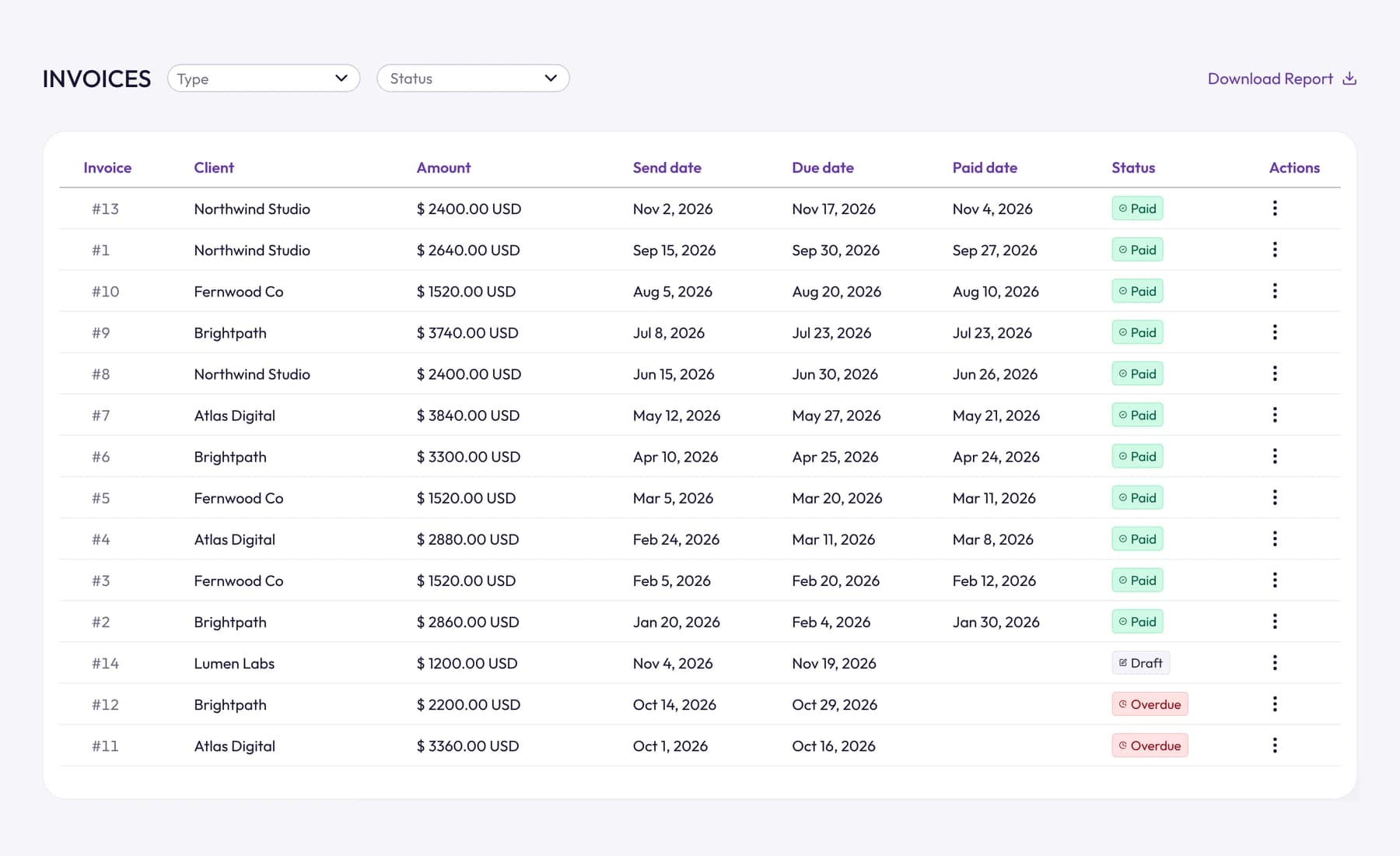
4. Unpaid and overdue invoices to chase
Why it matters. Money you've earned but not collected gets harder to collect the longer it waits. If a client's finance team closes over the holidays, an invoice not approved by mid-December may sit until January.
How to calculate it. List every unpaid invoice with its days past due. Here's a list run on 1 December:
| Invoice | Client | Amount | Due date | Days overdue |
|---|---|---|---|---|
| #38 | Client A | $3,360 | 16 October | 46 |
| #41 | Client C | $2,200 | 29 October | 33 |
| #45 | Small client | $1,800 | 20 November | 11 |
| #47 | Client B | $4,800 | 15 December | Not yet due |
| Total outstanding | $12,160 |
$7,360 of that is overdue: about four weeks of income at this year's average ($96,000 ÷ 52 = $1,846 a week).
What to do with the answer.
- Chase the oldest first, today, with the invoice attached and a request for a payment date. Our payment reminder email templates have wording for each stage.
- Call about anything over 30 days. Ask whether the invoice reached the right person and what's blocking it.
- Find work you never invoiced. Compare tracked billable hours with what you billed, and invoice the difference now.
If a client may never pay, ask your accountant how to handle it.
In Tristiks Grow, the invoice list shows which invoices are paid, due or overdue at a glance, and automatic reminders can go out 3 days before the due date, on the day, and 7, 14 and 30 days after.
5. Expenses and receipts for your accountant
Why it matters. A business cost you can't prove is a cost you may not be able to claim, and missing receipts are easier to find now than in spring.
How to calculate it. Total your expenses by category, check every line has a receipt, and check the costs you incurred for clients were billed back.
| Category | Spend | Receipts missing |
|---|---|---|
| Software and subscriptions | $1,920 | 2 |
| Equipment | $2,400 | 0 |
| Travel | $860 | 3 |
| Training and books | $450 | 1 |
| Billable costs (stock photos, fonts) | $1,480 | 0 |
| Total | $7,110 | 6 |
Of the $1,480 in billable costs, $1,140 was billed back and $340 wasn't. That $340 belongs on the client's next invoice.
What to do with the answer. Find the six missing receipts, bill back the $340, and send your accountant the list with receipts in the format they ask for.
How long to keep records depends on where you live. In the US, the IRS says you generally keep records that support income or deductions until the period of limitations for that return runs out, generally 3 years, and longer in some cases, such as 6 or 7 years (IRS: how long should I keep records?). Check what applies to you, and what you can deduct, with your accountant.
Working in a spreadsheet? Our free expense report template has columns for category, client, billable status and receipt. In Tristiks Grow's expense tracking, each expense keeps its receipt attached, you can scan a receipt and have its details filled in for you to check, and billable expenses show the invoice they were billed on, so the unbilled $340 stands out.
6. Estimates vs actual hours on projects
Why it matters. If your estimates are consistently short, you work unpaid hours on every fixed-price project.
How to calculate it.
Variance = (actual hours - estimated hours) / estimated hours x 100| Project | Estimate | Actual | Variance |
|---|---|---|---|
| Website redesign | 60 h | 78 h | +30% |
| Brand refresh | 40 h | 44 h | +10% |
| Mobile app MVP | 120 h | 168 h | +40% |
| Landing page copy | 20 h | 18 h | -10% |
| Total | 240 h | 308 h | +28% |
On fixed-price work, overruns cut your rate. The app was quoted at $12,000 for 120 hours, or $100 an hour. At 168 hours, it paid $71.43 an hour.
What to do with the answer. Look for patterns:
- One type of project always runs over: add the average overrun to your next estimate for that type.
- The overrun came from extra requests: that's scope creep, and the fix is a change request process, not a bigger estimate.
- The overrun is in one phase, such as revisions: estimate it separately and limit the rounds in your contract.
Our guide to project budgets shows how to check burn rate mid-project, so overruns surface in week two, not at handover. In Tristiks Grow, projects and tasks can carry time estimates, and a project shows its tracked time beside its estimate.
Set up January now
Spend an hour in December on these four things.
Raise your rates
If report 2 or 3 shows your rate falls short, raise it for the new year. Check your contract for a notice period, then tell clients in writing:
Hi [name],

Thank you for a great year working together on [project].
From 1 February 2027, my hourly rate will be [new rate], up from
[old rate]. Work already agreed will be billed as quoted.
Happy to talk it through if you have any questions.

Best,
[your name]
Then update the rate saved on each client's profile.
Update your contract template
Fix this year's problems in your template. Common fixes are shorter payment terms (see net 30 payment terms for the options), a deposit on new projects and a cap on revisions. Our guide to what to include in a freelance contract has the full clause list. Have a lawyer where you are check anything you're unsure of.
Make retainer invoices recurring
If you bill a client the same amount every month, stop building that invoice by hand. With recurring invoices in Tristiks Grow, you choose weekly, every other week or monthly, the send day, a start and end date and your payment terms, and each invoice goes out on its date.
Set goals you can measure
Turn this year's numbers into targets:
- Revenue and rate: $110,000 at 1,100 billable hours needs $100 an hour.
- Client concentration: no client above a share you choose, such as 40%.
- Utilization: a target based on this year's 62.5%.
- Estimates: total variance under a number you choose, such as 10%.
Check them each quarter.
Your year-end checklist
Year-end review: [year]
[ ] Export invoices, time log and expenses for the year
[ ] 1. Biggest client's share of revenue = ____%
[ ] 2. Effective hourly rate per client; lowest = ____
[ ] 3. Utilization: ____ billable / ____ worked = ____%
[ ] 4. Overdue invoices chased; unbilled hours invoiced
[ ] 5. Receipts found; costs billed back; list sent to accountant
[ ] 6. Estimate variance per project; total = ____%
[ ] New rates set and clients told
[ ] Contract template updated
[ ] Retainer invoices set to recur
[ ] Next year's goals written down
Frequently asked questions
When should I do a year-end review?
Early to mid-December, which leaves time to chase overdue invoices and give notice of new rates. If your financial year ends on another date, run the reports a few weeks before it.
What if I didn't track my time this year?
You can still run reports 1, 4 and 5 from invoices, bank statements and receipts. For reports 2, 3 and 6, estimate hours from your calendar and project files, accept that the numbers are rough, and start tracking on 1 January.
Should I send invoices before 31 December for tax reasons?
That depends on where you live, your accounting method and your situation, so ask your accountant. For cash flow, invoicing finished work promptly is always worth it.
Wrap up
A year-end review comes down to six questions: who pays you, what they pay per hour, how much of your time is billable, who still owes you, what you spent and how good your estimates were. Answer them in December and you start January knowing what to change.
To make next year's review a matter of downloading a few files, try Tristiks Grow time reports free for 14 days.
Category: Freelancing, Payments
Suraj Rao
Suraj Rao is the founder of Tristiks, the team behind Tristiks Grow and its desktop time tracker OneTrack. He writes about time tracking, client work and getting paid, and about DevOps, cloud and AI from years of building software.