How Much to Charge for Web Design in 2026
 By Suraj Rao11 min read
What You'll Learn
- Published rates for web design range from $15 to $30 an hour on Upwork to $100 to $149 for agencies listed on Clutch, and most web design projects reviewed on Clutch cost under $10,000.
- Price a project by estimating hours, multiplying by the rate your costs require, adding contingency, then checking the result against the value to the client and the market.
- Sell the site as a fixed price with tiers, price add-ons and care plans separately, and compare tracked hours with the estimate after every project.

How much to charge for web design depends on who you ask: as of November 2026, Upwork's median for web designers is $15 to $30 an hour, web design companies listed on Clutch charge $100 to $149 an hour, and most web design projects reviewed on Clutch cost under $10,000. The right price for you is your estimated hours times the hourly rate your costs require, plus contingency, checked against what the site is worth to the client and what similar designers charge.
This guide sets out the published rate and project data with sources and dates, explains why the numbers disagree, then walks through pricing a real project, choosing a pricing model, scoping add-ons and care plans, presenting the price and checking afterwards whether you made money.
Web design rates in 2026: what the data says
No single source measures what freelance web designers charge. Read the "who" column before the number.
| Source | Who it measures | Rate | Date |
|---|---|---|---|
| Upwork web designer costs | Web designers hired on Upwork, worldwide | $15 to $30/hour median range | As of Nov 2026 |
| Upwork hourly rates guide | All Upwork freelancers, by experience | Beginner $10 to $25, intermediate $25 to $60, expert $60 to $120+ | 2026 |
| Adobe Express freelance study | Freelance designers it surveyed | Web design averaged $59.40/hour, the highest design skill | Undated |
| Bonsai rate explorer | US freelancers using Bonsai | Design rates rarely reach $60/hour | Undated |
| YunoJuno design rates | UK freelance designers booked on YunoJuno | Design average £367/day (about £46/hour); digital designers £380/day | 2025 report, 2022 to 2024 bookings |
| US Bureau of Labor Statistics | US employees, not freelancers | Web and digital interface designers: median $104,000/year (about $50/hour) | May 2025 |
| Clutch web design pricing | Web design companies listed on Clutch | $100 to $149/hour | 2026 |
Why the numbers disagree
- Marketplaces vs agencies. Upwork's figures cover freelancers worldwide. Clutch lists companies with teams and overheads.
- Wages aren't rates. The BLS median is what employers pay employees. A freelancer charging $50 an hour earns far less than an employee paid $50, because you pay for your own tools, taxes, holidays and unbilled admin.
- One source can disagree with itself. Clutch's web developer pricing page puts development companies at $25 to $49 an hour, far below its design figure, most likely because different firms and countries sit behind each page.
By region: we found recent figures only for the US (BLS, Bonsai) and the UK (YunoJuno). The comparisons we found for India, Latin America and Eastern Europe were from 2017 and covered all freelance work, so we've left them out; compare live profiles in your niche instead.
The data is a sanity check, not a rate. Your own costs set the floor.
What websites cost by type
Independent price data by website type is thin, and most published ranges come from agencies or platforms that sell websites.
| Website type | What published sources show | Source |
|---|---|---|
| Basic site or small business site | From about $1,000 for a basic site; most web design projects reviewed on Clutch cost under $10,000 | GoodFirms 2026 survey, Clutch |
| Average agency project | $38,105 on Clutch, pulled up by a few large projects | Clutch |
| Larger ecommerce site | $10,000 or more for custom ecommerce design | Upwork website cost calculator |
| Complex or enterprise build | $150,000 and up | GoodFirms 2026 survey |
GoodFirms surveyed more than 300 web development firms in 31 countries, so these are agency prices, not freelance ones. The gap between Clutch's "most under $10,000" and its $38,105 average shows how a few big projects distort an average; none of these sources publishes a median.
How to calculate your price for a website
Use a three-part check: cost, value, market.
- Set your hourly rate from your costs. Income goal plus business costs plus tax, divided by the hours you can actually bill. Our guide to calculating your hourly rate covers each step, or use the free hourly rate calculator.
- Estimate the hours, phase by phase, including project management, revisions and launch. Our post on estimating project hours explains how to break the work down.
- Add contingency. 10% to 20% for a client and platform you know, more for a new client or unfamiliar tech.
- Check against value. If your price is a small fraction of what the site is worth to the client in a year, you may be underpricing. See value-based pricing.
- Check against the market. Compare with the ranges above and with designers in your niche and region.
Worked example: an eight-page small business site
A freelance designer whose costs require $85 an hour is quoting an eight-page site for a local accounting firm on WordPress.
Phase                                    Hours
Discovery call, sitemap, brief               6
Wireframes (home + 2 templates)              8
Visual design (home + 2 templates)          16
Build 8 pages, forms, basic on-page SEO     24
Content entry (client supplies copy)         6
Responsive testing and QA                    6
Revisions (2 rounds)                         8
Launch, redirects, handover training         4
Project management and email (about 10%)    8
                                          ----
Estimate                                    86
Contingency (15%)                           13
                                          ----
Hours to price                              99

99 hours x $85 = $8,415  -> quoted as $8,500 fixed price
Value check: the firm wins one in five enquiries, and each new client is worth about $1,500 a year. If the new site adds three enquiries a month, that's roughly $10,800 a year. An $8,500 site pays for itself in under a year, so the price is defensible and a premium tier is worth offering.
Market check: $8,500 sits inside Clutch's "most projects under $10,000" band for agencies, which is reasonable for an experienced solo designer.
Web design pricing models
| Model | How it works | Best for | Watch out for |
|---|---|---|---|
| Hourly | Bill tracked hours at your rate | Small fixes, unclear scope | Faster work earns you less |
| Fixed price | One price for a defined scope | Most website builds | Overruns are yours to absorb |
| Value-based | Price from the outcome's worth to the client | Ecommerce, lead generation | Needs a client who shares numbers |
| Tiered packages | Three options at different scopes | Most proposals | Too many differences confuse buyers |
| Retainer or care plan | Monthly fee for maintenance and changes | After launch | Unused hours and unclear limits |
| Productized | Fixed scope and price, published | Landing pages, repeatable work | Saying no to custom requests |
A common combination is a paid discovery phase, a fixed-price build sold in three tiers, then a monthly care plan. Smashing Magazine's guide to pricing projects suggests taking roughly 10% of the total budget as a separate, fixed-price discovery phase, so the build is priced on what you learned rather than a guess.
GoodFirms' 2024 survey found 70% of companies preferred hourly and fixed-price models and only 10% relied on retainers.
For the details of each model, see tiered pricing for freelancers, productized services and retainers vs fixed-price projects.
What to include and what to exclude
Most web design losses come from work nobody priced. Write the scope into your proposal or statement of work:
Include, with numbers:
- Number of pages and page templates
- Number of revision rounds per phase (two is common)
- Which platform, theme or framework
- Browsers and devices you test on
- Forms, integrations and plugins by name
- Basic on-page SEO: titles, meta descriptions, headings
- Launch support and a training session
- A bug-fix window after launch, such as 30 days
Exclude, or price separately:
- Copywriting and content writing
- Photography, stock images and licenses
- Logo or brand identity
- Ongoing SEO and content marketing
- Hosting, domains and paid plugins
- Data migration from the old site
- New features after sign-off
A short clause in the contract saves arguments later:
Copy and images are supplied by the client by the content deadline in the project schedule. If content arrives late, the launch date moves by the same number of days. Additional revision rounds, pages or features outside this scope are quoted separately before work begins.
When the client asks for more mid-project, use a change order rather than absorbing it. Our guide to scope creep covers the warning signs.
Add-ons and how to price them
Price each add-on from its own hours estimate, or as a fixed fee once you know how long it takes you.
| Add-on | How to price it |
|---|---|
| Copywriting | Per page, from your writing hours, or pass to a copywriter with a margin |
| SEO setup beyond the basics | Fixed fee for keyword research and technical setup; ongoing SEO as a monthly retainer |
| Extra pages | Per page, based on your build hours for a template page |
| Hosting and domains | Pass through at cost plus a handling margin, or bundle into a care plan |
| Ecommerce | Separate line item: product setup, payments, shipping and tax rules |
| Content migration | Per page or per hour, after you've seen the old site |
Care plans
Maintenance is recurring revenue. In MainWP's 2021 web care survey of WordPress professionals, 59.5% billed monthly and most plans were priced between $25 and $100 a month. In a 2019 ManageWP survey, just under half offered three tiers. Both are older, WordPress-only samples, so use them as a floor, not a target.
Build your tiers from hours and tool costs, the same as the build:
Essentials   updates, backups, uptime monitoring      0.5 h x $85 + $20 tools = $62.50 -> $75/month
Standard     Essentials + 1 h of small changes        1.5 h x $85 + $20 tools = $147.50 -> $150/month
Growth       Standard + monthly report, 3 h changes   3.5 h x $85 + $30 tools = $327.50 -> $330/month
Unused hours don't roll over. Extra work is billed at $85/hour.
How to present the price
- Lead with the outcome, then the scope, then the price.
- Offer three options. A lean version, the one you recommend and a premium version with add-ons like copywriting or a care plan. HoneyBook's website designer pricing guide template follows the same pattern.
- Show one price per option, with a list of what's included, not your hourly breakdown.
- State the payment schedule: for example 50% to start, 25% at design sign-off and 25% before launch. See how much deposit to ask for.
When a client says it's more than they expected, reduce scope, not price:
I understand. To bring it closer to your budget, we could launch with five pages instead of eight and add the remaining three next quarter, or you could supply the copy yourself. Either keeps the quality of the site the same. Which would suit you better?
Our guide to writing a project proposal has a full structure, and discovery call questions helps you get the budget range before you write it.
Check profitability with tracked hours
You only know whether a fixed price made money if you track time against it, including email and calls.
Quoted price                       $8,500
Hours estimated (with contingency)     99
Hours actually tracked                112

Effective hourly rate  = $8,500 / 112 = $75.89
Target rate                           $85.00
Shortfall                             -10.7%

Where the hours went over:
  Revisions        8 estimated  -> 18 tracked  (third round requested)
  Content entry    6 estimated  -> 14 tracked  (copy arrived in pieces)
The fix isn't to pad every estimate. It's to charge for the third revision round and add the content deadline clause above. After a few projects, your tracked hours per phase are better estimating data than any survey. Our guides to effective hourly rate and project profitability go deeper, and if your effective rate keeps beating your target, it's time to raise your rates.
Studios should do the same per role; an agency rate card turns each person's costs into a quotable rate.
How Tristiks Grow helps
Tristiks Grow covers quoting, tracking and billing:
- Proposals with a pricing table, with line items, taxes and currency, sent as a link. You see when the client opens it, they sign online, and a draft invoice for the deposit can be created on signing.
- Time tracking per client, project and task, from the desktop app or web timer, so each entry can be tagged to a phase such as design or revisions.
- Reports by client and project showing hours tracked and what they earned.
- Recurring invoices for care plans, with automatic payment reminders.
Tristiks Grow doesn't take card or PayPal payments on invoices yet (coming soon), so for now clients pay by bank transfer or another method and you mark the invoice paid.
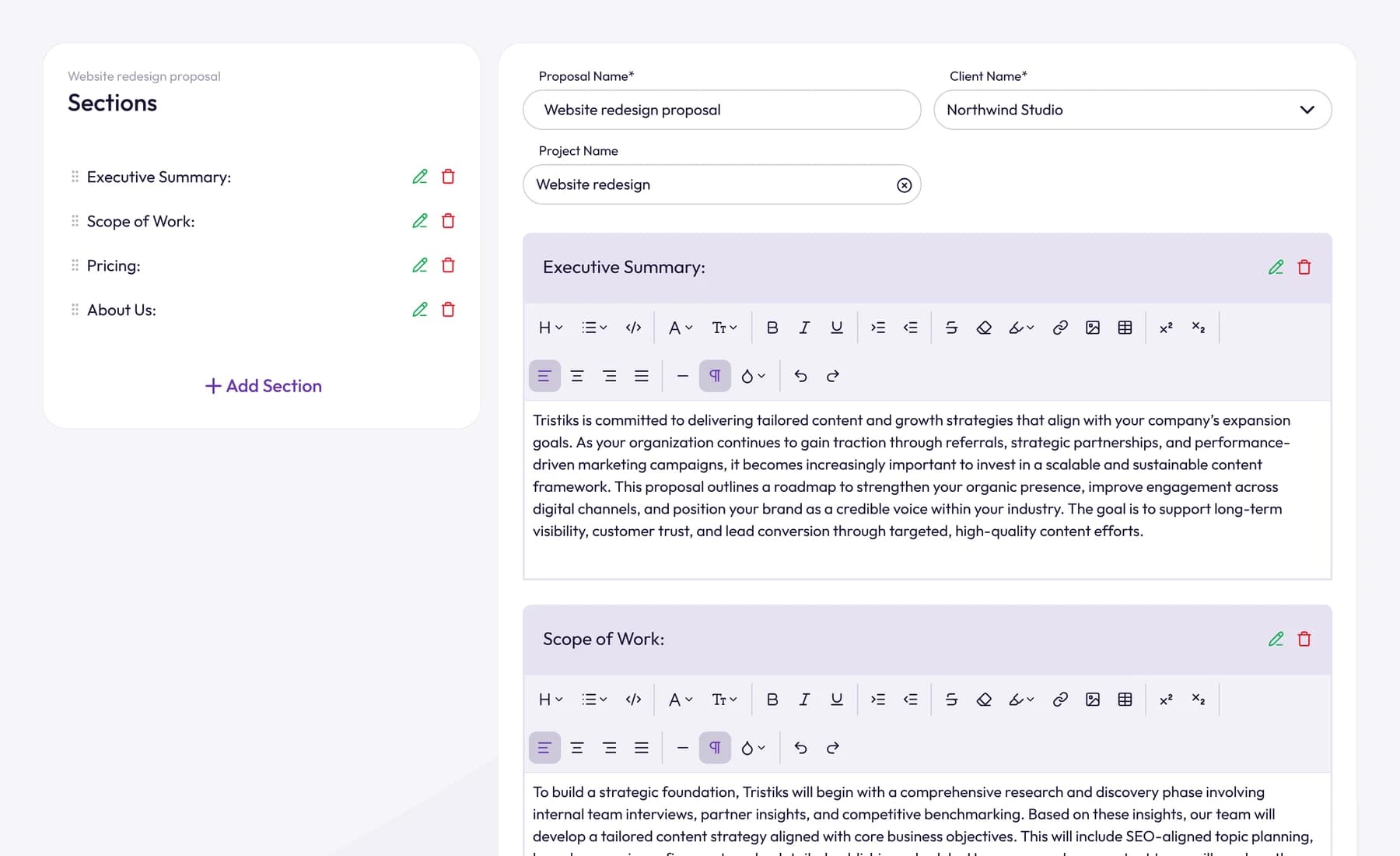
See how proposals and signing work on our proposal and contract software page.
Frequently asked questions
How much should a beginner web designer charge?
Upwork puts beginners across all skills at $10 to $25 an hour, and web designers at $15 to $30. Work out the minimum your own costs require first, and don't go below it to win a first client.
Should I charge hourly or per project for web design?
Per project for the build, with a clear scope and set revisions, and hourly for open-ended changes after launch. Track your hours either way.
How much should I charge for website maintenance?
Older WordPress surveys found most care plans between $25 and $100 a month. Price yours from the hours and tools each tier includes.
Wrap up
Published web design rates range from $15 an hour on Upwork to $149 an hour for agencies, so use them as a sanity check, not a price. Set your rate from your costs, estimate hours phase by phase, add contingency, check the total against the client's value, and compare tracked hours with the quote after every project.
To send priced proposals and see what every project really earned, try Tristiks Grow free for 14 days.
Category: Payments
Suraj Rao
Suraj Rao is the founder of Tristiks, the team behind Tristiks Grow and its desktop time tracker OneTrack. He writes about time tracking, client work and getting paid, and about DevOps, cloud and AI from years of building software.