Productized Services: How to Package and Price Your Freelance Work
 By Suraj Rao7 min read
What You'll Learn
- A productized service is a service sold like a product: a named offer with a defined scope, a set process and a fixed price, instead of a custom quote every time.
- Start from work you already repeat. Your time records show which projects repeat, how long they really take and where the hours leak.
- Price from real hours plus a margin for variation, write the limits into the offer, and check the effective hourly rate on every delivery so the package keeps paying.

A productized service is a freelance or agency service packaged like a product: one clearly named offer, a defined scope, a repeatable process and a fixed price that's published or quoted the same way every time. Instead of "web design, contact me for a quote", it's "a five-page website for physiotherapy clinics, delivered in three weeks, $4,500". Clients know what they get and what it costs before the first call; you get faster sales, fewer custom proposals and a process you can improve with every delivery.
Productizing works best for work you've already done many times. This guide covers the three common models, examples, a step-by-step way to build one, how to price it from your real hours and the traps that turn a good package into underpaid work.
Productized service vs custom work vs retainer
| Custom project | Retainer | Productized service | |
|---|---|---|---|
| Scope | Agreed per project | Hours or availability per month | Fixed, written into the offer |
| Price | Quoted each time | Monthly fee | Fixed, often published |
| Sales | Discovery, proposal, negotiation | Proposal, then renewal | Short call or straight to checkout |
| Process | Different each time | Varies | The same steps every time |
| Your risk | Estimating | Unused or overused hours | Scope creep inside a fixed price |
Retainers and productized services overlap: a monthly subscription with a fixed list of deliverables is both. Our guides to retainers vs fixed-price projects and capacity retainers cover the retainer side.
Three models, with examples
1. Fixed-scope packages
A one-off deliverable at a set price.
- A website audit with a prioritised fix list
- A brand identity package: logo, colors, type and a one-page guide
- A pitch deck redesign of up to 15 slides
- An onboarding email sequence of five emails
2. Subscriptions
Ongoing work for a monthly fee, with limits on what's included.
- Website care: updates, backups, uptime checks and two hours of small changes a month
- Design on demand: requests worked through one at a time
- Monthly bookkeeping for a set number of transactions
- Podcast editing per episode, billed monthly
The best-known example is Designjoy, a one-person design subscription launched in 2017, where clients submit requests to a queue that's worked on one at a time and can pause or cancel anytime.
3. Productized consulting
A paid first step that leads into larger work.
- A two-hour strategy session with a written plan
- A technical architecture review
- A paid discovery or roadmap phase, credited against the project if the client goes ahead
This model suits experts whose main projects are too varied to package, because the entry point is the same even when the work after it isn't.
Is productizing right for you?
It's a good fit if:
- you've done the same kind of project at least five or six times
- clients ask similar questions and need similar outcomes
- most of your projects' time goes on the same steps
- you'd rather improve one process than reinvent each project
It's a poor fit if every project is genuinely different, if clients mostly need deep custom strategy, or if you're new enough that you don't yet know where the time goes.
How to build one in six steps
1. Find the work you already repeat
Look at the last 12 months of projects. Which kinds came up again and again? Which did clients rate highest? Which were most profitable? Our post on project profitability shows how to check the last one.
If you track time by project and task, this is a 30-minute exercise instead of guesswork.
2. Pick one audience
"Website for clinics" sells better than "website for anyone", because you can speak to that audience's problems, reuse examples and build expertise. You can add a second audience later.
3. Write the scope as a list
The offer page should say exactly what's included and what isn't:
Clinic Website Starter: $4,500, delivered in 3 weeks

Included
- Up to 5 pages: home, about, services, team, contact
- Online booking link (your existing booking system)
- Copy editing of your text (you provide the drafts)
- Mobile-friendly design on our clinic template
- 2 rounds of revisions, at the design stage and before launch
- Launch and 30 days of fixes

Not included
- Copywriting from scratch (add-on: $600)
- Extra pages (add-on: $350 each)
- Custom features or integrations
The "not included" list is as important as the "included" one. It's your protection against scope creep, and add-ons turn extra requests into extra revenue instead of free work.
4. Price it from your real hours
Pull the hours from your past projects of this type. Use the actual hours, not what you quoted.
Past clinic websites (tracked hours)
Project A: 38 h    Project B: 44 h    Project C: 51 h
Project D: 36 h    Project E: 41 h

Typical (median): 41 h
Upper end:        51 h

Target effective rate: $100/h
Price at the typical case:  41 h x $100 = $4,100
Price that covers 51 h at $88/h (worst case): $4,500
At $4,500 you earn about $110 an hour on a typical project and still about $88 on the slowest one. As the process improves and hours fall, the same price earns more. Then check the price against value: what's a new website worth to a clinic in new bookings? If it's far more than $4,500, there's room to charge more. Our guide to value-based pricing covers that side.
5. Standardise the process
Write down the steps of every delivery and turn them into templates:
- an intake form that collects everything up front
- a checklist of tasks for each delivery, with who does what
- email templates for kickoff, review, launch and handover
- a short statement of work or terms page the client accepts before paying
Every repeat improves the template. That's where productized services get more profitable over time.
6. Make it easy to buy
Give the offer a name and its own page with the scope, price, timeline, examples and FAQs. Let clients book a short call or pay a deposit directly. If you sell a subscription, bill it automatically on the same day every month.
The traps
- Underpricing. Pricing from what you'd have quoted rather than what you actually spent. Use tracked hours.
- Scope creep inside the fixed price. "Just one more small change" adds up. Point to the scope list and offer an add-on.
- Selling to the wrong client. A client who needs something custom will be unhappy with a package. Say no, or quote custom work separately.
- Subscriptions that never stop. Unlimited requests without a limit on active requests or turnaround means unlimited work. Cap what's in progress at once.
- Never reviewing it. Check the numbers after every few deliveries.
Measure every delivery
A fixed price hides how much you earned per hour. Track time on every delivery and calculate your effective hourly rate: the price divided by the hours it really took. Watch for two things:
- The rate falling over time: scope is creeping, or the process has a step that keeps taking longer.
- Wide variation between clients: some clients need more, so your qualifying questions or the scope list need work.
How Tristiks Grow helps
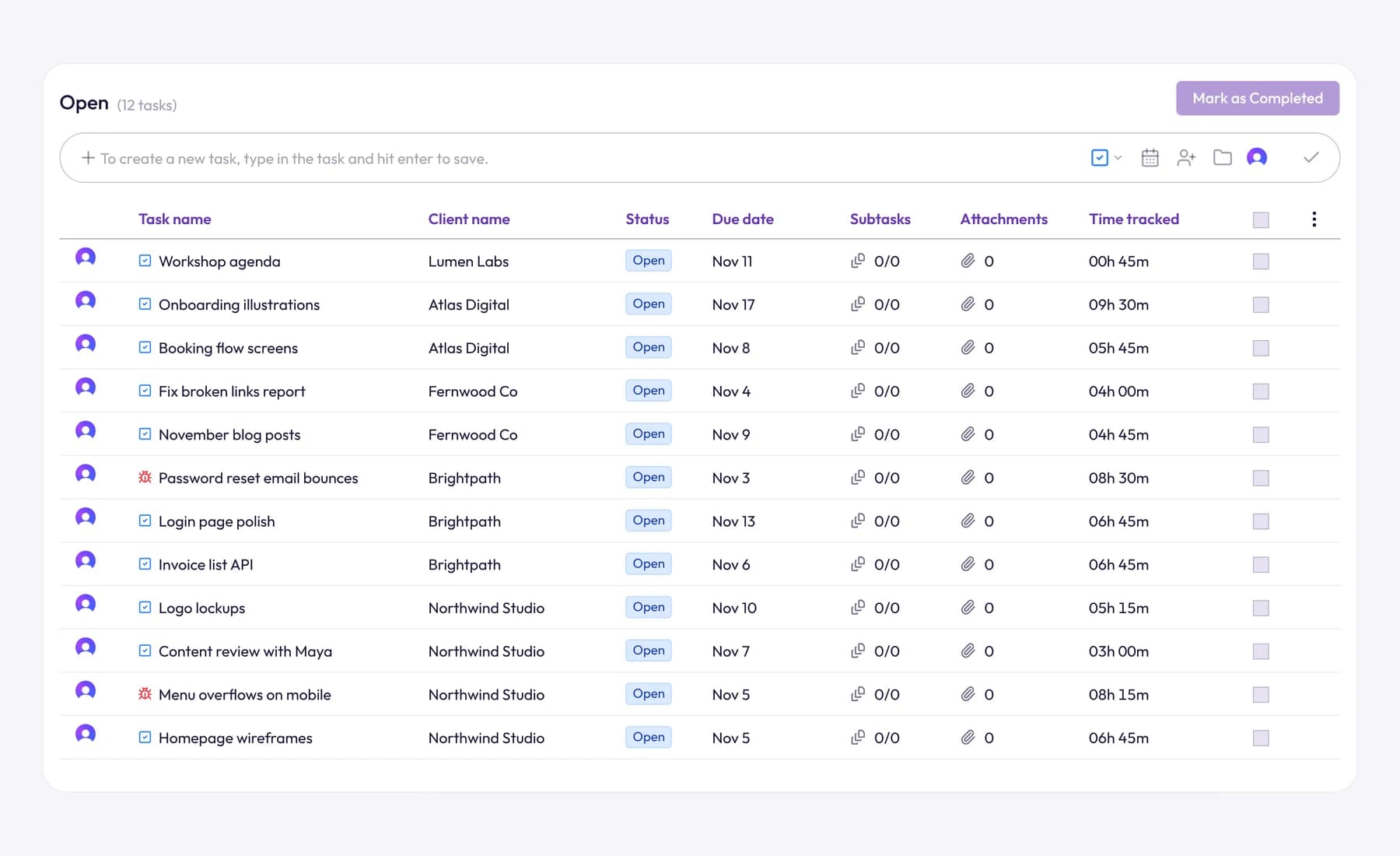
- Time tracked by client, project and task, so you know how long each step of each delivery really takes, and can find where hours leak.
- Reports by client and project, to compare past projects of the same type when you set or review the price.
- Recurring invoices for subscriptions, sent automatically on a schedule, with payment reminders.
- Proposals with a pricing table, so each package and its add-ons can be sent and signed in minutes.
See recurring invoice software for how subscription billing works.
Frequently asked questions
Should I publish my prices?
If the offer is truly fixed, yes. A visible price filters out clients who can't afford it and speeds up sales. If the price depends on a few variables, publish a "from" price.
Can an agency productize its services?
Yes, and agencies often benefit most, because a standard process lets more people deliver it consistently. Start with one offer and one team. Our guide to agency rate cards covers pricing packages across roles.
What if a client wants something slightly different?
Price the difference as an add-on, or quote it as custom work. Changing the package for each client turns it back into custom work at a fixed price, which is the worst of both.
Wrap up
A productized service is your most repeated work, sold with a clear scope, a set process and a fixed price. Pick work you've done many times, write the scope as a list of what's in and out, price it from your real tracked hours, and check the effective hourly rate after every delivery.
To price packages from real hours and bill subscriptions automatically, try Tristiks Grow free for 14 days.
Category: Freelancing
Suraj Rao
Suraj Rao is the founder of Tristiks, the team behind Tristiks Grow and its desktop time tracker OneTrack. He writes about time tracking, client work and getting paid, and about DevOps, cloud and AI from years of building software.