Why Freelance Software Keeps Getting More Expensive
 By Suraj Rao11 min read
What You'll Learn
- Recent changes at HoneyBook, Dubsado, Clockify and Harvest follow the same few patterns: new owners chasing margin, per-seat and usage-based pricing, AI moved into higher tiers and smaller free plans.
- Small increases across several tools add up, and one renewal on a new pricing model can cost more than the rest of your stack combined.
- Audit your stack yearly, know your renewal dates and price-change terms, export your data regularly and decide in advance how big an increase makes you switch.
Freelance software keeps getting more expensive because the companies behind it are under pressure to earn more from each customer. Tools get bought by owners who want higher margins, prices move to per-seat and usage-based models that grow with your business, AI features get bundled into pricier tiers and free plans shrink. None of that is likely to reverse, so the useful question is how to keep it from quietly eating your margin.
In the last two years, HoneyBook raised its plan prices, Dubsado raised prices for new subscribers, Clockify cut back its free plan and some Harvest customers reported renewal bills many times higher than before. Below: a dated timeline, why it keeps happening, what it can cost a small business and a playbook to protect yourself.
A timeline of notable price changes
Figures are as reported by the sources linked; where sources disagree, we say so. Check each vendor's pricing page for what applies to you today (checked November 2026).
| Date | Tool | What changed | Source |
|---|---|---|---|
| February 2025 | HoneyBook | Plan prices rose; Starter reported from $19 to $36 a month billed monthly | HoneyBook help center, Fstoppers |
| May 2025 | Notion | AI stopped being a separate add-on for new customers and was included in Business and Enterprise plans instead | Engadget |
| 2025 (reported as July) | Harvest | Acquired by Bending Spoons | Subscription Insider |
| November 2025 | Bonsai | Zoom announced it would acquire Bonsai | Zoom |
| December 2025 | Dubsado | Higher prices for new subscribers; existing paid users kept their plans and pricing | Dubsado |
| April 2026 | Clockify | Free plan limited to 5 users, with features such as billable rates and CSV and Excel exports moved to paid plans | Clockify help center |
| From August 2026 | Harvest | Customers reported renewals up as much as 1,500% after a move to seat fees plus usage charges | Silicon UK, Bloomberg Government |
HoneyBook. HoneyBook updated the prices and packages of its three plans in February 2025. Most reports put Starter at $19 rising to $36 a month on monthly billing, and Essentials at $39 rising to $59. Reports of the new Premium monthly price range from $125 to $129. Several reports describe a one-year transition discount for existing members, which has since ended.
Dubsado. Dubsado said new prices would apply to new subscriptions from December 1, 2025, and that existing paid users were not affected. Its own summary lists Starter at $35 a month or $335 a year and Premier at $55 a month or $525 a year. Third-party guides report the earlier monthly prices as $20 and $40.
Bonsai. Bonsai prices per user, from $9 to $49 per user a month billed annually on its listed tiers, so the bill grows with every teammate. Zoom said Bonsai would stay a standalone platform under its own brand. We haven't seen price changes tied to the deal; it's listed because a change of owner is a reason to watch.
Clockify. Clockify's parent company announced changes to the free plan in April 2026. Clockify's help center now lists 5 active users on Free, a 31-day report range, CSV and Excel exports on paid plans only (PDF exports stay free) and billable rates on Basic and above. Some users complained that the changes arrived with little notice. Freelancers who billed from the free plan lost the parts they relied on.
Harvest. This is the largest case. After the acquisition, Harvest added usage charges on top of per-seat pricing, and annual customers found out at renewal. Silicon UK reported a UK consultancy whose monthly bill went from about $130 to $2,110, and Bloomberg Government reported a freelance web designer whose annual renewal rose twelvefold. Harvest offered the consultancy a lower price after it pushed back. Our Harvest price increase guide covers what changed and what Harvest customers can do.
Why it keeps happening
New owners want a return
Buyers want a return on what they paid. Bending Spoons, which bought Harvest, has a track record: after it bought Evernote, the free plan was cut to one notebook and 50 notes in late 2023. According to Silicon UK, Bending Spoons says its prices are in line with comparable products.
Not every acquisition leads to price rises, but a change of owner is when pricing is most likely to be reworked. Treat it as a signal to check your plan.
Per-seat pricing grows with you
Per-seat pricing charges for every person on the account, including those who don't work every day: a part-time assistant, a subcontractor for one project, a partner who only sends invoices.
For a solo freelancer, per-seat and flat pricing look the same. The gap opens when you grow. Our post on per-seat vs flat pricing works through when each model is cheaper.
Usage charges make bills hard to predict
Usage-based pricing charges for how much you do: invoices sent, projects, clients, storage, API calls. According to Subscription Insider, Harvest says extra invoices, projects, clients and tasks can raise the cost under its usage-based plans. The public price is then only part of the bill, so you can't compare tools, or budget, from the pricing page alone.
AI features land in higher tiers
AI features cost vendors money to run, so they rarely arrive on cheap plans. Notion's 2025 change is the clearest example: instead of a separate add-on, AI came with the Business and Enterprise plans, so wanting the AI meant moving up a tier.
Free plans shrink
Free plans are a marketing cost, cut when a company needs paying customers more than sign-ups. Clockify's 2026 change and Evernote's 2023 change both kept a free plan but moved the parts people depended on behind a paywall. If your business runs on a free plan, that's the part of your stack most likely to change.
Old prices don't last forever
Grandfathered prices and transition discounts end eventually. HoneyBook's reported discount for existing members lasted a year. The longer you've paid an old price, the bigger the jump when it ends.
What it costs you: a worked example
Single increases look small, but they add up across a stack and arrive alongside the seats you add as you grow. These are made-up assumptions, not any vendor's prices. Swap in your own.
Assume a two-person studio with four tools:
Year 1 (all prices per month)
Client management, flat price:      $20
Time tracking, $10 per seat x 2:    $20
Project management, $10 x 2:        $20
Docs and notes, $10 x 2:            $20
Total: $80 a month = $960 a year
Now three things happen in year 2, each of a kind described above:
- The client management tool raises its price 75%, from $20 to $35.
- The docs tool moves the AI features you use into a tier that costs $20 per seat, so it goes from $20 to $40.
- You bring in a subcontractor for six months, which adds a seat to the three per-seat tools: $10 + $10 + $20 = $40 a month extra.
Year 2
Base monthly cost: $35 + $20 + $20 + $40 = $115
Base for the year: $115 x 12           = $1,380
Subcontractor seats: $40 x 6           = $240
Total:                                  $1,620

Increase: $1,620 - $960 = $660 (69% more)
At $75 an hour, that $660 is about nine billable hours a year just to stand still, and this is the mild version. A usage-based renewal like those reported at Harvest can cost more than the rest of a stack combined.
The subscriptions are also not the whole cost. Hours lost copying data between separate tools can cost more than the fees; our comparison of all-in-one software vs separate tools covers that side.
How to protect yourself: a playbook
You can't stop vendors raising prices, but you can make sure a rise never surprises or traps you.
1. Audit your stack once a year
List every tool you pay for, with:
- what you use it for
- plan, seats and price, monthly and yearly
- billing cycle and renewal date
- who owns the company, and whether that changed this year
- how you'd get your data out
Cancel what you don't use, drop unused seats and look for tools doing the same job twice. Our freelancer software stack guide covers which jobs need a tool at all, and your year-end review is a natural time to do it.
2. Weigh annual against monthly billing
Annual billing is usually cheaper: HoneyBook's Starter has been listed at $29 a month billed annually against $36 billed monthly. Paying for the year also tends to hold your price until renewal, though that depends on the terms.
The trade-off is flexibility. If a tool raises prices or changes owner mid-year, monthly billing lets you leave next month, while annual billing locks you in until renewal, and renewal is exactly where some Harvest customers met their new prices. A reasonable rule: pay yearly for tools you're sure you'll keep, and monthly for anything new, under review or recently acquired.
3. Read the renewal and price-change terms
Find out, before you need to:
- whether the plan renews automatically, and at what price
- how much notice the vendor gives of a price change, and how (email, in-app banner, or only on the invoice)
- whether a new price applies at your next renewal or sooner
- how to cancel or downgrade, and by when
Put each renewal date in your calendar 45 days early, so you have time to compare options and move your data. This is general information, not legal advice; your rights depend on your contract and where you are.
4. Ask about grandfathering and discounts
When a price rise is announced, ask support what applies to you. Dubsado said existing paid users kept their plans and pricing. HoneyBook was reported to give existing members a transition discount. Harvest offered at least one customer a lower price after it pushed back. You won't get any of these if you don't ask, and the answer helps you decide whether to stay.
5. Export your data regularly
Don't wait until you're leaving. Export once a quarter and keep the files somewhere you control:
- your client list and contact details
- signed contracts and proposals, as PDFs
- invoice history, paid and unpaid
- time logs, with client, project and billable status
- expenses and receipts
Exports can change too: after Clockify's 2026 change, free-plan users need a paid plan for CSV or Excel files, or settle for PDFs.
6. Own the things that make you hard to replace
Lock-in rarely comes from features. It comes from records you can't leave without: years of invoices, signed contracts, client history. Keep copies outside any single tool, use an email address on your own domain and, before you choose a tool, check it can export everything you'd need to start again elsewhere.
7. Watch for ownership changes
When a tool you rely on is acquired, read the announcement, look at what the new owner did with products it bought before and don't prepay a year until the new pricing is clear. If you're already on an annual plan, run your comparison well before renewal.
8. Set your switching threshold in advance
Decide before the email arrives how much of a rise makes you move. A simple test:
Switch if: yearly increase > hours to switch x your hourly rateThat means a switch pays for itself within a year. Say a tool rises by $600 a year and switching would take 6 hours at $75 an hour, or $450. The rise is bigger, so you switch. If it were $150, you'd stay and look again at the next renewal. Count everything in the hours: moving data, rebuilding templates and learning the new tool. The point is to decide calmly, not in the week before renewal.
If a rise does push you out, our guides to HoneyBook alternatives, Bonsai alternatives, Clockify alternatives and Harvest alternatives compare the options.
How Tristiks Grow helps
Tristiks Grow puts time tracking, tasks, client profiles, proposals and contracts, invoicing, expenses and reports in one workspace. Three things are relevant here.
Flat plan prices, not per seat. Each plan has one price for a set number of seats: Solo is $12 a month for 1 seat, Professional is $19 a month for up to 3 seats and Advanced is $39 a month for up to 10 seats. Adding a subcontractor within your plan's seats doesn't change the bill. Every plan includes unlimited clients and projects, time tracking, invoicing, proposals and contracts, task management and the desktop apps.
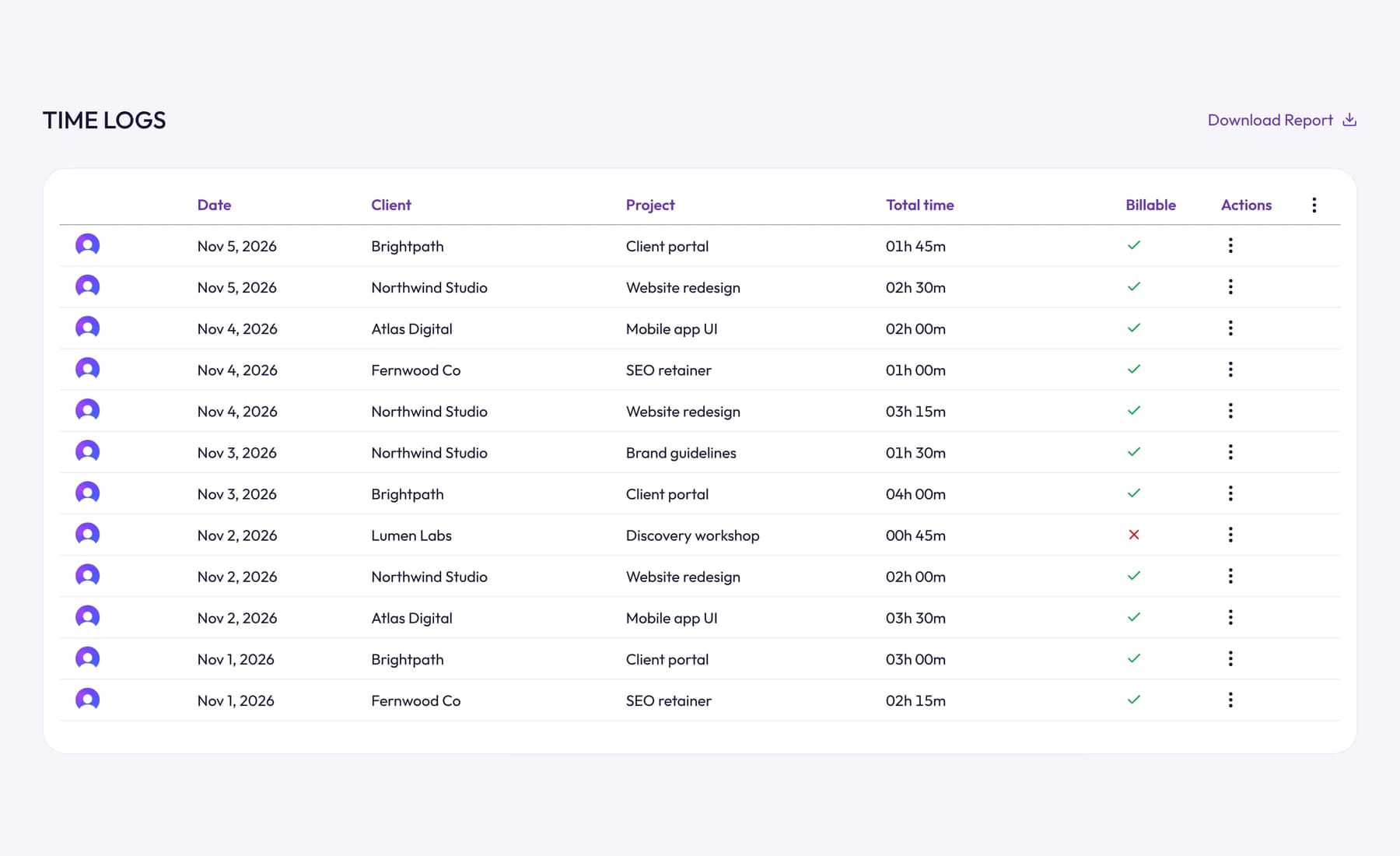
Your records are exportable. You can export the time log as CSV, with teammate, date, client, project, task, description, length, billable status and invoice number, along with CSV exports of expenses and invoices. That makes the quarterly export in step 5 a few clicks, and it means your history isn't stuck with us either.
Yearly billing saves 12%. If you decide a tool belongs in the "sure to keep" group, paying yearly costs less. Monthly billing is there if you'd rather keep the option to leave, and you can cancel anytime.
The Advanced plan also includes account migration support, help moving your data in, and there's a 14-day free trial with no credit card, so you can test it before your next renewal. See pricing for plan details.
Frequently asked questions
Can a software company raise my price in the middle of my plan?
It depends on the terms you agreed to. On annual plans, price changes commonly apply at the next renewal, and many vendors email notice before it. Read your vendor's terms of service and renewal emails. This is general information, not legal advice.
Did HoneyBook reverse its 2025 price increase?
We couldn't confirm that it did. Reports describe a one-year transition discount for existing members rather than a reversal. Check HoneyBook's pricing page for current prices.
Wrap up
Software prices keep rising because owners want margin, pricing has moved to seats and usage, AI is sold as a reason to upgrade and free plans are shrinking. You can't control that. You can know what you pay and when it renews, keep your records in your own hands and decide in advance what makes you switch.
To keep your time log, expenses and invoices exportable in one place, try Tristiks Grow's time reporting software free for 14 days.
Category: Freelancing
Suraj Rao
Suraj Rao is the founder of Tristiks, the team behind Tristiks Grow and its desktop time tracker OneTrack. He writes about time tracking, client work and getting paid, and about DevOps, cloud and AI from years of building software.