Capacity Retainers: How to Price, Scope and Invoice Them
 By Suraj Rao11 min read
What You'll Learn
- A capacity retainer sells a reserved share of your team's time each month, so your revenue stops shrinking every time AI or experience makes a task faster.
- Price it from reserved hours by role, a blended rate, a buffer for account management and a minimum term, then write rules for rollover, overage and response times.
- Invoice the fee in advance on a fixed date, bill overage in arrears, send a usage report with every invoice and watch for the signs the retainer is underpriced.

A capacity retainer is a monthly fee a client pays to reserve a set amount of your team's time, such as 60 hours across design, development and project management. The client gets guaranteed access and priority. You get predictable revenue that doesn't depend on how long each task takes.
That last point is why capacity retainers are getting more attention. When AI shortens tasks, billing each task by the hour means billing less for the same result. A capacity retainer moves the price from "how long did this take" to "how much of the team do you have", and the client gets more done inside the capacity they bought.
This guide covers how capacity retainers differ from other retainers, how to price one with a worked example, the scope rules to agree, how to report usage and invoice it, and the clauses to put in the contract. If you're still choosing between a retainer and project pricing, start with retainers vs fixed-price projects.
Three kinds of retainer
"Retainer" covers several different deals, and the kind you choose decides how you price it and what happens to unused time.
| Capacity retainer | Deliverables retainer | Access (advisory) retainer | |
|---|---|---|---|
| What the client buys | Reserved team time each month | A set output each month | The right to call on you |
| Example | 60 hours across design, dev and PM | 4 articles and a monthly report | 2 calls a month plus email advice |
| Measured in | Hours, days or roles | Deliverables | Availability and response time |
| If you get faster | The client gets more output | You keep the margin | You keep the margin |
| Unused time | Needs a rollover rule | Rarely an issue | Usually expires |
| Best for | Ongoing, varied work | Repeatable, stable work | Senior advice and oversight |
A deliverables retainer rewards speed most directly, but only works when the output is predictable. Most agency clients don't have predictable months: one is a campaign launch, the next is bug fixes and landing pages. A capacity retainer absorbs that variety without a change request every time the work shifts.
Why capacity retainers are growing
AI shortens tasks. On a pure hourly model, each efficiency gain is a revenue cut, as our guide to billing for AI-assisted work shows in detail.
Large agencies are saying it out loud. At WPP's February 2026 strategy update, CFO Joanne Wilson said a model more closely linked to client outcomes would let the group, over time, move away from time and materials and decouple revenue from headcount, according to AdNews. CEO Cindy Rose has also said, as reported by Digiday, that outcome-based pay is still a few years away. Even the biggest groups are moving gradually.
Smaller agencies haven't settled on an answer either. A follow-up survey of 174 agencies in Productive's Agencies in the AI Era pulse report found no consensus on pricing: some agencies were holding or raising prices, some lowering them, and a growing share were still working out their model.
A capacity retainer sits between hourly billing and outcome-based pricing. You still sell time, but in reserved blocks priced up front, so a faster team gives the client more output rather than you a smaller invoice. To price on results instead, see our guide to value-based pricing.
How to price a capacity retainer
Monthly fee = reserved hours x blended rate + account management bufferThen set a minimum term.
- Reserve hours by role. Don't sell "60 hours" as one pool: a senior developer's hour costs you more than a junior designer's. Base the split on time tracked on this client's last project or on similar clients.
- Work out a blended rate. Multiply each role's hours by its rate, add them up and divide by the total hours. You quote one number while still pricing senior time correctly. Our guide to building an agency rate card covers rates per role.
- Add a buffer for account management. Status calls, messages, reporting and planning aren't on anyone's task list. Counting them against the client's hours feels like short-changing them; ignoring them comes out of your margin. Leave them out of the capacity count and add 10–15% to the fee instead.
- Check your team can deliver it. Reserved hours can't be sold to anyone else, and nobody is billable 40 hours a week. Our guides to agency utilization rate and capacity planning for agencies show how to work out what each person can take on.
- Set a minimum term. Three months is common, because the first month usually goes on onboarding. After that, a 30-day notice period is typical.
A worked example
A small agency is pricing a retainer for an e-commerce client. The numbers are made up; swap in your own.
| Role | Reserved hours | Rate | Monthly value |
|---|---|---|---|
| Designer | 20 | $90 | $1,800 |
| Developer | 30 | $110 | $3,300 |
| Project manager | 10 | $130 | $1,300 |
| Total | 60 | $6,400 |
Blended rate:       $6,400 / 60 hours = $106.67 an hour
Account mgmt (10%): $6,400 x 0.10 = $640
Monthly fee:        $6,400 + $640 = $7,040, quoted as $7,000
Minimum term:       3 months, then 30 days' notice
Setup fee:          $3,000, paid in two instalments
Overage:            $120 an hour, only with written approval
Overage is priced above the blended rate because unplanned hours push other work around. Billing overage at each role's own rate also works, as long as it's written down.
After three months, tracked time shows the client used an average of 56 of the 60 hours, and account management took about 7 hours a month, so the buffer is roughly right.
Scope rules to agree before the first month
Most retainer disputes come from rules nobody wrote down.
What counts against capacity. List what uses the reserved hours (design, development, copy, QA, project management on the client's tasks) and what doesn't (internal reviews, your own admin, account management covered by the buffer). Say whether travel counts. Fixing your own mistakes usually shouldn't.
Rollover or use-it-or-lose-it. You turned other work away to reserve this time, so some expiry is fair. Fully banked hours turn the retainer into prepaid hourly work and can leave you owing a month of time. Middle grounds:
- Capped rollover: up to 10–20% of the monthly hours carry into the next month only.
- Rollover with expiry: unused hours can be used for one more month, then expire.
- Convert, don't bank: unused hours go towards a small agreed project, such as an audit, within the quarter.
Caps and overage. Either work pauses at the cap until the client approves extra hours, or you continue and bill the overage. Pausing is safer. Name who on the client side can approve overage, so a junior contact can't commit their budget.
Priority and response times. Priority is part of what the client buys, so put numbers on it: for example, urgent issues acknowledged within 2 business hours, standard requests within 1 business day and started within 3. Promise response and start times, not completion times.
Unused capacity at the end. Say whether rolled-over hours can be used during the notice period or expire on the last day. Otherwise a client leaving with 30 banked hours can ask for all of them in the final two weeks.
Report usage every month
A capacity retainer feels fair only when the client can see where the hours went. Send a short report with each invoice:
| Item | This month |
|---|---|
| Reserved hours | 60 |
| Rolled over from last month | 4 |
| Hours used | 58 (design 17, development 31, PM 10) |
| Remaining | 6 (up to 6 roll over) |
| Overage billed | 0 |
| Work completed | Checkout redesign, 3 landing pages, speed fixes |
| Planned next month | Holiday campaign pages, analytics setup |
Track time against the client's project from day one, including small tasks, because small requests are what add up. Mark internal work as non-billable rather than skipping it, so you see your real cost; our guide to billable vs non-billable hours covers where to draw the line.
The report is also an early warning. A client who uses 30 of 60 hours two months running will question the fee at renewal. Raise it first: suggest work to use the capacity, or offer to resize.
How to invoice a capacity retainer
- Bill the fee in advance, on a fixed date. The fee pays for capacity you're reserving, so invoice before the month starts, usually on the 1st. A predictable date helps the client's finance team schedule payment.
- Use short payment terms. Seven or 14 days, or due on receipt, suit an advance invoice better than 30 days, which can leave you most of the way through the month before you're paid. See net 30 payment terms for how the options compare.
- Bill overage in arrears. Add it as a separate line on the next month's invoice, or send its own invoice with the usage report, so the base fee stays clearly visible.
- Split setup fees into instalments. Half on signing and half when the first month starts is easier for a client to approve. Put the dates in the contract.
- Turn on payment reminders. An invoice that's the same every month is easy to ignore. Our payment reminder email templates cover what to say.
- Agree what happens if payment is late. Work pauses after a set number of days, and reserved capacity isn't held during the pause. If you charge late fees, check the rules where you work. This is general information, not legal or tax advice.
Contract clauses to copy
Adapt the numbers, and have a lawyer review them for where you and your client are.
Reserved capacity
The Agency will reserve 60 hours of team capacity each calendar month
for the Client: up to 20 hours of design, 30 hours of development and
10 hours of project management. Account management, reporting and
internal reviews do not count against these hours. The Agency will
acknowledge urgent issues within 2 business hours and standard requests
within 1 business day; these are not completion times.
Unused capacity and additional hours
Up to 6 unused hours may roll over to the following month only; other
unused hours expire at the end of the month and are not refunded. On
termination, rolled-over hours expire on the final day of the
agreement. Work beyond the monthly hours requires written approval from
the Client's named contact and is billed at $120 per hour in arrears.Fees, payment and term
The monthly fee of $7,000 is invoiced on the 1st of each month in
advance and is due within 7 days. If an invoice is unpaid 14 days after
its due date, the Agency may pause work, and reserved capacity is not
held during the pause. The initial term is 3 months, then month to
month until either party gives 30 days' written notice. The Agency may
review the fee once every 6 months, with 30 days' written notice.For the rest of the agreement, see what to include in a freelance contract.
Warning signs your retainer is underpriced
Check these every quarter:
- The client needs overage every month. The reserved capacity is too small.
- Account management outgrows the buffer. Calls and reporting take 15 hours and you priced for 6.
- Your effective rate is falling. Divide the month's fee plus overage by every hour tracked on the client, billable and non-billable. Well below your blended rate means the retainer costs more than it pays.
- Senior people are filling junior slots. Your developer doing work priced as design hours raises your cost.
- Work arrives outside the reserved roles. Video requests on a design and development retainer need a new scope, not a favour.
- The client pays late every month. That's a loan from you to the client.
One sign is worth raising at the next review. Two or more usually means the fee or the scope needs to change.
How Tristiks Grow helps
Tristiks Grow keeps a capacity retainer's paperwork in one place:
- Proposals and contracts with online signing. Save the clauses above in a template, add a pricing table and send it for the client to sign online by typing their name, with an optional draft invoice created when they sign. See proposal and contract software.
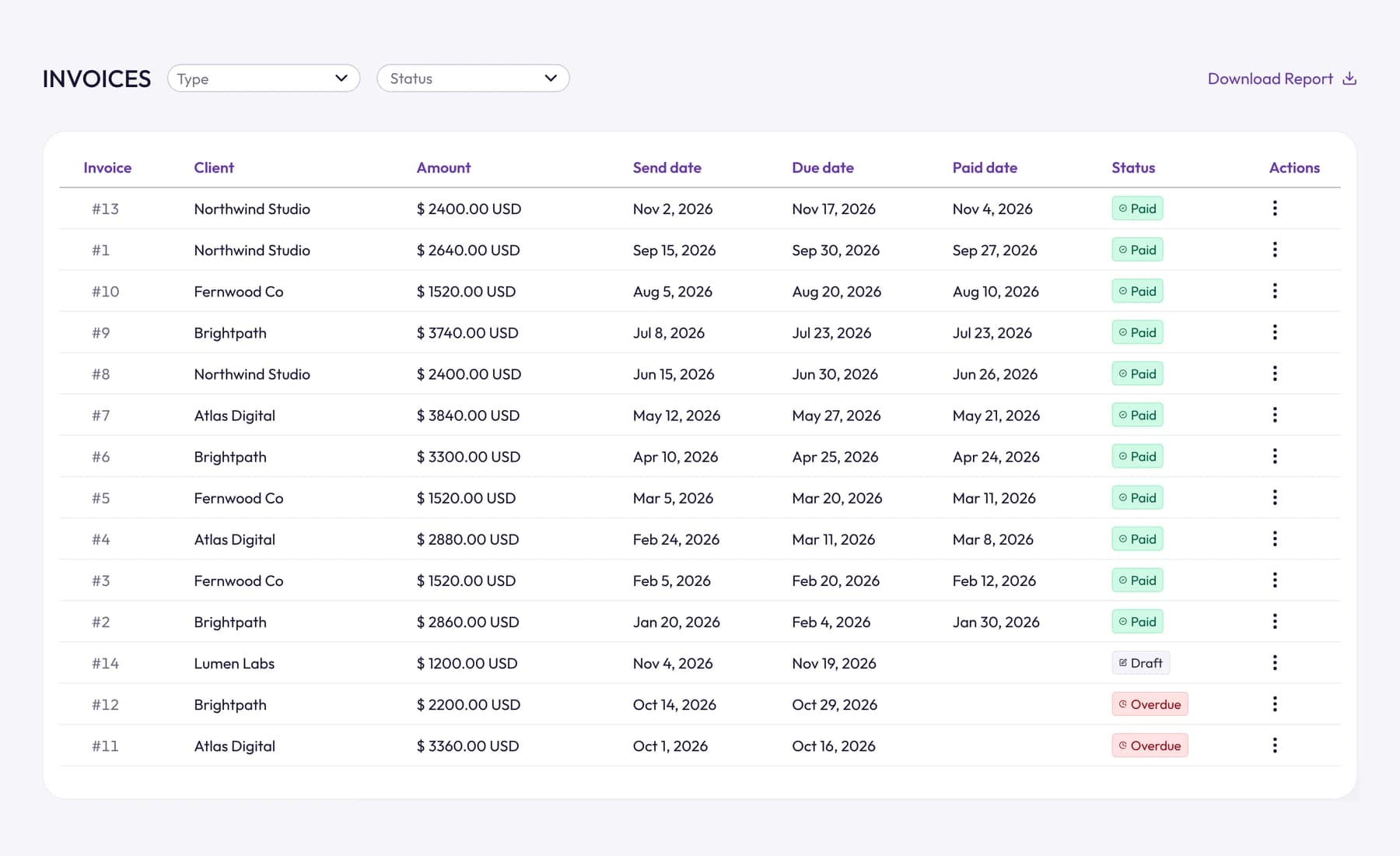
- Recurring invoices and scheduled sends. Set the retainer invoice to repeat monthly, with your payment terms. See recurring invoice software.
- Instalments. Split the setup fee into instalment payments, such as half on signing and half when the first month starts.
- Automatic reminders. Sent 3 days before the due date, on the due date, and 7, 14 and 30 days late.
- Time against an estimate. Give the project an estimate, such as the reserved hours, and see time tracked against it. Mark entries billable or non-billable, and save the client's hourly rate so reports show what the hours earned. See project time tracking.
- Time reports. Attach a PDF time report for the month to the invoice email, or export the time log as CSV.
Frequently asked questions
How is a capacity retainer different from an hourly retainer?
Both reserve hours each month. A capacity retainer usually reserves time by role, includes priority and response times, and is priced as one fee, so the conversation is about how much of the team the client has, not the cost of each task.
Should retainer hours roll over?
A capped rollover with an expiry is a fair middle ground. Full rollover turns the retainer into prepaid hours; use-it-or-lose-it is fair when you're reserving capacity, as long as the client sees the remaining hours before the month ends.
Wrap up
A capacity retainer prices your team's time in reserved blocks, so getting faster gives the client more rather than giving you less. Price it from hours by role, a blended rate, an account management buffer and a minimum term. Write down the rules for rollover, overage and response times, report usage monthly and invoice in advance on a fixed date.
To bill your retainer on a schedule with reminders built in, try Tristiks Grow's recurring invoices free for 14 days.
Category: Payments
Suraj Rao
Suraj Rao is the founder of Tristiks, the team behind Tristiks Grow and its desktop time tracker OneTrack. He writes about time tracking, client work and getting paid, and about DevOps, cloud and AI from years of building software.