How to Choose a Freelance Niche (With a Scoring Table)
 By Suraj Rao11 min read
What You'll Learn
- A niche can be an industry, a service, a problem or an audience. The strongest ones combine two, such as one service for one kind of client.
- Score candidate niches on earnings, demand, proof, reachability, client quality and enjoyment, using your own effective hourly rate and payment data rather than gut feel.
- Test a niche for 60 days before committing, keep your current clients while you shift your marketing, and don't niche yet if you have too few projects to learn from.

To choose a freelance niche, look at the clients and projects you've already had, find the group where you earned the most per hour, have the most proof and can reach new clients most easily, then test that niche for a couple of months before you commit. A niche can be an industry, a service, a problem you solve or an audience you serve. The best choice usually comes from your own numbers, not from a list of "most profitable niches."
This guide explains the four kinds of niche, what the research says about pricing and referrals, a scoring table you can fill in from your time and invoice records, how to test a niche cheaply, examples, how to niche down without losing the clients you have, and when not to niche at all.
What a freelance niche is
A niche is the answer to "Who do you help, and with what?" that's narrow enough for the right client to think "that's me." There are four common ways to draw the line:
| Kind of niche | You specialize in | Example |
|---|---|---|
| Industry (vertical) | One type of business | Web design for dental practices |
| Service (horizontal) | One deliverable or skill | Webflow development, for anyone |
| Problem | One outcome or pain point | Fixing slow online stores |
| Audience | One kind of person or stage | Brand design for first-time founders |
These overlap, and the strongest niches combine two: one service for one industry, or one problem for one audience. Bonsai's list of freelance tips describes a niche the same way, defined by a skill, a technology or an industry, and uses "restaurant logo designer" as the example: a client can tell at a glance whether you're for them.
A niche isn't a promise to turn down everything else. It's what you lead with. Moxie's guide to finding your freelancing niche makes a related point: a niche is something you specialize in, not simply an industry.
Why a niche helps pricing and referrals
Specializing doesn't guarantee higher rates, but the evidence points that way:
- Income and growth. The 2023 Mailchimp & Co Benchmark Report surveyed 1,545 agencies and freelancers in over 50 countries. As It's Nice That reported, 64% of specialists said they earned over $25K the previous year, against 43% of generalists, and 32% of specialist freelancers reported faster growth, against 12% of freelancers offering similar services without a specialism. That's a survey of Mailchimp's partner community, so it shows a link, not proof that niching caused the difference.
- Pricing power. Upwork's guide to how much freelancers make says freelancers usually earn more as they specialize, build proof of results and improve their pricing, and that work such as software development, analytics and specialized marketing generally has more pricing power than broad entry-level tasks.
- Referrals. Word of mouth is still the most common way independents find work: 53% cited it in MBO Partners' research on finding work as an independent professional. A niche makes you easier to refer. "She does websites" is forgettable; "she builds booking sites for physiotherapy clinics" is what a clinic owner repeats to a colleague.
Repeating similar projects also makes you faster, and if you charge per project, that speed is profit. Knowing an industry's numbers makes value-based pricing much easier too.
Step 1: pull your own data
Most niche advice starts with "What do you enjoy?" Start with your own clients, hours and invoices instead. They're better evidence than any list of trending niches.
For the last 12 to 24 months, list each client and project with:
- Revenue invoiced.
- Hours actually spent, including calls, revisions and admin.
- Effective hourly rate: revenue divided by hours. Our post on effective hourly rate explains why fixed-price projects often pay less than you think.
- Days to pay: from invoice date to paid date.
- How they found you: referral, marketplace, cold outreach, content.
- A 1 to 5 score for how much you enjoyed it. Be honest.
Then group the clients by industry, service or problem, whichever lines seem natural. If you track time against each client and project, this takes an afternoon. Our year-end review walks through the reports to run, and which clients actually make you money shows how to rank them.
Here's what that looks like for a freelance designer with 18 months of records:
Client group     Projects  Revenue   Hours  Effective rate  Avg days to pay  Referrals
SaaS startups        6     $27,600    345      $80/h              18             3
Restaurants          9     $10,800    240      $45/h              34             4
Nonprofits           4      $9,600    160      $60/h              41             1
Restaurants brought the most projects, but SaaS startups paid almost twice as much per hour, and paid faster.
Step 2: score your candidate niches
Pick two to four candidate niches from your groups, plus any you're curious about but haven't tried. Score each from 1 to 5 on six criteria, then multiply by the weight.
| Criterion | Weight | What a 5 looks like |
|---|---|---|
| Earnings | 3 | Highest effective hourly rate in your data |
| Demand | 2 | You can list 100 potential clients by name, and they hire regularly |
| Proof | 2 | Several finished projects and a result you can put a number on |
| Reachability | 2 | You know where they gather: an association, a community, an event, a referrer |
| Client quality | 1 | Pay on time, scope stays stable, decisions are quick |
| Enjoyment | 1 | You'd happily do this work for years |
Earnings gets the most weight because a niche you can't live on isn't worth narrowing into. Enjoyment gets the least, but don't ignore it: a niche you dislike is one you'll quit. Adjust the weights to your situation; if you're short of work, raise Reachability.
The designer's scores:
Criterion (weight)     SaaS startups   Restaurants   Nonprofits
Earnings (x3)            5 = 15          2 = 6         3 = 9
Demand (x2)              4 = 8           4 = 8         3 = 6
Proof (x2)               4 = 8           5 = 10        2 = 4
Reachability (x2)        3 = 6           4 = 8         3 = 6
Client quality (x1)      4 = 4           2 = 2         2 = 2
Enjoyment (x1)           4 = 4           3 = 3         5 = 5
Total (out of 55)          45              37            32
SaaS startups win clearly. The scores also show the weak spot: reachability. The designer's next job is to find where SaaS founders gather and who refers them, which is exactly what the test in step 3 is for.
If two niches finish within five points of each other, test both, or combine them.
Step 3: test the niche cheaply
Don't rebrand, buy a new domain or turn clients away yet. Run a 60-day test that costs a few hours a week:
| Test | Time | What it tells you |
|---|---|---|
| Rewrite your profile headline and website intro for the niche | 1 to 2 hours | Whether the new wording gets more relevant enquiries |
| Write one case study from your best project in the niche | 3 to 4 hours | Whether you have proof worth leading with |
| Ask 5 past clients in the niche for introductions | 1 hour | Whether referrals exist in this group |
| Send 20 personal messages to named prospects | 3 to 5 hours | Whether the problem you describe gets replies |
| Offer one fixed-scope package for the niche | 2 to 3 hours | Whether clients will buy a defined offer at your target price |
The fixed-scope package is the strongest test, because it makes people decide. Our guide to productized services covers how to package and price one, and how to find freelance clients covers the outreach channels.
Decide what counts as success before you start:
60-day niche test: SaaS onboarding design
Start: 1 December   Review: 30 January

Track:      replies, discovery calls, proposals sent, projects won, price agreed
Keep if:    3 or more qualified calls AND 1 project won at $85/h or more
Rethink if: replies but no calls (wrong message) or calls but no wins (wrong offer or price)
Drop if:    almost no replies from 20 messages and no referrals
HoneyBook's guide to finding a niche in the market adds a useful check for crowded niches: look at what competitors don't offer and build your offer around that gap. Competitors aren't a bad sign; they show that clients pay for this.
Freelance niche examples
A useful format is: "I help [audience or industry] [get an outcome or fix a problem] with [service]." You won't always say all three parts out loud, but you should know them.
| Generalist | Niche | Kind |
|---|---|---|
| Web designer | Webflow sites for B2B software companies with 10 to 50 staff | Service + industry |
| Copywriter | Email sequences for online course creators | Service + audience |
| Developer | Speeding up slow online stores | Problem |
| Marketing consultant | Filling appointment books for physiotherapy clinics | Problem + industry |
| Photographer | Product photos for handmade jewelry brands | Service + industry |
Notice that none of these is a single word. "Healthcare" is a market, not a niche. "Patient-intake forms for private clinics" is a niche.
How to niche down without losing current clients
Niching is mostly a marketing change, not a client purge. You can narrow what you lead with long before you narrow who you work with.
- Keep every current client. Existing clients don't need to hear anything. Their work, rate and relationship stay as they are.
- Change your public story first. Update your headline, put niche projects at the top of your portfolio and write case studies for them. Philip Morgan's guest post on Double Your Freelancing describes how his content didn't stand out until he positioned his business for a specific kind of client; that's the problem this step solves.
- Price out-of-niche work higher. For new projects outside the niche, quote your full rate or a project minimum. If they say yes, it's worth doing. Our guide to charging different rates for different clients shows how to handle the difference.
- Refer out what doesn't fit. Peers you refer to often send niche work back.
- Shift existing clients gradually. When you next review prices, raise rates for low-earning non-niche clients rather than dropping them. Our guide to raising your rates has email templates. If a client no longer fits after that, part ways politely.
- Measure the share. Each quarter, check what share of revenue comes from the niche. A rising share is the sign it's working.
When you ask past niche clients for introductions, keep it short:
Hi Dana, I'm focusing my design work on onboarding for software companies like yours, since that's where I've done my best work, including your signup flow. If you know a founder or product lead who's struggling with activation, I'd be grateful for an introduction. Nothing changes for our work together.
When not to niche
Niching isn't right for everyone, or not yet:
- You have too little data. With fewer than about 10 projects, your numbers are noise. Laura Briggs argues in Entrepreneur that most freelancers start broad and narrow as they learn, and that it's never too late to niche. If you're new, our checklist on how to start freelancing comes first.
- The niche is too small or shrinking. If you can't list 100 potential clients, or the industry is cutting budgets, the niche can't support you.
- One client is most of the niche. Specializing in an industry where one client provides most of your revenue concentrates your risk. Keep a buffer; our freelance cash flow guide covers how much.
- Clients would see a conflict. Mailchimp & Co's spotlight on specialist agencies notes that some clients may not like you working with their competitors. Industry niches carry that risk; service and problem niches mostly don't.
How Tristiks Grow helps
Choosing a niche well depends on knowing what each client really earned you per hour. Tristiks Grow keeps that data as you work:
- Time tracked against client, project and task, from the desktop app, the web timer or manual entries, so every hour of calls and revisions counts.
- Reports by client and project, with each client's hourly rate showing what the hours earned, which is the raw material for the scoring table.
- Invoices with paid dates, so days-to-pay for each client group is easy to work out.
- CSV exports of the time log and invoices when you want to group clients your own way in a spreadsheet.
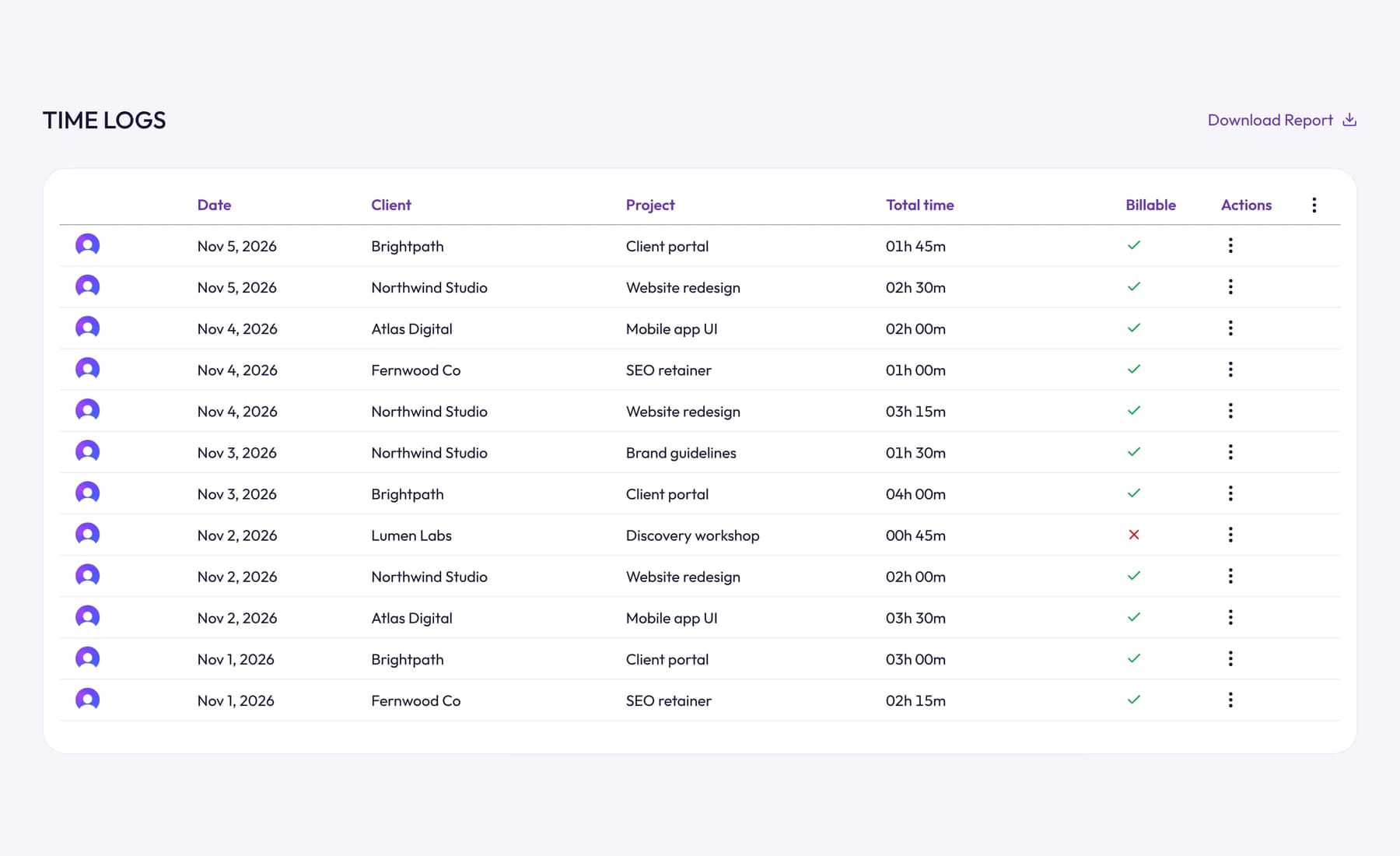
See how the reports work on our time reporting software page.
Frequently asked questions
How narrow should a freelance niche be?
Narrow enough that the right client recognizes themselves, broad enough that you can list at least 100 potential clients. Combining a service with an industry or audience usually hits that balance.
Can I have more than one niche?
Yes, but lead with one per channel. A separate portfolio page or profile for a second niche works; one homepage claiming three specialties reads like a generalist's.
Will I earn less while I switch?
Possibly for a few months, which is why you keep current clients and test with a few hours a week rather than turning work away. Set the 60-day success criteria before you start so you know when to commit.
Wrap up
Choose a niche from evidence: group your past clients, compare effective hourly rates, days to pay and referrals, then score two to four candidates and test the winner for 60 days. Shift your marketing before your client list, and hold off if you don't have enough projects to learn from yet.
To see what each client and project really earns you per hour, try Tristiks Grow free for 14 days.
Category: Freelancing
Suraj Rao
Suraj Rao is the founder of Tristiks, the team behind Tristiks Grow and its desktop time tracker OneTrack. He writes about time tracking, client work and getting paid, and about DevOps, cloud and AI from years of building software.