Which Clients Actually Make You Money?
 By Suraj Rao10 min read
What You'll Learn
- Your biggest client by revenue is often not your most profitable one; client profitability is revenue minus the cost of every hour and expense that client took.
- Meetings, revisions, email and reporting are where client profit disappears, so track them against the client even when you don't bill them.
- Score each client on margin and on the things money doesn't show, then reprice, re-scope, change terms or let go of the ones at the bottom.

Every agency has a client everyone loves to mention: the big logo, the biggest invoice, the account that pays the rent. It's often not the client that makes the most money. Revenue tells you what a client pays. Profit tells you what's left after the hours they take.
The difference is usually hidden time: the weekly call that runs long, the fourth round of revisions, the Slack thread that eats an afternoon. None of it shows on the invoice, and all of it costs you.
This post covers how to calculate profit and effective rate per client, where the hidden hours go and how to capture them, a worked example for a small agency, a client scorecard you can copy, and what to do with the clients at the bottom of the list.
Why revenue per client is the wrong ranking
Ranking clients by revenue answers "who pays us most?" It doesn't answer "who is worth our time?"
A $90,000-a-year retainer that takes 1,200 hours earns $75 an hour. A $30,000 client that takes 250 hours earns $120 an hour. The second client is smaller and better. If you're choosing where to put your best designer, or which client to push on price, you want the second ranking, not the first.
Revenue also hides how a client behaves. Two clients can pay the same fee while one sends a clear brief and approves first drafts, and the other needs three calls a week. Profitability is where that behavior shows up in numbers.
How to calculate client profitability
Client profitability uses the same formula as project profitability, added up across everything you do for one client over a period:
Client profit = client revenue − labor cost − unrecovered expenses
Client margin = client profit ÷ client revenue × 100- Client revenue is what you invoiced the client for the period, excluding pass-through costs billed at cost.
- Labor cost is every hour anyone spent on the client, multiplied by each person's cost rate. Include unbilled hours: they cost the same.
- Unrecovered expenses are costs for that client that you didn't bill back.
Effective rate per client
The quicker version, especially for freelancers, is the effective rate:
Effective rate = (client revenue − unrecovered expenses) ÷ total hours on that clientCompare it with your target rate. Our guide to effective hourly rate explains the formula in full. Margin is better for an agency because people's hours cost different amounts; effective rate is simpler when it's just you.
Pick a period that's long enough
One month is noisy: a project launch or a quiet August can swing it. Use a quarter, or the last six months for clients you only see occasionally.
Where the hidden time goes
Hidden time is work for a client that's real, takes hours and rarely appears in the quote. These are the usual places it goes:
| Hidden work | Why it's missed | How to capture it |
|---|---|---|
| Status calls and meetings | Feels like "relationship", not work | Track every call against the client, including prep |
| Revisions beyond the agreed rounds | Done quietly to keep the client happy | Track revisions as their own task |
| Email, Slack and quick questions | Each one is "only five minutes" | A running "client comms" task per client |
| Reporting and monthly updates | Not part of the deliverable | A "reporting" task on the retainer |
| Account management and internal coordination | Spread across several people | Each person tracks it against the client |
| Onboarding, access and setup | Happens before the "real" work | A setup task on the first project |
| Chasing approvals and invoices | Admin, so nobody logs it | Track it as non-billable client time |
The fix is the same for all of them: track the time against the client even when you won't bill it, and mark it non-billable. Your billable totals stay accurate, and your client profit becomes honest. Our guide to billable vs non-billable hours covers which of these to charge for.
A worked example: four clients over one quarter
Here's a hypothetical five-person agency, using a blended cost rate of $45 an hour across the team to keep the arithmetic simple. In practice, use each person's own cost rate.
| Client | Model | Revenue | Hours | Labor cost | Unrecovered expenses | Profit | Margin | Effective rate |
|---|---|---|---|---|---|---|---|---|
| A | Retainer, $7,500/month | $22,500 | 310 | $13,950 | $0 | $8,550 | 38.0% | $72.58 |
| B | Hourly, $120/hour | $18,000 | 165 | $7,425 | $0 | $10,575 | 58.8% | $109.09 |
| C | Two fixed-price projects | $12,000 | 190 | $8,550 | $300 | $3,150 | 26.3% | $61.58 |
| D | Retainer, $2,000/month | $6,000 | 60 | $2,700 | $0 | $3,300 | 55.0% | $100.00 |
| Total | $58,500 | 725 | $32,625 | $300 | $25,575 | 43.7% | $80.28 |
Client B billed 150 hours; the other 15 were unbilled calls and invoicing.
What the table shows
- The biggest client is in the middle. Client A brings in 38% of revenue at a 38% margin. It pays the rent, but each hour on it earns $72.58, well below Client B or D.
- The smallest client is one of the best. Client D pays a quarter of what A pays, at a much higher margin.
- Client C is the problem. Two fixed-price projects at a 26.3% margin. Every hour spent there could have earned more almost anywhere else.
Where Client A's hours went
Breaking down the 310 hours shows why the retainer underperforms:
| Work | Hours |
|---|---|
| Agreed deliverables | 220 |
| Status calls and meetings | 38 |
| Extra revision rounds | 27 |
| Email and Slack | 15 |
| Monthly reporting | 10 |
| Total | 310 |
That's 90 hours, or 29% of the time, that the retainer was never priced for. If the agency had held the account to 220 hours, its margin would have been ($22,500 − 220 × $45) ÷ $22,500 = ($22,500 − $9,900) ÷ $22,500 = 56.0%. The client isn't bad. The retainer is under-scoped.
A client scorecard
Margin is the most important number, but not the only one. A low-margin client might bring referrals, a logo that wins pitches or a team your people enjoy working with. A scorecard puts the money and the rest side by side.
Score each client from 1 (poor) to 5 (excellent) on each line, multiply by the weight, and add up. Change the weights to suit your agency.
CLIENT SCORECARD                  Client: ______________  Period: ______

Factor                            Weight   Score (1–5)   Weighted
Margin vs target                   x3       ___           ___
Effective rate vs target rate      x2       ___           ___
Pays on time                       x2       ___           ___
Scope stays stable                 x2       ___           ___
Hidden time (calls, revisions)     x1       ___           ___
Strategic fit (work we want more of) x1     ___           ___
Referrals and portfolio value      x1       ___           ___
Team wants to work with them       x1       ___           ___

Total (max 65)                                           ___
Action: keep / grow / reprice / re-scope / change terms / exit
For Client C in the example, a filled-in scorecard might read: margin 1, effective rate 1, pays on time 4, scope stable 2, hidden time 2, strategic fit 3, referrals 3, team 3. That's 3 + 2 + 8 + 4 + 2 + 3 + 3 + 3 = 28 out of 65. The money is poor, the client pays reliably, and the scope keeps moving. That points at re-scoping and repricing before anything drastic.
Run the scorecard once a quarter for every active client, and keep the old ones. A client whose score falls three quarters running is telling you something.
What to do with low-margin clients
You have more options than "keep" or "fire". Work through them roughly in this order.
1. Reprice
If the client is good to work with but the price is too low, raise it. Use the hours data: "Last quarter this account took 310 hours against the 220 we priced." Our guide on how to raise your rates has scripts and timing.
2. Re-scope
Bring the work back to what the fee covers. Cap revision rounds, write down what the retainer includes and turn extras into change requests. Our guide to scope creep has the wording.
3. Cut the hidden time
Move a weekly call to fortnightly, send a written update instead, or name one contact on each side. Our guide to setting client boundaries covers response times, channels and revision limits.
4. Change the terms
For fixed-price work that keeps overrunning, switch to hourly or a retainer with an hours cap. For a slow payer, ask for a deposit and shorter payment terms. See how much deposit to ask for.
5. Change who does the work
If senior people do work a junior person could do, the cost of each hour falls and the margin rises, with no change for the client.
6. Keep it on purpose, with a deadline
Sometimes a low-margin client is worth keeping for a portfolio piece or a door into an industry. Fine, but write down why, and set a date to review it. "Strategic" shouldn't mean "forever".
7. Let go
If nothing else works, end it politely and hand over well. Our guide on how to fire a client covers notice, the final invoice and scripts.
A repricing script
Hi [Name],

We've just reviewed the last quarter of work on [account]. We're proud of
[result], and we want to keep doing great work for you.

Over the quarter the account took [310] hours against the [220] the
retainer is built on, mostly in extra revision rounds and meetings. To keep
the same level of service, from [date] the retainer will be [$new amount] a
month for up to [hours] hours. Alternatively, we can keep the current fee
and limit revisions to two rounds and calls to every other week.

Happy to talk through either option this week.

[Your name]
Offering a choice between more money and less work makes it a conversation, not an ultimatum.
Tracking client profitability in Tristiks Grow
In Tristiks Grow, time is tracked against a client, project and task, from the desktop app, the web timer or a manual entry, and each entry is marked billable or non-billable. That means the calls, revisions and email you'll never bill can still sit on the client's timesheet. Tristiks Grow tracks the hours per client and project next to what you bill them, and each client's profile shows what they've paid and what's still unpaid this year, with every invoice and its status.
You save each client's hourly rate, currency, tax rate and payment terms on their profile, and a PDF time report uses that rate to show what your hours earned. Payment reminders can email clients 3 days before the due date, on the day, and 7, 14 and 30 days after, so slow payers cost less of your time.
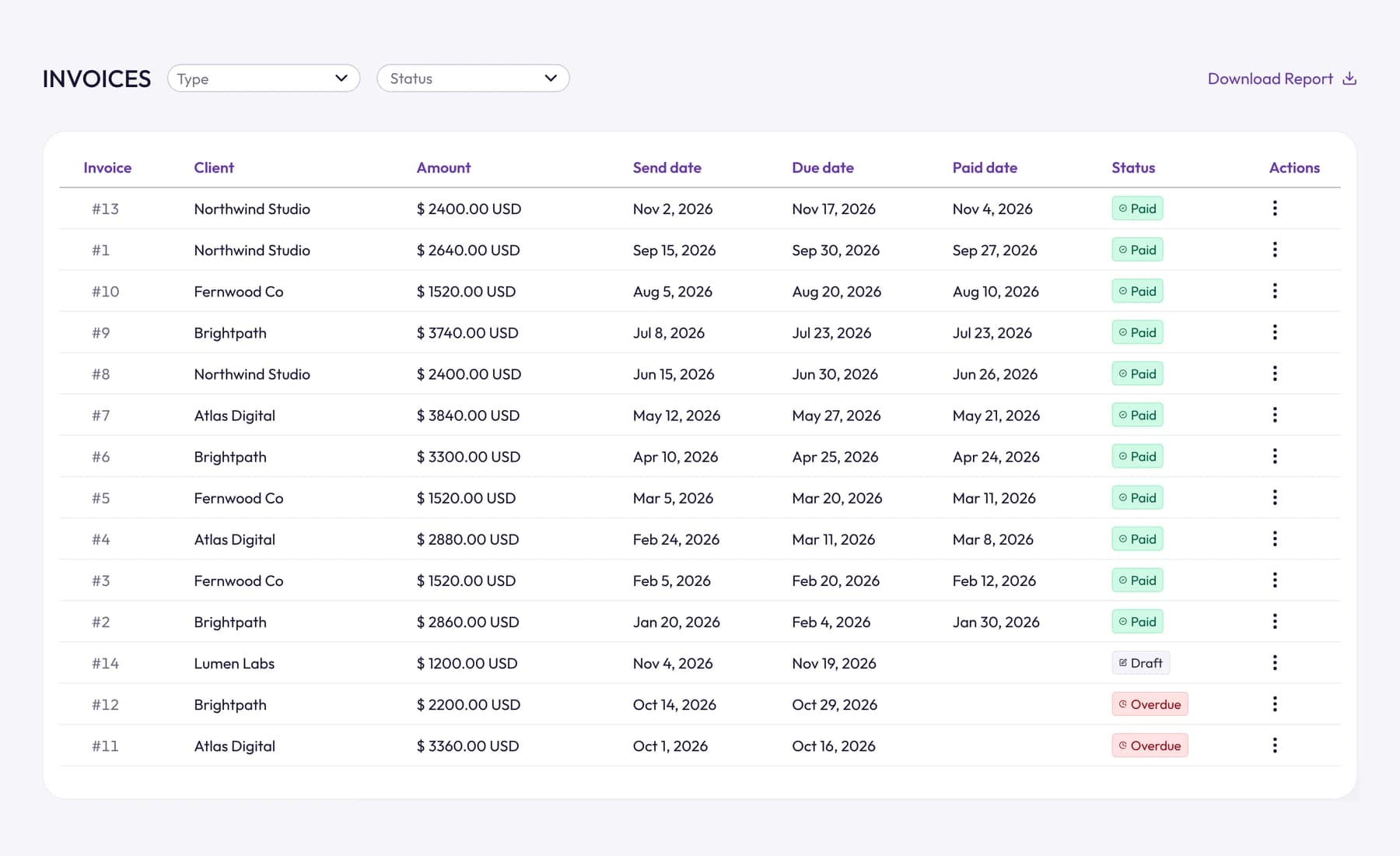
Tristiks Grow doesn't store cost rates or produce a profitability report. For margin per client, download the time log as a CSV, with each entry's teammate, date, client, project, task, length, billable status and invoice, plus the invoices and expenses CSVs. Add each person's cost rate in a spreadsheet and the table above takes a few minutes.
Frequently asked questions
How often should I review client profitability?
Quarterly works for most small agencies and freelancers. It's long enough to smooth out one busy or quiet month, and short enough to act before a bad client costs you a year. Check sooner if a fixed-price project starts running well over its estimate.
Should non-billable time count against a client?
Yes. If the time was spent because of that client, it's part of what the client costs you, whether you bill it or not. Leaving it out is how retainers end up looking profitable when they aren't.
What margin should a client have?
Set a target from your own numbers: high enough that, across all clients, you cover the team, overheads and profit. A client well below your average is worth a closer look, even if it's still positive. Our post on agency KPIs covers margin targets and benchmarks.
Is it risky to depend on one big client?
Yes, even a profitable one. If one client is a large share of revenue, losing them hurts cash flow and staffing at once. Track that share as its own number and grow other accounts before you need to.
Wrap up
The client you'd name as your best is often not the one that makes you the most. Track every hour against the client, billable or not, work out margin and effective rate each quarter, and use a scorecard to decide what to do about the ones at the bottom.
To keep every client's hours, rates and invoices in one place, try Tristiks Grow client management free for 14 days.
Category: Productivity
Suraj Rao
Suraj Rao is the founder of Tristiks, the team behind Tristiks Grow and its desktop time tracker OneTrack. He writes about time tracking, client work and getting paid, and about DevOps, cloud and AI from years of building software.