How to Charge Different Rates for Different Clients
 By Suraj Rao11 min read
What You'll Learn
- Charging clients different rates is normal and fair when the difference comes from the work: its type, urgency, timing, volume, risk or the length of the relationship.
- Rush and out-of-hours rates work best as a written surcharge on top of the base rate, agreed before the work starts and shown as its own line on the invoice.
- A simple rate register (one row per client with base rate, currency, surcharges, discounts and a review date) stops you billing the wrong rate.

Most freelancers and small agencies end up with more than one rate. The client who's been with you for four years pays less than the one who signed last month. The weekend launch costs more than the Tuesday task. The large company pays more than the local nonprofit.
That's normal. Professionals in most fields price work differently depending on what it involves, and clients rarely object when the reason is clear. The problems come from two places: rates that differ for no reason you could explain, and rates you can't keep track of, so the wrong one ends up on an invoice.
This guide covers when charging different rates is fair, the common reasons rates differ and by how much, grandfathering existing clients, rush and weekend rates with wording to copy, discounts that don't wear down your base rate, and a simple system for keeping every client's rate straight.
Is it fair to charge clients different rates?
Yes, when the difference comes from the work or the terms, not from who you think will pay without noticing. A useful test: could you explain the difference to both clients in one sentence, without embarrassment?
| Fair reasons | Shaky reasons |
|---|---|
| The work needs a specialist skill | "They looked like they had money" |
| The deadline forces you to move other work | "They didn't negotiate" |
| The work happens at night or on a weekend | Charging more after the scope is agreed because they need you |
| The client commits to a volume or a retainer | Different rates for the same work, with no difference in terms |
| Longer payment terms or a higher payment risk | Anything tied to personal characteristics |
| A rate agreed years ago, phased up on a schedule |
The last item on the right matters legally as well as ethically. In many places, pricing that discriminates by protected characteristics such as race, sex or religion can be unlawful. This is general information, not legal advice; check with a lawyer where you work if you're unsure.
There's also a contract point. Some larger clients' contracts include a clause promising them prices at least as good as any other customer's for the same service. If you sign one, your rate for that service with every other client becomes part of the deal. Read the payment section before you sign.
Common reasons rates differ
Here are the differences most freelancers and agencies use, with how they usually show up.
| Reason | How it usually works | How to explain it |
|---|---|---|
| Type of work | A higher rate for specialist work (strategy, audits) than for production | "Strategy work is billed at my senior rate." |
| Urgency | A rush surcharge on top of the base rate | "Starting within 48 hours means moving other work, so rush jobs carry a surcharge." |
| Timing | A multiplier for nights, weekends and holidays | "Work outside business hours at your request is billed at 1.5×." |
| Volume or commitment | A lower effective rate for a retainer or a block of prepaid hours | "Retainer hours are discounted because they're committed in advance." |
| Payment terms | A higher rate, or no discount, for long terms | "My standard rate assumes net 15. For net 60, the rate is 5% higher." |
| Currency and market | A rate set in the client's currency | "Your rate is set in euros, so you're not exposed to exchange rates." |
| History | An older client still on a lower rate, with an end date | "Your current rate stays until 30 June, then moves to the standard rate." |
| Cause | A discount for nonprofits or community work | "Registered nonprofits receive 15% off my standard rate." |
Notice what's missing: discounts for the client who simply asked. A discount with a reason (commitment, prepayment, a nonprofit policy) is a pricing decision. A discount without one is a precedent.
Payment terms are worth a closer look. A client on net 60 is effectively borrowing your money for two months, and our guide to net 30 payment terms explains why that matters for cash flow. Pricing longer terms into the rate is fair and common.
Grandfathering existing clients
Grandfathering means letting an existing client keep an older, lower rate after you've raised your rate for new clients. It's a reasonable thank-you to a client who pays on time and sends referrals, and it avoids losing a good client to a sudden jump.
Two rules keep it from becoming a problem:
- Always set an end date. "Your rate stays at $75 until 30 June, then moves to $90" is a gift with a plan. A grandfathered rate with no end date is a slow pay cut, because your costs keep rising and theirs don't.
- Write it down where you bill from. The most common grandfathering mistake isn't the price. It's forgetting the end date and billing the old rate for another year.
For how much notice to give and phased increases with email templates, see our guide on how to raise your rates.
Rush rates and weekend rates
Rush and out-of-hours work are where freelancers give away the most money, usually because the client asks nicely and it seems awkward to mention a surcharge.
How much to charge
There's no industry standard. As one example, freelancermap's guide to rush fees suggests 25% of the project cost as a benchmark and says rush fees can range from 25% to 300% depending on urgency. Treat that as advice from one source, not a market rate. Pick numbers you'd be glad to be paid, and define the trigger clearly.
A simple structure:
| Type | Trigger | Surcharge |
|---|---|---|
| Rush | Start within 2 working days, or a deadline half the normal time | +25% |
| Same-day | Delivered the same working day | +50% |
| Out of hours | Work before 8 a.m., after 7 p.m. or on weekends, at the client's request | 1.5× the base rate |
| Public holidays | Work on a public holiday, at the client's request | 2× the base rate |
The phrase "at the client's request" matters. If you choose to work on Sunday because it suits you, that's not the client's cost.
Worked example
Your base rate is $80 an hour. A client asks for a 12-hour job, starting tomorrow, and 4 of those hours will be on Saturday.
- Weekday hours: 8 × $80 = $640.
- Saturday hours at 1.5×: 4 × $120 = $480.
- Base for the job: $640 + $480 = $1,120.
- Rush surcharge at 25% on the weekday hours: $640 × 0.25 = $160.
Total: $1,280. Decide in advance whether surcharges stack. Here the weekend multiplier already covers the Saturday hours, so the rush surcharge applies only to the weekday hours. Whatever you choose, write it down so it's the same every time.
On the invoice, show the surcharge as its own line rather than hiding it in a higher rate:
| Description | Hours | Rate | Amount |
|---|---|---|---|
| Landing page fixes, Thu to Fri | 8.00 | $80.00 | $640.00 |
| Landing page fixes, Saturday (1.5×) | 4.00 | $120.00 | $480.00 |
| Rush surcharge, 25% of weekday work | $160.00 | ||
| Total | 12.00 | $1,280.00 |
Wording for your contract or proposal
Rush and out-of-hours work
Work that must start within 2 working days of the request is billed at
the standard rate plus 25%. Work requested for evenings (after 7 p.m.),
weekends or public holidays is billed at 1.5 times the standard rate
(2 times on public holidays). Rush and out-of-hours rates are confirmed
in writing before the work starts.
Wording when the request arrives
"Happy to help with this. To start tomorrow I'll need to move another project, so it would be billed at my rush rate, which is the standard rate plus 25%. The Saturday hours would be at 1.5×. That brings the estimate to about $1,280. If Monday works instead, it's $960 at the standard rate. Which would you prefer?"
Always offer the non-rush option. Many "urgent" requests turn out to be fine on Monday once there's a price attached.
Discounts that don't wear down your base rate
When you do discount, protect your base rate. A client who pays $68 an hour remembers $68. A client who pays $80 an hour with a 15% nonprofit discount remembers $80, and the discount can be changed or removed later without a rate negotiation.
Three ways to do it:
- Show the discount as a separate line. "20 hours at $80 = $1,600; nonprofit discount 15% = −$240; total $1,360."
- Discount for commitment, not for asking. A lower effective rate for a 3-month retainer or 40 prepaid hours gives the client something real in exchange.
- Add value instead of cutting price. An extra revision round or a short training session often costs you less than a 10% discount.
How to keep track of every rate without mistakes
Different rates only cause trouble when you lose track of them. The fix is one place that holds every client's terms, checked before every invoice.
A simple rate register
Keep one row per client. A spreadsheet works; so does the client record in your billing tool, as long as everything is in one place.
Client       | Base rate | Currency | Rush | Out of hours | Discount       | Terms  | Effective from | Review / end date
Acme Ltd     | 90/hr     | USD      | +25% | 1.5x         | none           | Net 30 | 1 Jan 2027     | 31 Dec 2027
Green Trust  | 80/hr     | USD      | +25% | 1.5x         | 15% nonprofit  | Net 15 | 1 Jan 2027     | 31 Dec 2027
Nordlicht    | 85/hr     | EUR      | +25% | 1.5x         | none           | Net 30 | 1 Mar 2026     | 28 Feb 2027
Old Client   | 75/hr     | USD      | +25% | 1.5x         | grandfathered  | Net 15 | 1 Jan 2026     | 30 Jun 2027 -> 90/hr
The last column does the most work. It's where the grandfathered rate ends and the yearly review happens.
Before every invoice
- Check the client's row: base rate, currency, any discount, any end date that has passed.
- Check whether any hours were rush or out of hours, and that the client agreed in writing.
- Bill surcharges and discounts as their own lines.
- Invoice in the currency you agreed. Our guide on invoicing international clients covers which currency to choose.
The mistakes this prevents
- Billing the old rate for months after a rate increase.
- Billing the new rate to a client who was promised the old one until June.
- Forgetting a rush surcharge the client already agreed to.
- Applying a discount twice: once in the rate, once as a line.
- Invoicing a euro client in dollars.
It's also worth comparing what each client really pays per hour of your time, once revisions, calls and email are counted. A client on a high rate who takes twice the hours can be worth less than one on a lower rate. Our guides to effective hourly rate and client profitability show how to work it out.
Keeping client rates in Tristiks Grow
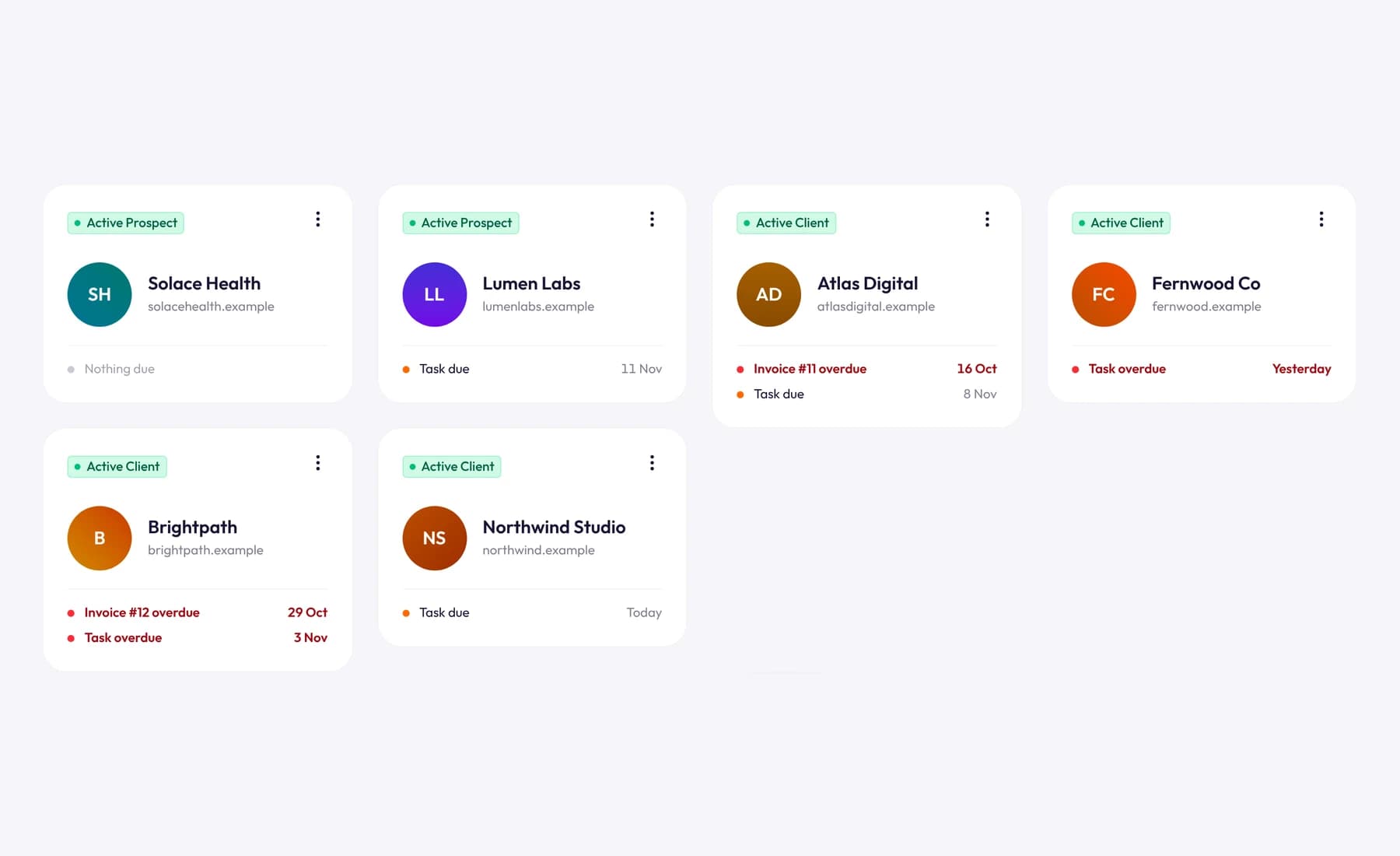
Tristiks Grow keeps the per-client part of your rate register on each client's profile:
- Billing details per client. Save each client's hourly rate, currency, tax rate and payment terms on their client profile, so they're in one place when you bill them.
- Earnings at each client's rate. Time reports price your tracked hours at each client's hourly rate and currency, so you see what the hours earned before you invoice.
- Invoices in the client's currency. With Tristiks Grow invoicing, build an invoice from the client's tracked hours and expenses, in their currency. When you add hours, you set the rate for them, so a rush or out-of-hours rate goes on that line. Hours already invoiced are locked, so they can't be billed twice.
- Client rates kept private. When a collaborator downloads their own time report, the earnings are left out, so they don't see what each client pays.
Tristiks Grow doesn't apply rush or weekend multipliers for you, and it doesn't track grandfathering end dates. Keep those in your rate register, and add a note in the invoice message when a surcharge applies.
Frequently asked questions
What if a client finds out another client pays less?
Explain the reason in one sentence: a longer relationship, a retainer commitment, a nonprofit policy or different work. If there's no reason you can say out loud, that's a sign the lower rate should change at the next review, not that the higher one should drop.
Should I charge new clients more than existing ones?
Most freelancers raise rates for new clients first, because there's no existing agreement to change. Existing clients usually move to the new rate after notice, sometimes in phases, with a clear date for each step.
Is it unprofessional to charge a rush fee?
No. It's a standard term in many service businesses, and it pays for moving other work. Put it in your contract, confirm it in writing before you start, and always offer a non-rush deadline as an alternative.
How many different rates is too many?
When you can't remember them, and you will soon. Keep one base rate per client, a short, consistent list of surcharges that applies to everyone, and write every exception in your rate register with an end date.
Wrap up
Different rates for different clients are fair when the reason is the work, the timing or the terms, and you could explain it to either client. Agree surcharges before the work starts, show them as their own lines, give every grandfathered rate an end date, and keep it all in one register you check before each invoice.
To keep each client's rate, currency and payment terms on their profile and see what your hours earned at each rate, try Tristiks Grow client management free for 14 days.
Category: Payments
Suraj Rao
Suraj Rao is the founder of Tristiks, the team behind Tristiks Grow and its desktop time tracker OneTrack. He writes about time tracking, client work and getting paid, and about DevOps, cloud and AI from years of building software.