Freelancer to Agency: Signs You're Ready and the Math
 By Suraj Rao11 min read
What You'll Learn
- You're ready when your own data says so: months of billable hours above your target, work turned away, rates already raised, and a cash buffer that covers a few lean months.
- Start with subcontractors unless the work is steady enough to keep an employee at least half billable. An employee costs more than their salary, and you pay for idle hours too.
- Your job changes from doing the work to selling, managing and checking it, so price for a team (role or blended rates), write processes down first and get worker classification right.

You're ready to go from freelancer to agency when your own numbers show more demand than you can deliver, not just a wish for more income: three or more months of billable hours above your target, good work turned away, rates already raised, and enough cash to carry a hire through a slow month. Most freelancers should start with subcontractors, move to an employee once the work is steady, and price for a team rather than for themselves. If your problem is income rather than capacity, raise your rates first.
Below: the signs to check in your data, three ways to grow, worked first-hire math, how your role and pricing change, US and UK legal basics, and when staying solo is the better business.
Signs you're ready, from your own data
Your time log and invoices say whether you're busy enough, for long enough, with work someone else could do. Pull the last six months and check these:
| Signal | Where to find it | Ready when |
|---|---|---|
| Billable hours | Time log, by week | Above your target (say 30 a week) for 3+ months in a row |
| Work turned away | Your inbox and notes | You've declined or delayed paying work you wanted |
| Effective rate | Revenue ÷ hours per client | Healthy on most clients, so you're not just busy with underpriced work |
| Repeatable work | Time by task type | A large share of hours is on tasks you could brief someone else to do |
| Client concentration | Revenue by client | No single client is more than about a third of revenue |
| Cash buffer | Bank balance vs monthly costs | You could pay a helper for 2 to 3 months if a client paid late |
Two of these trip people up. If you're full because fixed-price work runs over, your effective hourly rate will show it, and hiring only adds cost to a pricing problem. And the work has to be repeatable: Everhour's freelancer-to-agency guide and Shopify's advice for partners growing a team both stress defined services and documented processes before more people.
A worked check:
Last 6 months (26 weeks)
Billable hours:         884   → 34 a week, against a 30-hour target
Weeks over 30 hours:    21 of 26
Leads declined:         4, worth about $28,000
Revenue:                $106,080 at an average $120 an hour
Largest client:         $31,000 (29% of revenue)
Hours on repeatable work (builds, edits, reporting): 52%

Verdict: ready. Half the hours could be briefed out and $28,000 went elsewhere.
If most of your hours are strategy and calls only you can do, raise your rates instead.
The three models
"Agency" can mean three quite different businesses:
| Model | How it works | Fixed costs | Control over quality | Admin |
|---|---|---|---|---|
| Solo with subcontractors | You sell and manage; freelancers deliver parts of the work and invoice you | Low: you pay only for hours used | Medium | Low |
| Collective | Independent freelancers share a brand, leads or clients; each runs their own business | Very low | Low to medium | Low, but needs agreed rules |
| Small agency with employees | You hire staff on payroll and own the delivery process | High: salaries are paid whether work comes in or not | High | High |
Subcontractors let you test whether you like managing people without committing to a salary; see hiring your first subcontractor. A collective suits peers with complementary skills who want bigger projects without anyone becoming a boss; agree in writing who owns each client and who invoices. Employees make sense when the work is steady, and they turn variable costs into fixed ones, which is the biggest change of all.
The money math of your first hire
The question isn't "can I afford their pay?" but "will their billable hours cover their full cost with margin to spare?"
Step 1: the full cost of an employee
Salary is only part of what an employee costs. In June 2026, wages and salaries were 70.0% of total employer compensation costs for US private industry workers, with benefits making up the rest, according to the Bureau of Labor Statistics. It's an average, but a sensible first estimate: total cost is roughly salary ÷ 0.70.
Step 2: billable hours, not paid hours
You pay for every working hour but bill only some. Published targets for individual contributors are about 70% to 85% utilization (Teamwork); a new hire with lumpy demand will often sit lower. See our agency utilization rate guide.
Worked example: employee vs subcontractor
EMPLOYEE (designer)
Salary:                          $65,000
Total cost (÷ 0.70):             $92,857
Available hours:                 1,920  (48 weeks × 40)
Billed to clients at:            $120 an hour

At 70% utilization:  1,344 billable hours
  Revenue:            1,344 × $120 = $161,280
  Gross profit:       $161,280 − $92,857 = $68,423  (42.4% margin)
  Cost per billable hour: $92,857 ÷ 1,344 = $69.09

At 50% utilization:  960 billable hours
  Revenue:            960 × $120 = $115,200
  Gross profit:       $22,343  (19.4% margin)
  Cost per billable hour: $96.73

Break-even utilization: $92,857 ÷ ($120 × 1,920) = 40.3%

SUBCONTRACTOR (same work)
Rate:                $70 an hour, paid only for hours worked
1,000 hours billed:  revenue $120,000, cost $70,000, profit $50,000 (41.7%)
  500 hours billed:  revenue  $60,000, cost $35,000, profit $25,000 (41.7%)
The subcontractor's margin holds when work dries up. The employee only wins if you keep them well above 50% billable, month after month.
Step 3: count your own time
Briefing and reviewing take your time. Say 6 hours a week, about 288 hours a year. At your $150 rate, that's $43,200 you could have billed, so the 70% example's $68,423 gross profit is worth about $25,200 to you in year one, before recruiting and equipment. It improves as they need less supervision.
Agency finance consultancy Parakeeto suggests aiming for a delivery margin over 50% across the business. That's one firm's benchmark, but a useful check: at $120 an hour and 70% utilization, the $65,000 hire falls short. Our guide to agency KPIs explains delivery margin.
What changes in your role
You stop being paid mainly for doing the work and start being paid for selling it, organizing it and checking it.
| Area | As a freelancer | As an agency owner |
|---|---|---|
| Sales | Fit it in when the pipeline is empty | A steady weekly job: the team needs work every week |
| Delivery | You do it | You plan it, brief it and unblock people |
| Quality | You check your own work | You review others' work against a written standard |
| Client contact | You're the only contact | You decide who talks to the client, and when |
| Money | Invoice, chase, pay yourself | Plus payroll or contractor payments, margins and cash flow |
Your billable hours will fall. Teamwork puts typical utilization for managers and directors at about 40% to 60%. A freelancer's week might change like this:
Before (solo):        32 billable, 8 admin
After (first hire):   18 billable, 8 sales, 8 managing and review, 6 admin
Budget for that dip, or the first six months feel like a pay cut. Capacity planning for agencies shows how to set a non-billable allowance per role.
Processes to set up first
Write down how you work before anyone joins. The founder of Arch Web Design, interviewed by Webflow about growing to a 14-person team, advises not growing fast until the processes are in place. Set these up first:
- A scope document for every project: a short statement of work with deliverables, exclusions and acceptance criteria.
- A brief template for handing work over. Our subcontractor guide has one to copy.
- A QA checklist per type of deliverable, so "good" doesn't live only in your head (example below).
- Time tracking on every project from day one, by client, project and task, for everyone.
- A client communication rule: who answers which questions, and how fast.
- A weekly 30-minute review of hours, deadlines and next week's capacity.
QA checklist: [deliverable type]

Brief:     Every item in the brief is done, nothing extra added
Accuracy:  Names, numbers, links and dates checked
Standard:  Matches the brand guide and our house style
Function:  Tested where it will be used (browsers, devices, platforms)
Hours:     Time logged against the right task, overruns explained
Sign-off:  Reviewed by [owner] before the client sees it
How your pricing changes
As an agency, your price has to cover other people's cost, your management time and a margin. Three changes usually follow.
From your rate to role or blended rates. If you bill your hours at $150 and your designer's at $110, a project that's 40% your time and 60% theirs has a blended rate of (0.4 × $150) + (0.6 × $110) = $126 an hour. Check the real mix with tracked time afterwards. See how to build an agency rate card.
From hours to packages. Fixed-scope offers are easier to delegate because the scope is already written. See productized services and retainers vs fixed-price projects.
No discount for "it's not me doing it". The client pays for the result and your oversight. If your rate can't absorb a team member's cost at a healthy margin, raise it before you hire.
Legal and admin basics
This is general information, not legal or tax advice. Rules differ by country and US state, so check with an accountant or employment lawyer.
Contractor or employee? The label in your contract doesn't decide it; the working relationship does.
- US: The IRS looks at behavioral control, financial control and the relationship of the parties, explained in its guide to independent contractors vs employees. The Department of Labor proposed a new independent contractor rule for wage law in February 2026, so check its status, and some states are stricter.
- UK: GOV.UK explains the difference between employees and the self-employed and contractors, and HMRC's Check Employment Status for Tax tool gives its view for tax purposes.
- Elsewhere: Most countries have their own test. A contractor who works only for you, on your schedule, with your tools, is a warning sign almost everywhere.
If you hire an employee:
- US: The IRS hiring employees page covers Form I-9, Form W-4 and payroll tax withholding; your state adds its own registrations.
- UK: GOV.UK's guide to employing someone for the first time covers right-to-work checks, insurance, registering with HMRC, payroll and pensions.
Either way: use a written agreement covering scope, payment, confidentiality and who owns the work, and check your client contracts allow subcontracting. See what a freelance contract should include.
Risks, and when to stay solo
Growing adds risks a solo freelancer doesn't carry:
- Fixed costs meet lumpy demand. One lost client can turn a month into a loss when you have salaries to pay.
- You pay before you're paid. Your team expects pay on time even when clients pay late; see freelance cash flow.
- Quality slips quietly. Clients hired you; they notice when the work changes.
- You may not enjoy it. Managing and selling is a different job from your craft.
Staying solo is a normal choice, not a failure. About 78% of US business establishments had no paid employees in 2023, according to the US Census Bureau. Stay solo, or stay at one or two trusted subcontractors, if:
- your income goal is reachable by raising rates or dropping your least profitable clients;
- most of your hours are the expert work clients specifically hire you for;
- you'd rather do the work than manage it;
- your pipeline is full for now but has been patchy over the past year.
How Tristiks Grow helps
Tristiks Grow gives you the numbers behind the decision as you add people:
- Time tracking for you and the team with the desktop app or web timer, by client, project and task, each entry marked billable or not: the data behind the readiness check and utilization math.
- Reports by client and project, with client rates showing what the hours earned, so you can compare cost and revenue per client.
- Tasks with subtasks you can assign, with comments and time tracked per task.
- Invoices built from tracked hours and billable expenses.
- Flat pricing, not per seat: Professional is $19 a month for up to 3 seats and Advanced is $39 a month for up to 10, as of November 2026. Our comparison of per-seat vs flat pricing shows what that means as a team grows.
It doesn't run payroll or bookkeeping, so you'll still need a payroll provider and an accountant once you employ people.
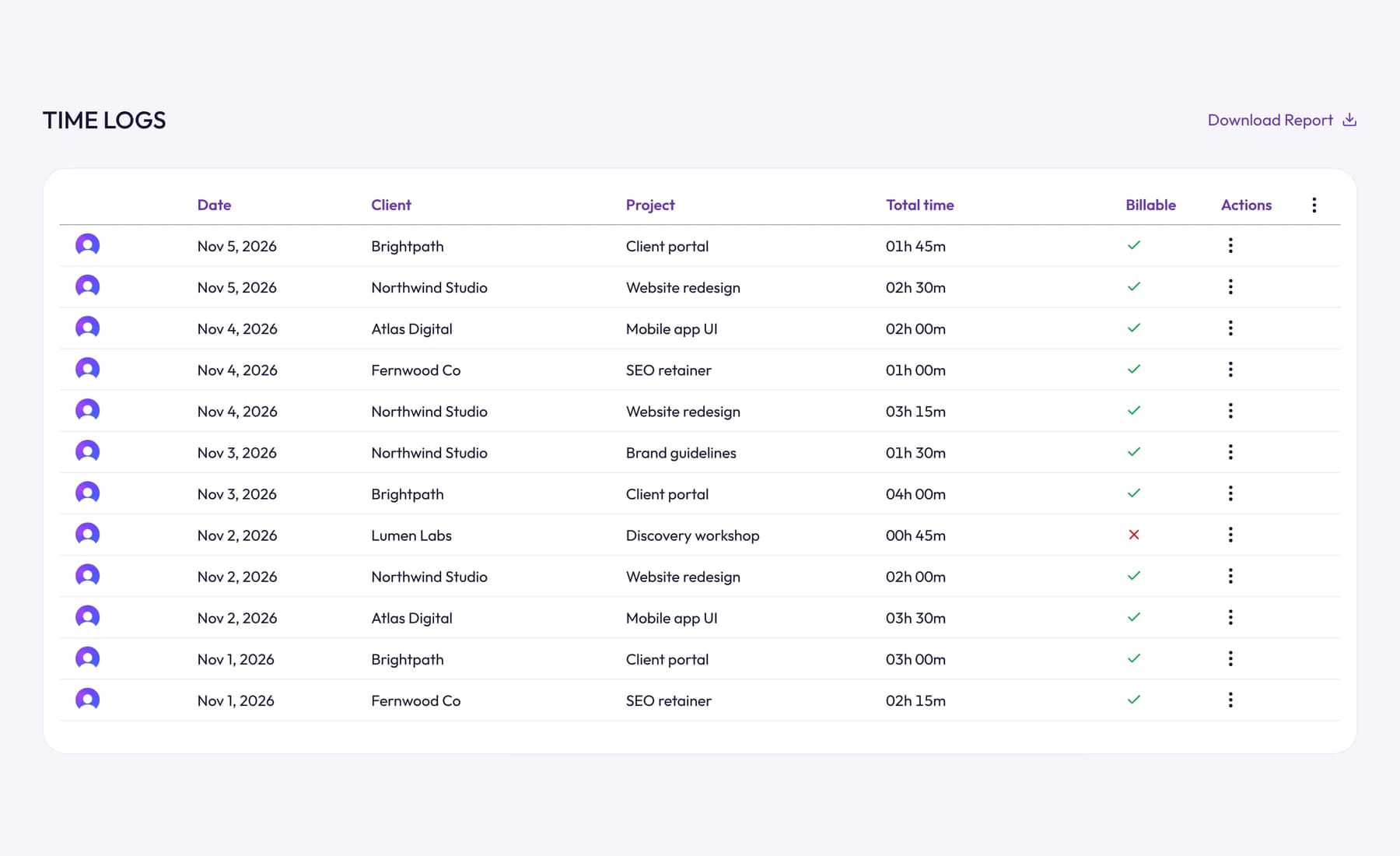
See how it works for teams on our time tracking for agencies page.
Frequently asked questions
How much revenue do I need before hiring?
There's no single number. The work you hand over must cover the person's full cost with margin, and you need a buffer for two to three months of their pay. Run the worked example with your own rates.
Should my first hire be a subcontractor or an employee?
Usually a subcontractor: you pay only for hours worked and your margin holds when work slows. Move to an employee when the work can keep them comfortably above 50% billable.
Do I need to tell clients someone else is working on their project?
Check your contract, since some forbid subcontracting without consent. Even when it's allowed, being open builds trust; clients mostly care that quality and their point of contact stay the same.
Wrap up
Go from freelancer to agency when your time and revenue data show steady, repeatable demand you can't meet, not just a wish to earn more. Start with subcontractors, do the full-cost and utilization math before hiring an employee, write your processes down, price for a team and get classification right.
To track your own and your team's hours by client and project from the start, try Tristiks Grow free for 14 days.
Category: Freelancing
Suraj Rao
Suraj Rao is the founder of Tristiks, the team behind Tristiks Grow and its desktop time tracker OneTrack. He writes about time tracking, client work and getting paid, and about DevOps, cloud and AI from years of building software.