30 Discovery Call Questions for Freelancers and Agencies
 By Suraj Rao7 min read
What You'll Learn
- A discovery call has two jobs: understand the problem well enough to propose a solution, and decide whether this client is a fit before you spend hours on a proposal.
- Send a short intake form first, then use a 30-minute agenda and pick 10 to 15 questions from the five groups below rather than asking all of them.
- Always cover budget, the deadline and who signs off. Recap what you heard in writing the same day, then send a proposal built from the client's own words.

The best discovery call questions find out five things: what the client wants to achieve, what's in and out of scope, what they can spend, when they need it and who decides. Ask about the business problem before the deliverable ("What happens if this doesn't get done?" before "How many pages?"), listen more than you talk, and don't hang up without a budget range, a deadline and the name of whoever signs off.
A discovery call isn't a pitch. It's how you decide whether a lead is worth a proposal and gather what you need to write one that wins. Below: what to send before the call, a 30-minute agenda, 30 questions in five groups, red flags, and the follow-up email that turns the call into a proposal.
Before the call: a short intake form
Ask leads to fill in a short form before you book. It filters out poor fits, saves basic questions for the call and shows you're organised. Five questions are enough:
- What's your name, company and website?
- What do you need help with, in a sentence or two?
- When do you need it done?
- What budget range have you set aside? (Give ranges to pick from.)
- How did you hear about us?
Dubsado's guide to lead capture forms has more ideas. Read the answers and look at their website before the call, so you don't spend the first ten minutes on things you could have found out.
A 30-minute agenda
Thirty minutes is enough for most freelance and small agency projects. Say the agenda out loud at the start, so the client knows a budget question is coming.
| Minutes | Part | Goal |
|---|---|---|
| 0 to 3 | Introductions and agenda | Set expectations |
| 3 to 15 | Goals and problem | Understand why this matters now |
| 15 to 22 | Scope and requirements | Understand what's needed |
| 22 to 27 | Budget, timeline and decision | Qualify |
| 27 to 30 | Next steps | Agree what happens after the call |
Aim to listen more than you talk. Sales call analysis from Gong found the most successful discovery calls asked around 11 to 14 targeted questions, spread across the call rather than all at the start, so pick from the lists below instead of reading them all out.
Goals and the problem behind the project
These are the questions that separate a freelancer from an order-taker. The answers tell you what the project is worth to the client, which matters if you use value-based pricing.
- What made you look for help now?
- What's the business goal behind this project?
- How will you know it worked? What would you measure?
- What happens if it doesn't get done, or gets done six months later?
- What have you already tried, and what happened?
- If we're talking a year from now and this went well, what's changed?
Follow up on vague answers. "We want more leads" becomes useful when it turns into "We get 20 enquiries a month and need 50 by summer."
Scope and requirements
These questions shape your estimate and protect you from scope creep later.
- What do you picture as the finished deliverable?
- What's definitely included? What's definitely not?
- Is there anything you've seen that's close to what you want?
- What will you provide: content, access, assets, approvals?
- Are there other people or vendors involved, such as a developer, agency or in-house team?
- What tools or systems does this need to work with?
- How many rounds of feedback do you expect?
- Is there a phase two you're already thinking about?
If you write a statement of work afterwards, most of its sections come from these answers.
Budget
Budget is the question people skip and regret. Ask it plainly and give them an easy way to answer.
- What budget have you set aside for this?
- If they don't know: "Projects like this usually run between $X and $Y. Does that fit what you had in mind?"
- Is the budget fixed, or is there flexibility if the return justifies it?
- How do you prefer to pay: fixed price, by milestone, hourly or monthly retainer?
- Are there procurement steps, such as purchase orders or supplier registration, before you can pay?
Giving a range from your own past projects (question 16) works better than waiting for the client to name a number. If it's far above their budget, you've saved yourself a proposal. Our guide to estimating project hours helps you build those ranges from real data, and retainers vs fixed-price covers which pricing model fits which project.
Timeline
- When do you need this finished, and what's driving that date?
- Is the date fixed (a launch, an event) or a preference?
- When would you want to start?
- Are there busy periods or holidays on your side we should plan around?
- How quickly can you usually give feedback?
A fixed deadline with slow feedback is a risk. Name it on the call and plan for it in the proposal.
Decision-making and fit
- Who else is involved in choosing who to work with?
- Who gives final sign-off on the work itself?
- Are you talking to other freelancers or agencies?
- What made you reach out to us specifically?
- Have you worked with a freelancer or agency before? What went well, and what didn't?
- What would make you say no to a proposal?
Question 29 is the most revealing on the list. A client who blames every past supplier will probably blame you too. HoneyBook's list of discovery questions for new leads has more on fit.
Red flags to listen for
Most problems with clients are visible on the first call. Listen for:
- No budget, and no willingness to discuss one.
- "It's a quick job" from someone who can't describe the deliverable.
- Several decision-makers, none of them on the call.
- A deadline that's already slipping before you've started.
- Asking for free work as a "test", or a detailed plan before any agreement.
- Criticism of every past freelancer.
One red flag isn't a reason to walk away, but it is a reason to protect yourself with a deposit and a tighter contract. Our list of 15 client red flags covers more, and how much deposit to ask for covers the protection.
After the call: the recap email
Send a short recap the same day, before the proposal. It shows you listened, catches misunderstandings early and gives you the client's agreement to the scope in writing.
Subject: Recap of our call: [project name]
Hi [Name],
Thanks for your time today. Here's what I heard, so you can correct anything I've got wrong:
- Goal: [the business outcome, in their words]
- Scope: [what's included], not including [what's excluded]
- Timeline: start [date], finish by [date] because [reason]
- Budget: [range discussed]
- Decision: [who signs off], by [date]
I'll send a proposal by [day]. If anything above is off, just reply to this email.
[Your name]
Then write the proposal using the client's own words for the problem and the goal. Our guide to writing a project proposal walks through each section, and proposal vs contract explains what to send after it's accepted.
How Tristiks Grow helps
Tristiks Grow picks up from the end of the call:
- Client profiles for prospects, so a lead has a home for notes, files and the recap before it's a paying client.
- Proposals with a pricing table, in the client's currency, sent as a link. You see when it's viewed, and the client signs online by typing their name.
- A draft invoice on signing, with the same line items, if you turn that on before sending, so the deposit goes out the moment they say yes.
- Time tracking from day one, against the client and project, so the hours you estimated on the call can be checked against the hours you work.
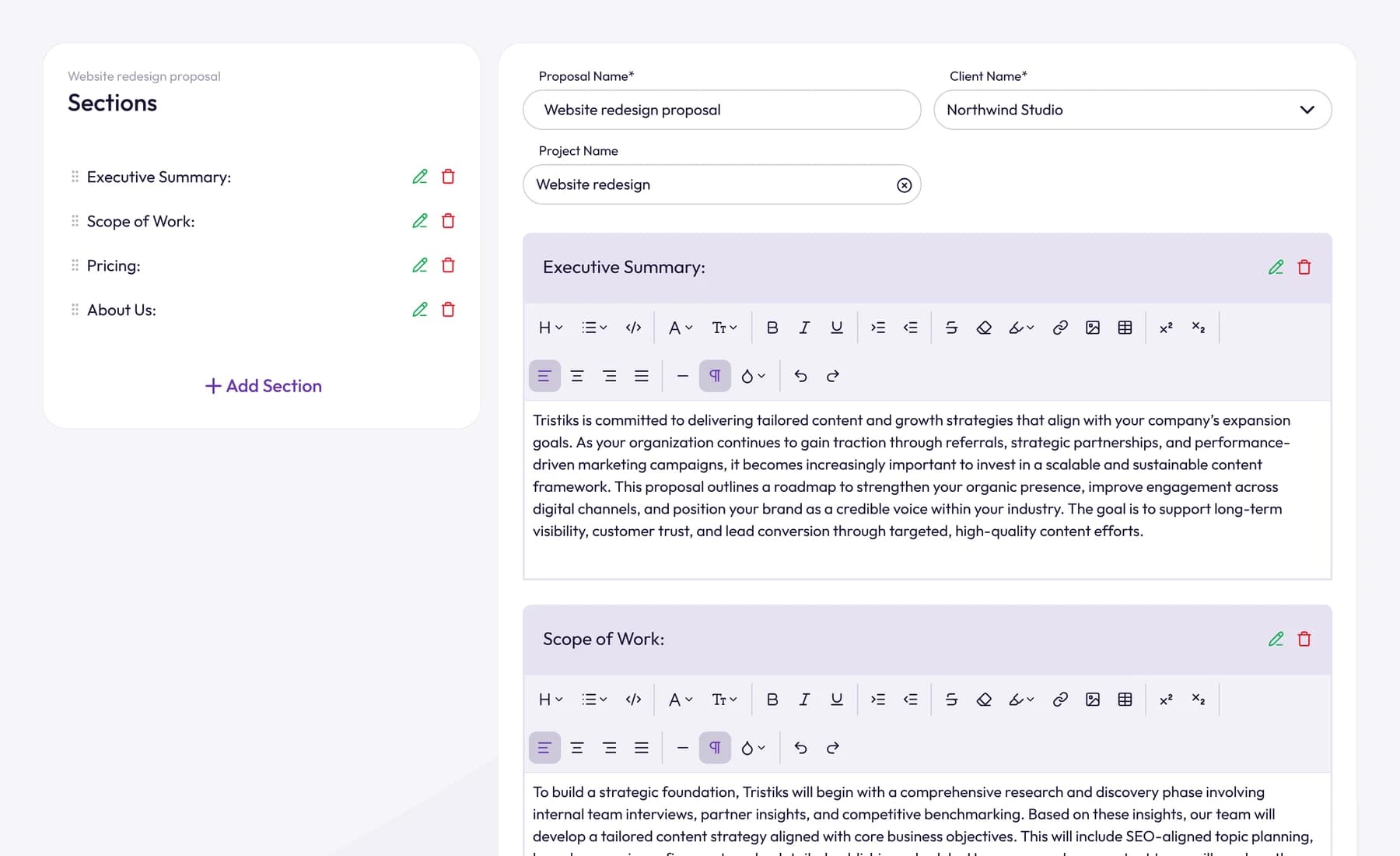
See proposal and contract software for how proposals work.
Frequently asked questions
How long should a discovery call be?
Thirty minutes for most freelance projects; 45 to 60 minutes for larger agency work with several stakeholders. If you need longer, schedule a paid workshop instead.
Should I charge for a discovery call?
Not for a short qualifying call. If the client wants detailed recommendations, a strategy or a technical audit before deciding, that's work. Offer it as a paid discovery phase, credited against the project if they go ahead.
What if the client won't share a budget?
Give a range from past projects and ask if it fits. If they still won't say, send a proposal with two or three options at different prices and let them choose.
Should I give a price on the call?
A rough range, yes, so neither of you wastes time. A firm price, no: wait until you've thought through the scope and written it down.
Wrap up
A good discovery call is a conversation with a structure: goals before deliverables, scope before price, and budget, timeline and decision-maker before you hang up. Send an intake form first, pick 10 to 15 questions, listen for red flags and recap in writing the same day.
To turn your call notes into a proposal the client can sign online, try Tristiks Grow free for 14 days.
Category: Client Management
Suraj Rao
Suraj Rao is the founder of Tristiks, the team behind Tristiks Grow and its desktop time tracker OneTrack. He writes about time tracking, client work and getting paid, and about DevOps, cloud and AI from years of building software.