Proposal vs Contract: What's the Difference?
 By Suraj Rao11 min read
What You'll Learn
- A proposal is a sales document that describes the work and price so the client can say yes; a contract is the agreement that sets the rules both sides must follow.
- A signed proposal can become a binding agreement in many places, but it usually lacks the clauses that protect you when something goes wrong, so pair it with a contract.
- For small, simple jobs one combined document can work; for anything larger, send the proposal first and a contract that refers to it.
A proposal and a contract both describe client work, and both often end with a signature. That's why freelancers mix them up. But they do different jobs. A proposal persuades: it shows the client you understand the problem and offers a way to solve it, with a price. A contract protects: it sets the rules for payment, changes, ownership and what happens if things go wrong.
Most client relationships need both. The proposal gets the yes. The contract makes sure the yes still means the same thing three months later, when the project is late, the client wants extra pages, or an invoice is overdue.
This post explains the purpose of each document, how much legal weight each carries, what goes in each, when one document can do both jobs, and how to move from one to the other without writing the same thing twice. There's a side-by-side table and a short checklist at the end.
The short answer
A proposal is an offer. It tells the client what you'll do, how long it will take and what it costs, and invites them to accept.
A contract is an agreement. It records what both sides have agreed to and adds the terms that govern the relationship: payment schedule, revisions, change requests, intellectual property, confidentiality, termination and liability.
Put simply: the proposal answers "should we hire you?" and the contract answers "what happens now that we have?"
Proposal vs contract: side by side
| Proposal | Contract | |
|---|---|---|
| Main job | Win the work | Set the rules for the work |
| Who it's written for | The decision-maker who has to say yes | Both parties, and anyone who later needs to settle a dispute |
| Tone | Persuasive, about the client's goals | Precise, neutral, about obligations |
| Typical contents | Problem, approach, scope, deliverables, timeline, price, options | Parties, scope reference, payment terms, revisions, changes, ownership, confidentiality, termination, liability |
| How often it changes | A new one for each project | Often a reusable template, adjusted per client |
| Legal weight | An offer; can become binding once accepted, depending on the law where you are | Intended to be binding once both sides sign |
| Length | 2 to 10 pages for most freelance work | 2 to 8 pages for most freelance work |
| When it's sent | After the discovery call | After the client accepts the proposal, or together with it |
What a proposal is for
A proposal exists to help a client decide. It should make the decision easy by showing three things:
- You understood the problem. Restate the client's goal in their words. If they said "our checkout loses people on mobile", don't write "we will optimize the conversion funnel".
- You have a credible plan. Explain the approach, what they'll get and when.
- The price is clear. One price, or two or three options, with what's included in each.
We cover the sections of a proposal in detail, with a template, in how to write a project proposal, so this post won't repeat them. If you need to decide whether to send a quote, an estimate or a full proposal, see quote vs estimate vs proforma invoice vs invoice.
What a contract is for
A contract exists so that both sides know what they've promised and what happens when something changes. It's written for the bad day, not the good one. On the good day nobody reads it.
The clauses that matter most for freelancers and small agencies are:
- Payment terms: amounts, due dates, deposit, and what happens if payment is late.
- Scope and change requests: what's included, and how extra work is quoted and approved.
- Revisions: how many rounds are included.
- Ownership: when the client owns the work (usually on full payment) and what you can show in your portfolio.
- Confidentiality: what each side must keep private.
- Termination: how either side can end the work, and what's paid for work done.
- Liability: a cap on what you can be asked to pay if something goes wrong.
Each of these is explained, with sample wording, in freelance contract: what to include. You can also start from our free contract template.
Is a proposal legally binding?
This depends on where you and your client are, so treat what follows as general information, not legal advice.
In many legal systems, a contract forms when one side makes an offer and the other accepts it, with something of value exchanged on both sides. Cornell Law School's Legal Information Institute describes the usual elements of a contract as mutual assent (typically shown by offer and acceptance), consideration, capacity and legality.
A proposal looks a lot like an offer. It names the work and the price. So if a client signs it, or clearly accepts it in writing, you may well have an enforceable agreement, even without a separate document called "contract". In India, section 2 of the Indian Contract Act, 1872 even uses the word "proposal" for what other systems call an offer, and says an accepted proposal becomes a promise.
That's the good news. The bad news is that a signed proposal is usually a thin agreement. It says what you'll do and for how much, but it's often silent on:
- what happens if the client pays late;
- who owns the work, and when;
- how many revisions are included;
- how either side can end the project;
- how much you could be liable for.
When those questions come up and the document is silent, the answer depends on general law, which may not be what you'd have chosen. That's the main reason to pair a proposal with a contract. If you work across borders or on high-value projects, have a local lawyer review your contract template once. It's a small cost against the size of the risk.
Signing online is widely accepted; our contract guide covers the US rule in its section on how to sign a freelance contract online.
What goes in each document
The easiest way to avoid writing everything twice is to decide which document owns which information. Here's a split that works for most freelancers and small agencies:
| Information | Lives in the proposal | Lives in the contract |
|---|---|---|
| Client's goals and problem | Yes | No |
| Your approach | Yes | No |
| Scope and deliverables | Yes, in full | Refers to the proposal or SOW |
| Exclusions (what's not included) | Yes | Refers to the proposal or SOW |
| Timeline and milestones | Yes | Refers to it; may add what happens if the client delays |
| Price and options | Yes | Refers to the accepted option |
| Payment schedule and deposit | Summary | Yes, in full |
| Late payment terms | No | Yes |
| Revisions policy | Summary ("two rounds included") | Yes, with what counts as a round |
| Change requests | Brief mention | Yes, the full process |
| Ownership and licensing | No | Yes |
| Confidentiality | No | Yes |
| Termination | No | Yes |
| Liability cap | No | Yes |
| Case studies and your background | Yes | No |
The contract points to the proposal for anything specific to the project, and the proposal points to the contract for the rules. When you start a new project with an existing client, you only need a new proposal or a short statement of work under the same contract.
When one document can do both jobs
For small, simple work, sending two documents can feel heavy. A combined "proposal and agreement" is common, and it can work well when:
- the project is small (a few days of work, a modest fee);
- the scope is easy to describe in a paragraph or a short list;
- the client is an individual or a small business, not a procurement department;
- you're comfortable with standard terms you've used many times.
To make one document do both jobs, put the persuasive part first and the terms in a clearly labelled section after the price, followed by the signature. Here's an outline you can copy:
1. Your goal (2-3 sentences in the client's words)
2. What I'll do (approach and deliverables)
3. What's not included
4. Timeline
5. Price and payment schedule
   - 50% deposit on signing, 50% on delivery
   - Invoices due within 14 days
6. Terms
   - Two rounds of revisions included; extra rounds at $90/hour
   - Changes to scope are quoted in writing before work starts
   - You own the final files once the last invoice is paid
   - Either side can end the project with 7 days' written notice;
     work done to that date is paid for
   - My total liability is limited to the fees paid under this agreement
7. Acceptance: name, title, date, signature
The numbers above are placeholders. Swap in your own rate, deposit and notice period.
When to keep them separate
Use two documents when any of these are true:
- The project is large or long, or has several phases.
- The client has a legal or procurement team. They'll want to review terms in their own format, and they won't want to mark up your sales copy.
- You'll work together again. Sign one master contract once, then agree each new project with a short proposal or statement of work. You don't renegotiate ownership and liability every time.
- The proposal is competitive. You may send several versions or options before the client chooses. The contract should only describe the one they accepted.
The order of documents in a typical project
For most freelance and agency work, the documents follow this order:
- Discovery call. You learn the goal, budget and deadline.
- Proposal. You send the scope, timeline and price, ideally within a few days of the call.
- Acceptance. The client picks an option and signs or confirms.
- Contract. You send a contract that refers to the accepted proposal. Some freelancers send it together with the proposal so the client signs both at once.
- Deposit invoice. You invoice the agreed deposit. Our guide on how much deposit to ask for covers the usual splits.
- Kickoff. Work starts once the contract is signed and the deposit is paid. The client onboarding checklist picks up from here.
Don't start work on a verbal yes. If the client is in a hurry, that's the moment to make signing easy, not to skip it.
Common mistakes
Putting legal terms in the sales pitch. Ten paragraphs of liability clauses in the middle of a proposal kill the momentum. Keep the terms in their own section or their own document.
Letting the proposal and contract disagree. If the proposal says "three revision rounds" and the contract says "two", you've created a dispute before the work starts. Have the contract refer to the proposal for project details instead of restating them.
Changing scope without a paper trail. Once the client signs, changes go through a written change request that updates the price or the timeline. That's how you keep scope creep under control.
Proposals and contracts in Tristiks Grow
Tristiks Grow handles both documents, linked to the client and project they're for. You start a proposal or contract from a ready-made template or one of your own, edit the sections, and add line items to a pricing table that works out the subtotal, taxes and total in the currency you choose. Your logo, business details and brand colors appear on each one.
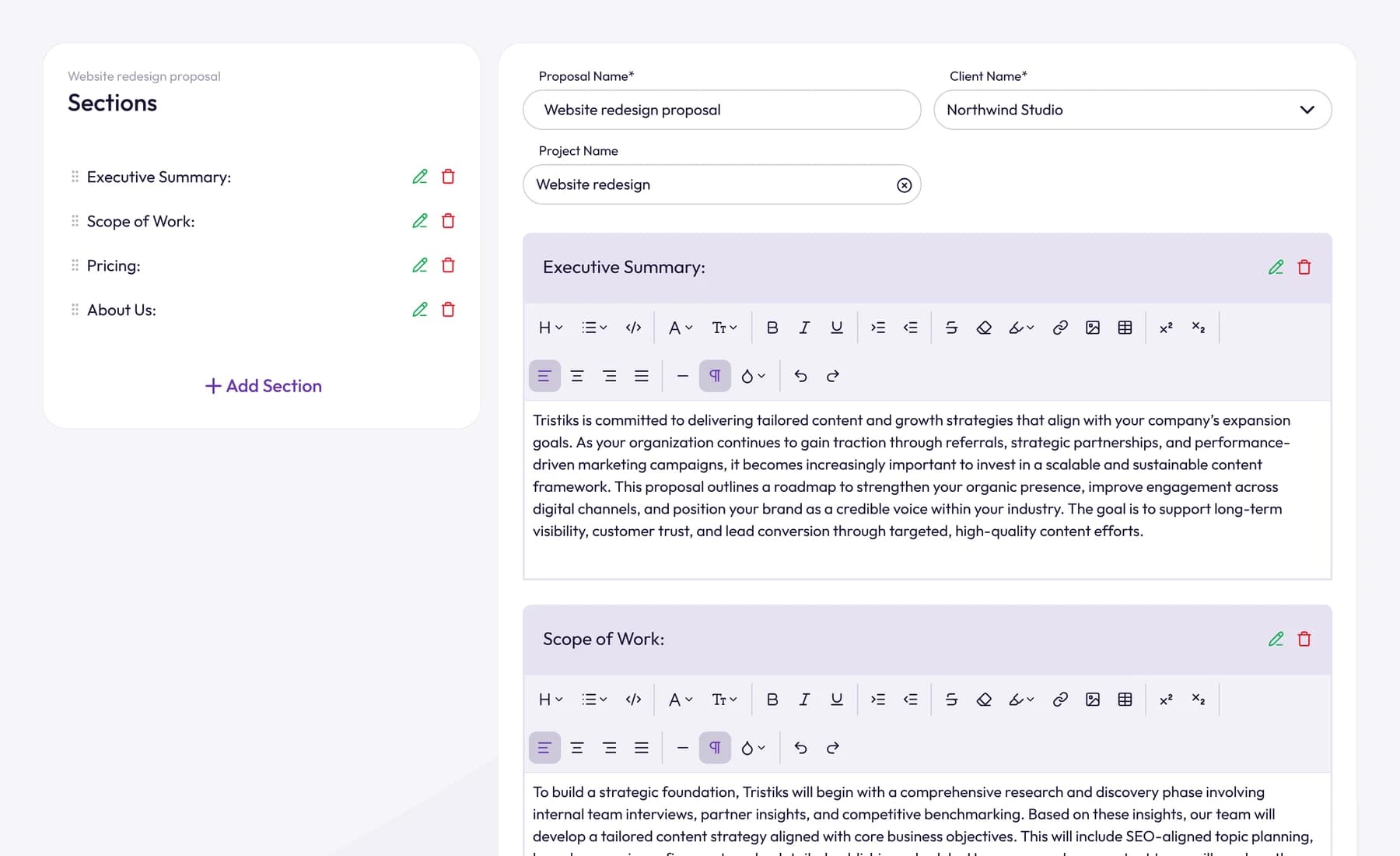
You send it to one or more people at the client. Each gets a secure link to read it in their browser and signs by typing their name, without creating an account. You see it move from sent to viewed to signed, and a signed document is locked so nobody can change it. A contract can be linked to the proposal it follows, and if you turn on one option before sending, a signed proposal creates a draft invoice with the same line items, taxes and total. You can also import proposals and contracts signed elsewhere, so every agreement stays with its client. See the details on our proposal and contract software page.
Tristiks Grow doesn't give legal advice or review your terms. The words in your contract are yours, so have them checked where you work.
Frequently asked questions
Can a proposal be used as a contract?
It can, especially for small jobs. If the client signs or clearly accepts it, it may be binding where you are. But most proposals don't cover late payment, ownership, termination or liability, so add those terms in a labelled section or a separate contract.
Should I send the proposal and contract together?
For small projects with a decisive client, sending both at once saves a round trip. For larger or competitive projects, send the proposal first, then send the contract for the option the client chose. That way the contract only describes the agreed work.
Do I need a new contract for every project with the same client?
Usually not. Many freelancers sign one master contract with a returning client and agree each new project with a short proposal or statement of work under it. Update the master contract when your standard terms change.
What's the difference between a proposal and a statement of work?
A proposal sells the work and usually comes before the client has agreed. A statement of work defines the agreed work in detail, typically under an existing contract. See our guide on how to write a statement of work for the sections and a template.
Wrap up
A proposal wins the work by showing the client you understand their problem and have a clear plan and price. A contract protects the work by setting the rules for payment, changes, ownership and endings. Keep each document focused on its job, let the contract refer to the proposal for project details, and get both signed before you start.
To send proposals and contracts from templates, see who has opened them and get them signed online, try Tristiks Grow proposals and contracts free for 14 days, or grab our free proposal template to get started.
Category: Client Management
Suraj Rao
Suraj Rao is the founder of Tristiks, the team behind Tristiks Grow and its desktop time tracker OneTrack. He writes about time tracking, client work and getting paid, and about DevOps, cloud and AI from years of building software.