How to Upsell Existing Clients (Without Being Pushy)
 By Suraj Rao11 min read
What You'll Learn
- The best upsells solve a problem the client already has. Your time log shows you where: recurring small requests, work that keeps creeping past scope, and tasks the client does badly in-house.
- Raise it at a natural moment, such as after a win, at a quarterly review or when the same out-of-scope request comes up a third time, and offer two or three packaged options rather than an open question.
- Price the expansion from your real hours, not a guess, and never discount it just to close. If a client says no, deliver the current work well and ask again next quarter.

To upsell existing clients without being pushy, offer more only when it solves a problem the client already has, and back the offer with evidence from the work you're doing for them. Look in your time log for recurring requests and work that keeps running past scope, raise it at a natural moment like a project win or a quarterly review, and offer two or three clearly priced options. If the answer is no, keep doing good work and ask again later.
Growing an existing account is usually easier than winning a new one, because the client already trusts you. This guide covers where to find opportunities, the difference between upselling and cross-selling, when to bring it up, scripts for six situations, how to package and price add-ons and retainers, how to run a quarterly business review, and what not to do.
Why your current clients are the best place to grow
You've already paid to win your current clients: the proposals, the discovery calls, the unpaid first-month hours. Extra work from them comes without that cost, and they know how you work, so saying yes is less risky for them.
The research on retention is often overstated, so here's what's solid. Fred Reichheld of Bain & Company, known for his research on customer loyalty, found that in financial services a 5% increase in customer retention produced more than a 25% increase in profit, partly because customers who stay tend to buy more over time. Wider ranges get quoted online, often unsourced. Nobody has measured it for a design studio or a two-person dev shop, but the direction holds: a client you keep and grow is cheaper than one you replace.
There's a catch. An upsell that doesn't help the client erodes the trust that made it possible. HubSpot's guide to upselling makes the same point: the people who upsell well understand what their clients need and deliver results before they pitch anything.
Upsell, cross-sell and expansion: the difference
| Type | What it means | Example |
|---|---|---|
| Upsell | More or better of what they already buy | 10 blog posts a month instead of 4; a premium support tier |
| Cross-sell | A different service that fits alongside | Email campaigns for a client you write web copy for |
| Retainer conversion | Ad hoc work becomes a monthly agreement | 12 small fixes a month become a 15-hour care plan |
| Rate or scope reset | Same work, priced correctly | A client whose requests have doubled since you quoted |
Proposify's guide to upselling and cross-selling uses the same split. The last two rows matter most for freelancers, because they often turn work you're already doing for free into paid work.
Where to find upsell opportunities
Start with what's happening in the account, not with what you'd like to sell.
1. Your time log
Filter your tracked time by client for the last three months and look at the notes and tasks. Three patterns are worth a conversation:
- Recurring small requests. The same kind of task every week or two, each one too small to quote separately.
- Work outside the original scope. Hours logged against tasks that weren't in the statement of work.
- Non-billable time that keeps growing. Calls, reports and "quick questions" you've absorbed. Our guide to billable vs non-billable hours shows how to tell which is which.
Here's a worked example from one client's quarter:
Client: online furniture store, fixed-fee site build
(finished in July), ad hoc work since

Aug–Oct time log, by task:
  Product page updates      14 entries   9.5 h
  "Quick" banner changes    11 entries   6.0 h
  Checkout bug fixes         3 entries   4.5 h
  Calls and emails             –         5.0 h (non-billable)
                                        -----
  Total                                 25.0 h
  Billed                                16.0 h ($1,440 at $90/h)
  Effective rate                        $57.60/h
That client is buying about eight hours a month of ongoing work, paying for some of it, and getting the rest free. The upsell isn't a new service. It's a monthly care plan that covers what they already need, at a price that pays you for all of it. Our guide to client profitability walks through this kind of check for every client.
2. Scope creep patterns
One out-of-scope request is normal. The same one three times is a product the client wants to buy. Scope creep you notice early becomes an add-on; scope creep you ignore becomes resentment.
3. The client's goals
Go back to what they told you on the discovery call. If the goal was more leads and you built the website, the next constraint might be traffic, conversion or follow-up. You can sell the thing that removes it, or refer someone who can.
4. What they're doing badly in-house
"I just throw the newsletter together on Friday nights" is a cross-sell, if it's something you do well.
When to bring it up
| Good moment | Why |
|---|---|
| Right after a visible win | The client is seeing value from you now |
| At a quarterly or monthly review | Planning the next quarter is the agenda |
| The third time an out-of-scope request comes up | You have evidence, and so do they |
| At renewal or contract end | They're deciding what comes next anyway |
| When they mention a new goal or problem | They've opened the door |
A win is also the best moment to ask for a testimonial. Ask for that first, and save the bigger conversation for a call a few days later.
Bad moments: while an invoice is overdue, after a missed deadline or a complaint, in the middle of a launch, or in the first month before you've delivered anything. Fix the relationship first; our guide to setting client boundaries helps if the problem is how the work is requested.
Scripts for six situations
1. Recurring small requests become a retainer
Hi Priya, I was looking back over the last three months and noticed we're doing about eight hours a month of updates and fixes, which I've been billing piece by piece. I think a monthly care plan would work better for you: a fixed 10 hours a month at $850, a guaranteed two-day turnaround, and one invoice instead of five. Want me to send over the details?
2. Scope creep becomes an add-on
Happy to take this on. Monthly reporting dashboards weren't part of the original scope, and since it's come up a few times now, I'd suggest adding it as a regular piece of work: $400 a month for a dashboard and a one-page summary. Or I can quote this one as a one-off. Which suits you better?
3. Cross-sell after a win
The new landing page converted at 4.1% in its first month, up from 2.3%. The next bottleneck is probably what happens after someone signs up: right now they get one automated email. I write onboarding sequences too. Would it be useful if I sketched what a five-email sequence could look like?
4. Upgrade to a higher tier
You've used your full 15 hours in each of the last three months, and we've pushed some work into the following month twice. Moving to the 25-hour plan would cover what you're actually using, and the rate per hour drops from $95 to $85. Shall I set that up from next month?
5. Proposing something at a quarterly review
Looking at next quarter's goals, the product launch in March is the big one. Here are three ways I could support it, from lightest to most complete. Option B is what I'd recommend.
6. When they say no
Totally understand, and thanks for considering it. I'll keep things as they are. If it becomes a priority later, just let me know.
Then do exactly that. A graceful no today makes the next conversation easy.
Package add-ons and retainers
Open-ended offers ("Let me know if you need anything else!") rarely sell. Packaged ones do, because the client only has to choose. Flywheel's advice to agencies is the same: bundles make upsells easier because the extra service is already defined and priced.
Offer three options when you can. Research on the compromise effect, starting with Itamar Simonson's 1989 study in the Journal of Consumer Research, found that people are more likely to choose an option when it sits in the middle of a set than at either end. Put the option you'd recommend in the middle, and make the top one genuinely useful rather than a decoy.
| Essentials | Growth | Full support | |
|---|---|---|---|
| Monthly hours | 5 | 12 | 25 |
| Turnaround | 5 business days | 2 business days | Next business day |
| Monthly report | None | One-page summary | Report and 30-minute call |
| Price | $475/mo | $1,080/mo | $2,125/mo |
A few rules for add-ons and retainers:
- Define the unit. Hours, deliverables or outcomes, so neither of you argues about what's included. Our guides to capacity retainers and productized services go deeper.
- Say what happens to unused and extra hours. Roll over, expire or bill at the standard rate. Write it down.
- Give existing clients first access. Webflow's guide to upselling suggests offering a new service to current clients first, sometimes at a launch price. It rewards loyalty and tests the offer with people who already trust you.
If you're unsure whether a client should be on a retainer at all, read retainers vs fixed-price projects.
Run a quarterly business review
A quarterly business review (QBR) is a 30 to 45 minute meeting where you look back at results and plan the next quarter together. It's the most natural place to expand an account, because planning what comes next is the point of the meeting. Guides from AgencyAnalytics and Gong follow roughly the same shape:
- Results against goals (10 minutes): what you said you'd do, what happened, with numbers.
- What you learned (5 minutes): what worked, what didn't, what you'd change.
- The client's priorities for next quarter (10 minutes): ask before you suggest anything.
- Recommendations (10 minutes): two or three options that serve those priorities, priced.
- Next steps (5 minutes): who does what, by when.
For smaller clients, a written quarterly update can do the same job; our client status update templates include one. Our list of agency KPIs helps you choose which numbers to show.
Pricing the expansion
Price from your real data, not the number that feels safe to say out loud.
Care plan pricing, from the furniture store example

Average monthly work (Aug–Oct)       8.3 h
Add a buffer for request spikes      +20% → 10 h
Your target rate                     $90/h
Plan price                           10 × $90 = $900/mo
Retainer discount for commitment     −5% → $855, round to $850

Check: if they use all 10 h,
effective rate = $850 ÷ 10 h = $85/h
(vs $57.60/h effective before)
A small discount for a monthly commitment is reasonable: you get predictable income and fewer invoices. A discount just to get a yes isn't; offer a smaller package instead.
Check your capacity before you sell: ten more hours for one client is ten fewer for someone else. If your existing work is underpriced, fix that first; our guide to raising your rates has the emails. Agencies selling across several roles can price add-ons from an agency rate card.
What not to do
- Don't sell what you can't deliver well. A weak cross-sell can lose you the original account.
- Don't pitch in every email. One clear offer at the right moment beats constant hints.
- Don't absorb scope creep for months and then present a bill. Raise it the second or third time, not the tenth.
- Don't discount to close. It sets the new price as the real price.
- Don't hide the change in an invoice. Agree any new work and price in writing first, ideally as a short proposal the client signs.
How Tristiks Grow helps
Tristiks Grow gives you the evidence for an upsell conversation and the tools to formalize it:
- Time tracked by client, project and task, with notes and billable status, so recurring requests and out-of-scope work show up in your time log rather than in your memory. Export to CSV if you want to sort it yourself.
- Reports by client and project, with client rates showing what the hours earned, so you can see which accounts are underpriced.
- Proposals with a pricing table, sent as a link and signed online, so an add-on or care plan is agreed in writing before the work starts.
- Recurring invoices, so a new monthly retainer bills itself on schedule.
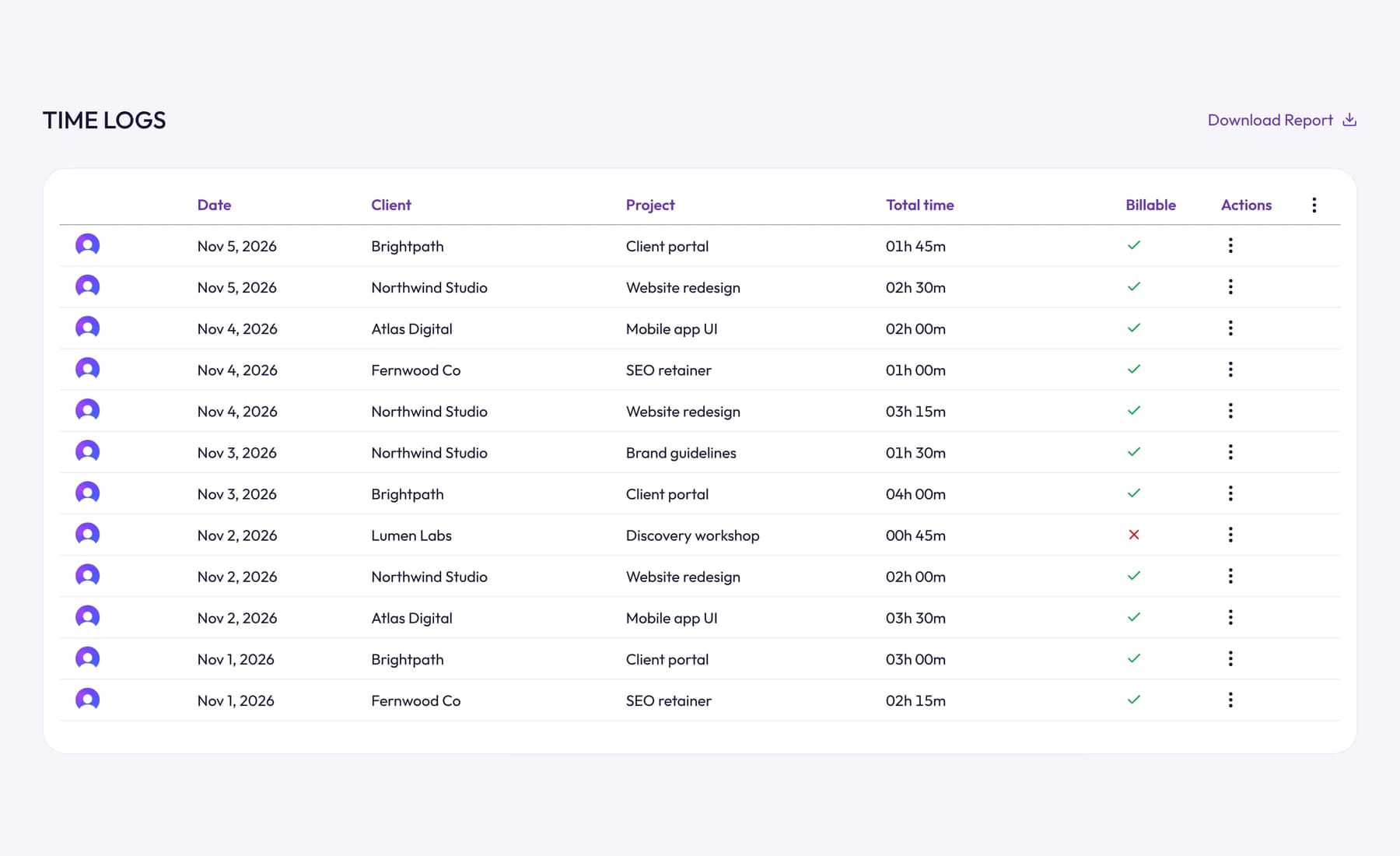
See how client and project reports work on our time reporting software page.
Frequently asked questions
What's the difference between upselling and cross-selling?
Upselling sells more or a higher tier of what the client already buys, like more hours or faster turnaround. Cross-selling sells a different, related service, like email marketing for a client you build websites for.
How often should I suggest new work to a client?
Once a quarter is a good default, usually at a review meeting, plus whenever the client raises a new goal or the same out-of-scope request comes up repeatedly.
Should I give existing clients a discount on new services?
A small discount for a longer commitment or early access to a new service is fair. Don't discount just because the client hesitates; offer a smaller package instead.
What if a client keeps asking for extra work but won't pay more?
Show them the hours from your time log and offer two choices: a package that covers the work, or a smaller scope that fits the current fee. If neither works, it may be time to review whether the client is worth keeping.
Wrap up
Upselling without being pushy means selling what the client already needs, at a moment they're open to it, with evidence and clear options. Your time log shows the opportunities, a quarterly review gives you the moment, and packaged, correctly priced add-ons make yes an easy answer.
To see which clients are buying more than they pay for, try Tristiks Grow free for 14 days.
Category: Client Management
Suraj Rao
Suraj Rao is the founder of Tristiks, the team behind Tristiks Grow and its desktop time tracker OneTrack. He writes about time tracking, client work and getting paid, and about DevOps, cloud and AI from years of building software.