How to Ask Clients for Testimonials (With Templates)
 By Suraj Rao11 min read
What You'll Learn
- Ask when the client is happiest: right after a milestone lands, when they praise you unprompted, or once results show up. Ask once, clearly, and follow up once.
- Don't ask for a testimonial, ask three specific questions. The answers become the testimonial, and the best ones become a case study with real numbers.
- Get written approval of the final wording, don't reword it to change its meaning, and never tie a reward to a positive review: the FTC's rule on fake reviews and testimonials has applied since October 2024.

The best way to ask a client for a testimonial is to ask soon after a visible win, in a short personal email, with two or three specific questions instead of "Could you write me a testimonial?" Offer to draft it from their answers, get their written approval of the final wording and their permission to use their name, and follow up once if they don't reply. Never offer a reward that depends on the review being positive.
Most freelancers and agencies collect far fewer testimonials than they could because asking feels awkward. This guide covers when to ask, templates for five situations, questions that get usable answers, turning a testimonial into a case study, the US and UK rules on incentives and editing, and where to use what you collect.
When to ask
Ask when the client feels the value of your work, not when you need marketing material. HoneyBook's testimonial guide makes the same point: ask at the right moment and give the client clear direction.
| Moment | Why it works | What to ask for |
|---|---|---|
| The client praises you unprompted | They've already written half of it | Permission to quote what they said |
| A milestone lands (launch, sign-off) | Goodwill is at its peak | Two or three short answers |
| Results show up, 30 to 90 days later | You can ask for numbers, not just feelings | A results quote or a case study |
| A retainer renews or hits six months | They've chosen to keep working with you | A quote about the ongoing relationship |
Make the end-of-project ask a habit: our client offboarding checklist puts feedback first and the testimonial second, every time.
Don't ask in the same email as an invoice, while a payment is overdue, straight after a dispute, or before the client has seen any result.
Make it easy: ask questions, not for a testimonial
"Would you write me a testimonial?" gives the client homework with no instructions. They put it off, then send "Great to work with, highly recommend." Specific questions get specific answers, and specific answers persuade the next client.
Pick three of these:
- What was the situation before we started working together?
- What made you choose me (or us) over other options?
- What changed after the project? Is there a number you can share?
- What was working together like, day to day?
- Who would you recommend me to, and why?
Questions 1 and 3 together give you a before-and-after story, which is what a prospect wants to read.
Then offer the easy route: "If it's simpler, I can draft two or three sentences from your answers for you to approve." Most busy clients will say yes. That's fine, as long as they approve the final words.
On format: an email reply is easiest for the client. A short form suits you if you ask many clients, as Dubsado's testimonial guide suggests. A 15-minute call is best for case studies, and video is the most convincing but the hardest to get.
Testimonial request templates for five situations
Personalize each one. A template that reads like a template gets ignored.
1. At the end of a project
Subject: Three quick questions about [project name]
Hi [Name],
Now that [the site's live / the campaign has run], I'd love to know how it went from your side. Would you answer these in a line or two each?
- What was the situation before we started?
- What's changed since?
- What was it like working together?
If you're happy for me to share your answers on my website, I'll send you the exact wording to approve first. If you'd rather not, that's completely fine.
[Your name]
2. When the client has just praised you
Thank you, that's great to hear. You said the new onboarding emails "finally got people using the product in week one." Would you be happy for me to quote that on my website, with your name, title and company? I'll send you the exact wording first.
3. When results have come in
Subject: How's [deliverable] doing?
Hi [Name],
It's been about two months since we launched [deliverable]. Have you seen any change in [the metric we discussed: enquiries, conversion rate, hours spent on X]?
If the numbers are good, I'd love to write a short case study about the project. You'd approve the draft, and I can leave out your company name or any figures you'd rather keep private.
[Your name]
4. For a LinkedIn recommendation
The person can decline or ignore a LinkedIn request, so make the message do the work. LinkedIn's help page on recommendations covers the current limits, such as one recommendation per position per member.
Hi [Name], I really enjoyed working on [project] with you. If you have five minutes, would you write a short LinkedIn recommendation? It would help most if you mentioned [how I handled the tight deadline / the result we got with X]. No pressure if now's not a good time.
5. The one follow-up
Hi [Name], just floating this back up in case it got buried. If it's easier, reply with a sentence or two and I'll do the rest. If now isn't a good time, no problem at all.
Send it about a week after the first ask. If there's still no reply, stop.
Turning a testimonial into a case study
A testimonial says you're good. A case study shows how. It's worth the effort for your best two or three projects, especially if you sell larger engagements or use value-based pricing, where a prospect needs to believe the outcome before they believe the price.
Use a simple structure: the client and their problem, what you did, what changed, and a quote. Here's an illustrative summary box for the top of one:
Client:      Regional physio clinic, 3 locations
Problem:     Most bookings came by phone; front desk
             spent ~15 hours a week on calls
What we did: New booking flow, SMS reminders, a
             rebuilt services page (6-week project)
Result:      Online bookings went from 32% to 71% of
             the total within 3 months
Quote:       "Our front desk finally has time for the
             patients in front of them." (Clinic manager)
In a real case study, every result figure should come from the client, and the client should approve it. Don't estimate their results for them.
To get the material, book a 15-minute call once results are in and ask: What was going on before? Why act then? What's different now, and can you share a figure? What would you tell someone in your position?
Your own records fill in the rest. The phases and the hours each took come from your time log, and comparing them with the estimate also shows whether the project was actually profitable.
If the client can't be named, ask whether you can publish an anonymized version ("a regional healthcare provider") with their approval. Check your contract too: a confidentiality clause may limit what you can say, and a portfolio clause can settle the question in advance.
Permissions, editing and the rules on incentives
This is general information, not legal advice. The short version: publish only what the client said or approved, don't pay for praise, and disclose any connection a reader would want to know about.
Get written permission
Before you publish, get a written yes (an email is enough) covering the exact wording, how they'll be named (full name, title and company, or initials only), whether you can use their photo or logo, and where it will appear: website, proposals, social media or ads. Keep that email with the client's records, and take the testimonial down if they ask.
Editing: tidy, don't change the meaning
The FTC's Endorsement Guides say an endorsement needn't use the endorser's exact words unless you present it as a direct quote, but it can't be presented out of context or reworded to distort their opinion or experience. In practice:
- Fixing a typo or trimming a long answer is fine. Send the edited version to the client to approve.
- Quotation marks mean their words. Don't put them around a sentence you wrote.
- Cutting "It was a bumpy start, but the final site is excellent" to "the final site is excellent" is fine. Cutting "It's excellent value if you don't need it fast" to "excellent value" is not.
If a testimonial quotes an unusual result, don't imply every client gets it. Add context ("a three-location clinic, six-week project").
Incentives: what the FTC rule says
The FTC's Trade Regulation Rule on the Use of Consumer Reviews and Testimonials took effect on October 21, 2024. As of November 2026, it bans, among other things:
- Fake testimonials, including from people who didn't use your service or that misrepresent their experience. AI-generated ones count.
- Paying for positive reviews. You can't offer incentives in exchange for, or conditioned expressly or by implication on, reviews expressing a particular sentiment, positive or negative. A disclosure doesn't fix this.
- Undisclosed insider reviews, such as testimonials from your staff or relatives without saying who they are.
- Review suppression, such as threatening a client to stop a negative review.
Courts can impose civil penalties for knowing violations, adjusted for inflation each year; the FTC's 2025 warning letter template put the maximum at $53,088 per violation. The FTC's Q&A on the rule answers common questions.
The simplest policy for a freelancer: don't offer anything in exchange for a testimonial. A discount "for a five-star review" is exactly what the rule bans.
Platform rules and the UK
Review sites often have stricter rules. Google's policy prohibits incentivizing reviews and selectively soliciting positive reviews, so if you ask for Google reviews, ask every client the same way. In the UK, fake reviews and concealed incentivized reviews have been banned since April 6, 2025; the CMA's online reviews guidance for businesses explains the rules.
Where to use your testimonials
| Place | What to use | Tip |
|---|---|---|
| Homepage | One or two short quotes | Pick ones that name a result |
| Service pages | A quote about that service | Match the testimonial to the page |
| Proposals | A quote or case study from a similar client | Put it next to the price |
| Case studies page | Your best two or three projects | Lead with the result |
| Recommendations, plus posts sharing case studies | Tag the client only with permission |
Proposals are where testimonials work hardest, because the reader is deciding right then. A case study from a similar client, near the pricing, answers "Will this work for us?" as the question comes up. Our guide to writing a project proposal shows where it fits, and one line of proof does more in cold outreach than a paragraph about yourself when you're finding new clients.
If you move clients off Upwork or another marketplace, your platform reviews don't come with you, so ask those clients for a direct testimonial first.
Following up and keeping them fresh
Old testimonials for services you've dropped hurt more than they help. Build a small routine:
- Track who you've asked: a note on each client's record with the date asked, received, approved and where it's published.
- Ask every client with a good result, not just the big names. A specific result from a small client beats a vague quote under a famous logo. The same moment is often the right time to talk about what else you could do for them.
- Review them twice a year and swap in newer ones. Your year-end review is a good moment for one of these.
- Learn from lukewarm feedback. Ask what you could have done better. Often the answer is "I didn't know what was happening," which regular status updates fix.
How Tristiks Grow helps
Tristiks Grow doesn't collect or publish testimonials for you: there's no review form or testimonial widget. It helps with the work around the ask:
- Client profiles with notes and files, so the approved wording and the permission email live with the client's other records.
- Tasks with due dates, so you can set a reminder to ask about results 60 days after launch, shown next to your Google Calendar events.
- Time tracked per project and task, which gives you the timeline and effort for a case study, against the original estimate.
- A proposal editor with sections, so you can keep a case study section ready to drop into each proposal near the pricing table.
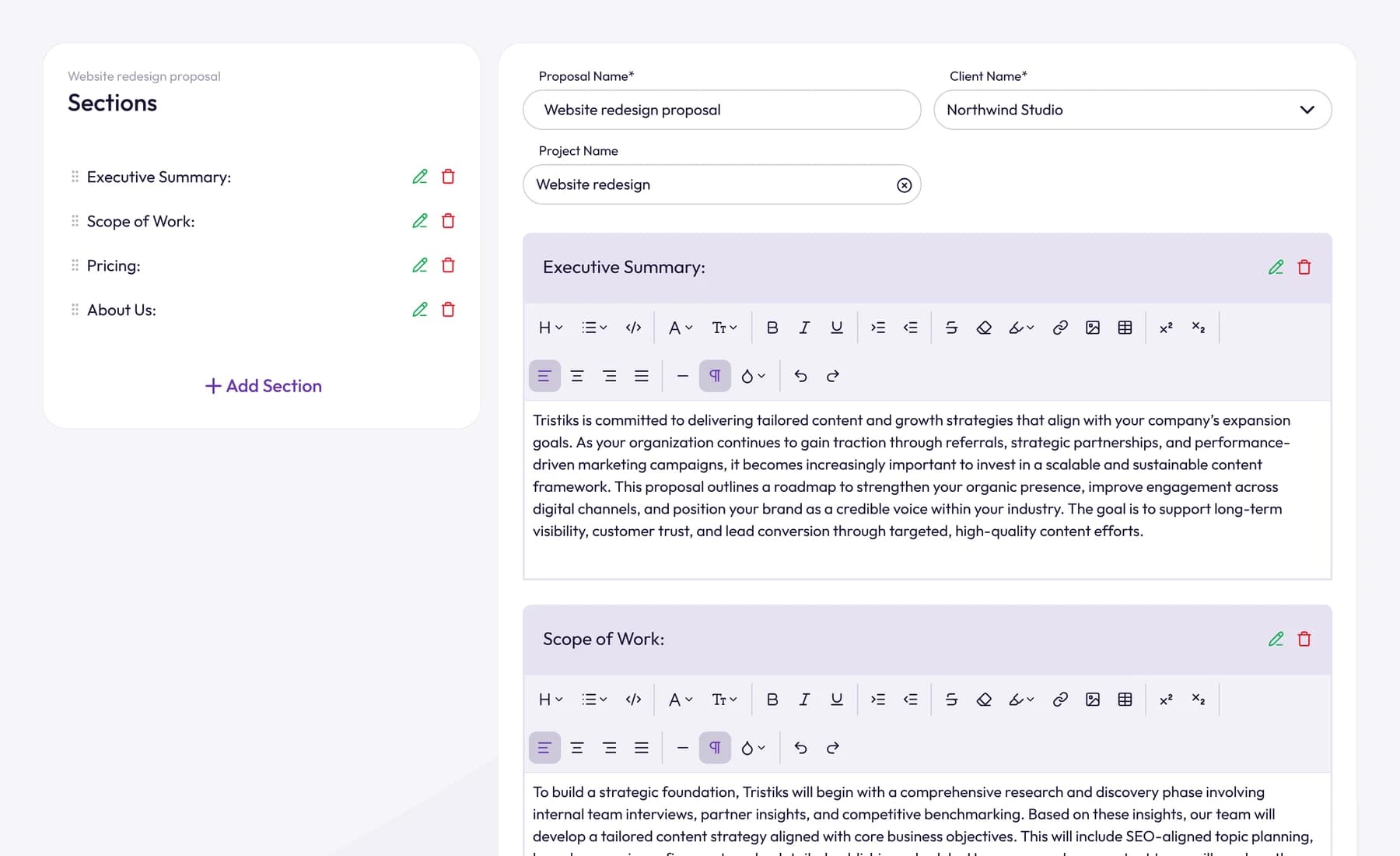
See how proposals work on our proposal and contract software page.
Frequently asked questions
How long should a testimonial be?
Two to four sentences for a website or proposal: enough for the situation and the result, short enough to read at a glance. Keep longer answers for a case study.
Can I write the testimonial for my client?
You can draft it from their answers, and many clients prefer that. They must approve the final wording as their honest view before you publish it.
Can I offer a discount in exchange for a testimonial?
It's safest not to. The FTC rule bans incentives tied to a positive review, and Google bans incentivized reviews altogether.
What if a client says no?
Thank them and move on. Some companies don't let staff endorse suppliers. You can ask once whether an anonymized version would be acceptable.
Wrap up
Ask right after a win, send three specific questions rather than a vague request, offer to draft the wording, and get written approval before anything goes live. Turn your best results into short case studies for your proposals, refresh them twice a year, and keep it honest: no rewards for praise, no edits that change the meaning.
To keep client notes, files and proposals in one place, try Tristiks Grow free for 14 days.
Category: Client Management
Suraj Rao
Suraj Rao is the founder of Tristiks, the team behind Tristiks Grow and its desktop time tracker OneTrack. He writes about time tracking, client work and getting paid, and about DevOps, cloud and AI from years of building software.