Tiered Pricing for Freelancers: Good, Better, Best
 By Suraj Rao11 min read
What You'll Learn
- Three options turn a yes-or-no decision into a choice between your offers, give a tight budget a way in, and let clients who want more pay for more.
- Build the middle tier first, take away something that matters for the lower tier, add outcome, speed or support for the top one, and recommend the middle.
- The decoy research is weaker than marketing blogs suggest, so make every tier a real offer and check each one's effective hourly rate with tracked time.

Tiered pricing, often called good-better-best, means offering a client three versions of the same project at three prices instead of a single quote. It works because it changes the client's question from "Should we hire this person?" to "Which option suits us?", gives a smaller budget a way in, and lets clients who want more pay for more. Build the tiers around outcomes rather than hours, recommend the middle one, and check that each tier pays your rate at the hours it will really take.
This guide covers the research behind three options (and where it's weaker than you've heard), how to design each tier, how far apart to set the prices, a worked example with numbers, how to present the options in a proposal, when not to use tiers, and how to check each tier's profit with tracked time.
Why three options work
A single price invites a yes or no. Three prices invite a comparison, and the comparison is between your options rather than between you and another freelancer. Pricing consultant Rafi Mohammed makes the commercial case in Harvard Business Review: one price is too high for some buyers and too low for others, while a lower tier brings in price-sensitive customers and a premium tier lets those who value more spend more.
Four findings from decision research are usually cited as well. Here's what each says and how much weight it can bear:
| Effect | What the research found | What it means for a proposal |
|---|---|---|
| Anchoring | Arbitrary numbers pulled people's estimates toward them (Tversky and Kahneman, 1974) | The first price a client reads frames the others |
| First offers | In negotiation experiments, the first offer strongly predicted the final price (Galinsky and Mussweiler, 2001) | Name your prices before the client names a budget |
| Compromise effect | An option gains share when it becomes the middle of a set (Simonson, 1989) | The tier you put in the middle tends to look like the sensible choice |
| Decoy (attraction) effect | Adding an option that's clearly worse than one other option can raise that option's share (Huber, Payne and Puto, 1982) | Weak in real-world tests; don't build a fake tier |
There's also evidence on order. In consumer experiments, people chose pricier options when prices were listed from high to low than when they were listed from low to high (Suk, Lee and Lichtenstein, 2012).
The Economist example, and its limits
The best-known decoy story comes from behavioral economist Dan Ariely. In his TED talk and his book Predictably Irrational, he describes an Economist offer: web only for $59, print only for $125, or print and web for $125. When he gave the three options to 100 MIT students, 84 chose print and web and none chose print only. When a second group saw only web and print-and-web, 68 chose web only and 32 chose print and web. An option nobody wanted changed what people picked.
Two cautions before you copy it. First, it was a classroom exercise with students, not a test of real sales. Second, later researchers struggled to reproduce the effect outside the lab. Frederick, Lee and Baskin ran a series of studies with real, experienced products and found little or no attraction effect, and sometimes the reverse (The Limits of Attraction, 2014). The effect's original authors replied that the conditions needed to produce it are restrictive (Huber, Payne and Puto, 2014).
The practical takeaway: three options help mainly because they give clients a real choice and a clear recommendation. Make every tier something you'd be happy to sell.
How to design the three tiers
Start with the middle tier
The middle tier is the project you'd recommend after the discovery call: the scope that solves the client's problem properly. Build it first, from what the client told you. If you haven't had that conversation yet, our list of discovery call questions covers what to ask.
Build the lower tier by taking something away
The lower tier is for a client with a smaller budget or less urgency. Make it smaller, not just cheaper: remove a deliverable, a revision round, the strategy work or the support period. Mohammed calls the missing features "fences", the things that stop clients who need more from trading down. If the lower tier is the same work for less money, everyone picks it and you've discounted yourself.
Build the top tier by adding value, not hours
The top tier is for the client who wants more of the outcome, sooner or with less risk. Good additions:
| Lever | Example additions |
|---|---|
| Scope | More pages, more assets, a second market or language |
| Outcome | Testing, measurement, a launch plan |
| Speed | A shorter timeline or priority turnaround |
| Support | 30 to 90 days of fixes and questions after launch |
| Access | A monthly strategy call, a direct line to you |
| Risk | A paid discovery phase, an extra revision round |
Set the price gaps
There's no research-backed ratio. As a starting point, put the middle tier at roughly 1.5 to 2 times the lower one and the top tier at roughly 1.5 to 2 times the middle, then adjust so each step up is easy to justify in one sentence. Tiny gaps underprice the upgrade; huge ones make the middle look like a stretch.
Pick the one you recommend
Recommend one tier, usually the middle, and say why in a sentence tied to the client's goal. Three options with no recommendation hand the work back to the client.
Worked example: a brand identity project
A freelance brand designer is quoting a new bakery chain. Her floor is $90 an hour, the least she'll accept after costs and non-billable time (our guide to calculating your hourly rate shows the math). She estimates hours for each tier from similar past projects she tracked.
| Essentials | Brand identity (recommended) | Brand and launch | |
|---|---|---|---|
| Logo and color palette | Yes | Yes | Yes |
| Revision rounds | 2 | 3 | 3 |
| Typography and one-page brand guide | Yes | Yes | |
| Packaging and menu templates | 4 | 10 | |
| Social media templates | 12 | ||
| Launch support (30 days) | Yes | ||
| Timeline | 3 weeks | 5 weeks | 7 weeks |
| Price | $3,000 | $5,000 | $8,500 |
Before sending, she checks each tier against her floor, including a 20% allowance for overruns:
Tier             Price    Est. hours   Rate at estimate   Hours +20%   Rate at +20%
Essentials       $3,000   24           $125.00/hr         28.8         $104.17/hr
Brand identity   $5,000   40           $125.00/hr         48.0         $104.17/hr
Brand and launch $8,500   65           $130.77/hr         78.0         $108.97/hr

Floor: $90/hr. All three tiers clear it, even with a 20% overrun.
Price steps: $5,000 / $3,000 = 1.67x; $8,500 / $5,000 = 1.70x
Each step has a one-line reason: Essentials gets the bakery a logo; Brand identity gets it everything a designer or printer needs to apply the brand; Brand and launch gets the brand onto shelves and social media without the owner lifting a finger. The hours and rates are for her eyes only and stay out of the proposal.
If any tier had fallen below $90 at +20%, she'd either raise its price or take something out of it, never quietly hope the project ran smoothly. Our guide to estimating project hours covers building estimates from past data.
How to present the options in a proposal
Put the options in the pricing section, after the scope, so the client reads what they're getting before the prices. Our guide to writing a project proposal covers the rest of the structure. Then:
- Restate the goal in the client's words, so every option reads as a route to it.
- Show a comparison table like the one above, with ticks for what's included.
- Mark one option as recommended and say why.
- Consider listing the top tier first. In the ordering study above, people chose pricier options when prices ran from high to low. Test it on your own proposals.
- Keep terms the same across tiers: the same deposit, payment schedule and expiry date. Our guide on how much deposit to ask for covers the amounts.
- Walk through it on a call rather than sending it cold.
Wording you can adapt:
Investment
You told us the goal is a brand that looks as good as your bread and works on everything from the shop sign to Instagram. Here are three ways to get there.
Essentials, $3,000: a new logo and color palette with two revision rounds. Best if you need a mark now and will build the rest later.
Brand identity, $5,000 (recommended): everything in Essentials, plus typography, a one-page brand guide and four packaging and menu templates. This is what we'd recommend: it gives your printer and future designers everything they need to keep the brand consistent.
Brand and launch, $8,500: everything in Brand identity, plus ten templates, twelve social media templates and 30 days of launch support.
All options: 50% on signing, 50% on delivery. Prices are fixed for the scope above and valid until 15 January.
Keep extras that don't fit a tier as add-ons with their own price, and write down what happens if the client asks for something outside their tier. A clear statement of work is what stops a mid-tier client from slowly receiving top-tier work; see what scope creep is for how that happens.
When not to use tiered pricing
Three options aren't always the right answer:
- The client has asked for one specific thing, such as a formal tender or a procurement team that needs one price to compare.
- The job is small. Three options for a two-hour fix is more admin than the work.
- The scope is unclear. Tiers built on guesses are three guesses. Sell a paid discovery phase first.
- You can't deliver the top tier well. Don't offer what you'd struggle to deliver just to make the middle look reasonable.
- The work is ongoing and open-ended. Hourly or a retainer may fit better; retainers vs fixed-price projects compares them.
If you sell the same thing over and over, consider a fixed menu instead: our guide to productized services covers packaging work with published prices.
Check each tier is profitable with tracked hours
Tiers are fixed prices, and fixed prices hide overruns: the invoice says $5,000 whether the work took 40 hours or 70. The only way to know whether a tier pays is to track time against each project and compare.
After each project, work out its effective hourly rate: the price, minus project expenses, divided by every hour it took, including calls and revisions. After a few projects, group them by tier (these had no project expenses):
Tier             Sold   Avg hours   Avg price   Effective rate   Verdict
Essentials       5      31          $3,000      $96.77/hr        Barely above floor: remove a revision round
Brand identity   7      42          $5,000      $119.05/hr       Healthy: keep
Brand and launch 2      71          $8,500      $119.72/hr       Healthy: keep
Watch which tier sells, too. If almost everyone picks the lowest tier, the middle may be too expensive or too vague. If almost everyone picks the top tier, your prices are probably too low. Our guide to project profitability covers margin as well as rate, and value-based pricing covers pricing tiers on what the outcome is worth to the client rather than on hours alone. When the data says a tier is underpriced, raise it for new clients; how to raise your rates covers existing ones.
How Tristiks Grow helps
Tristiks Grow covers both halves: sending the options and checking what they earned.
- Proposals with a pricing table, with line items, taxes and the client's currency, sent as a link. You see when the client opens it, and they sign online by typing their name.
- A draft invoice on signing, if you turn that on, so the deposit can go out the same day.
- Time tracking by client, project and task, from the desktop app or the web timer, so the hours behind each tier are recorded.
- Reports by client and project, to compare each project's hours with its price.
There's no built-in option picker in proposals, so lay out the three tiers in a proposal section, agree the tier with the client, and send the pricing table for the tier they choose to sign.
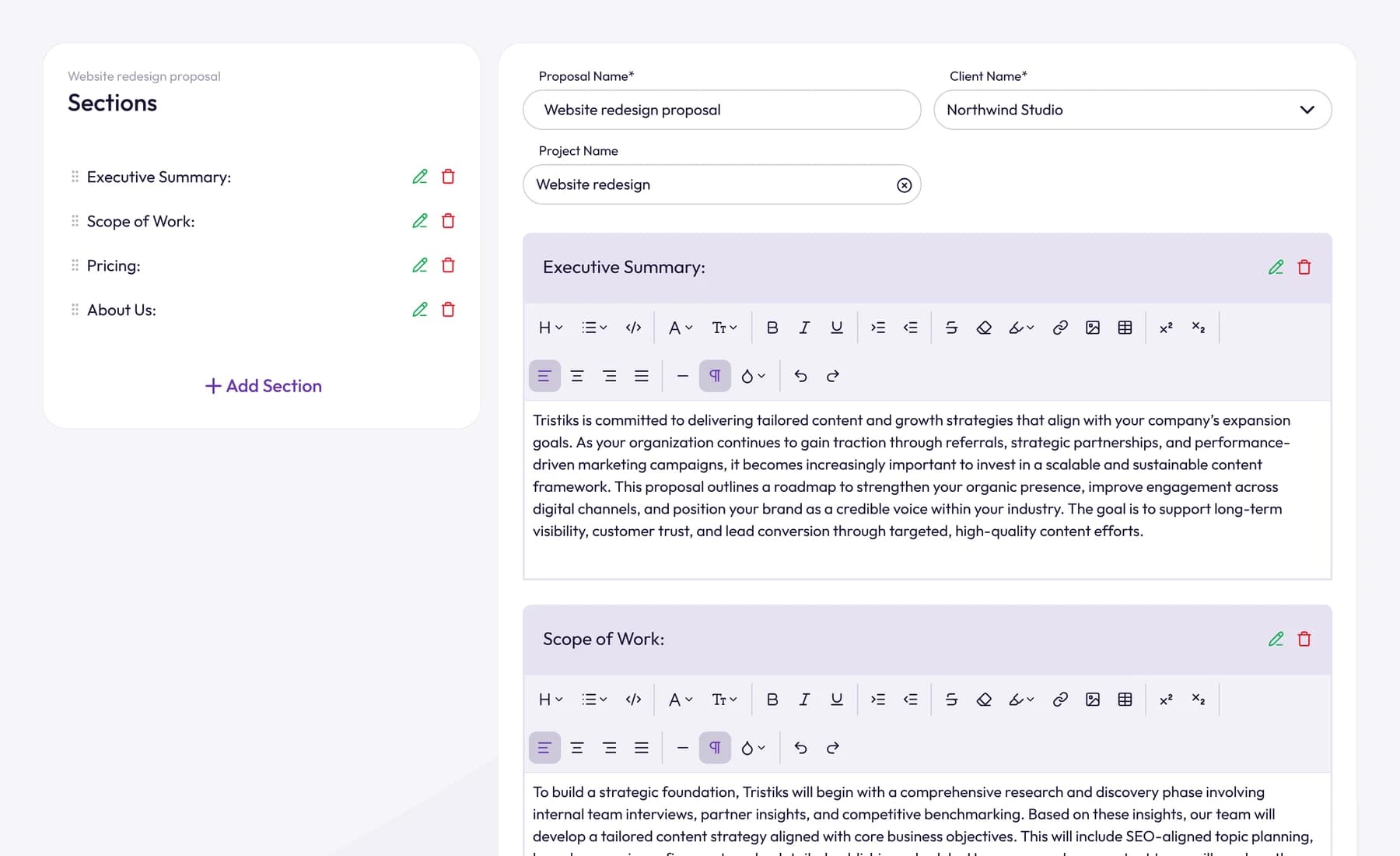
See how proposals and signing work on our proposal and contract software page.
Frequently asked questions
Should I always offer three options?
No. Use them when the client's budget is unknown and the project can sensibly be done at more than one size. For a small fix, a fixed request or an unclear scope, one price or paid discovery works better.
Which tier should I recommend?
The one that best solves the client's problem, which is usually the middle one if you built it first. Say why in one sentence linked to the goal they told you.
What if the client wants to mix and match tiers?
Price the extra items as add-ons on top of the tier they choose. If you swap features between tiers for each client, the tiers stop meaning anything.
Does the decoy effect really work?
It's been shown in lab studies, but researchers have struggled to reproduce it with real products. Don't rely on a fake option; give clients three real choices and a clear recommendation.
Wrap up
Good-better-best pricing gives clients a choice between your options instead of a yes or no. Build the recommended middle tier first, make the lower tier smaller rather than cheaper, add outcome or support to the top one, and check every tier against your floor rate before and after the work.
To send tiered proposals and see what each project really earned per hour, try Tristiks Grow free for 14 days.
Category: Payments
Suraj Rao
Suraj Rao is the founder of Tristiks, the team behind Tristiks Grow and its desktop time tracker OneTrack. He writes about time tracking, client work and getting paid, and about DevOps, cloud and AI from years of building software.