How to Bill Expenses Back to Clients
 By Suraj Rao10 min read
What You'll Learn
- Bill a client for costs you only incurred because of their project; keep general running costs in your rate.
- Agree in the contract which expenses you'll rebill, whether you add a markup and which costs need approval first, so the invoice holds no surprises.
- Keep the receipt with every expense, list expenses separately from your fees on the invoice and record which invoice each one went on.
Freelancers and small agencies spend money on client work all the time: a stock photo, a font license, a train ticket to a workshop, a month of a tool the client asked for. Each one is small. Forget to bill them and, across a year, they add up to a real hole in your margin.
The fix isn't complicated, but it needs a few decisions made up front. Which costs can you bill back? Do you add a markup? What does the client need to see? And how do you make sure each receipt actually reaches an invoice, exactly once?
This post covers reimbursable vs non-reimbursable expenses, whether and how to mark them up, what to put in the contract, which receipts to keep, how expenses should look on the invoice and a full worked example.
Reimbursable vs non-reimbursable expenses
A reimbursable (or billable) expense is a cost you paid on the client's behalf, which they agreed to pay back. A non-reimbursable expense is a cost of running your business, which your rate already has to cover.
The simplest test: would you have spent this money if this client didn't exist? If not, it's a candidate for billing back. If you'd have spent it anyway, it's overhead.
| Usually billable to the client | Usually your overhead | Depends on the contract |
|---|---|---|
| Stock photos, fonts or plugins licensed for their project | Your laptop, phone and monitor | Travel to the client's office |
| Software or hosting bought only for them | Software you use for every client | Software you bought for them but kept |
| Printing, shipping and couriers for their materials | Your internet and coworking space | Meals while traveling |
| Ad spend you place on their behalf | Your own marketing and website | Subcontractors working on their project |
| Event, venue or equipment hire for their project | Training and courses | Rush fees caused by the client's late changes |
| Travel and accommodation they asked for | Accounting and insurance | Mileage for local client visits |
The middle column belongs in your rate. If you're not sure your rate covers it, our guide to calculating your hourly rate shows how to build overheads in.
The right-hand column is where disagreements start. None of it is wrong to bill, but none of it should be a surprise. Decide each one before the project starts and write it down.
Should you add a markup?
A markup is an extra percentage on top of the cost. Some freelancers and agencies add one to cover the time spent buying, managing and accounting for the item, and the cash tied up until the client pays. Others pass costs through at exactly what they paid. Both are normal; what matters is that the client agreed.
| Approach | How it works | Good for | Watch out for |
|---|---|---|---|
| At cost | Bill exactly what you paid | Small costs, trusted clients, travel | You carry the cash and admin for free |
| Percentage markup | Cost plus an agreed percentage, such as 10% | Items you source and manage, like stock assets or equipment hire | Must be agreed in writing; some clients won't accept it |
| Flat handling fee | A fixed admin fee per expense or per invoice | Lots of small purchases | Can look petty on small items |
| Built into your price | No expenses billed; your fee covers them | Fixed-price work with predictable costs | You absorb any overrun |
| Client pays directly | The client buys the item on their own account | Large ad budgets, annual software subscriptions | Slower, but you carry no risk |
A few practical rules of thumb:
- Don't mark up travel unless you've agreed to. Most clients expect travel at cost.
- For large costs, have the client pay directly. Fronting a few thousand dollars of ad spend for a client who pays in 30 days is lending them money.
- Be consistent per client. Pick one approach and apply it every time.
Put it in the contract
Most expense disputes come from expectations that were never written down. Your contract or proposal should say:
- Which kinds of expenses you'll bill back.
- Whether you add a markup, and how much.
- Which costs need the client's approval first, such as anything over $100.
- How you bill travel: at cost, a per-mile rate or a daily allowance.
- When expenses are invoiced: with your next regular invoice, or at the end.
- What evidence the client gets: receipts on request, or attached to every invoice.
Here's a clause you can adapt:
Expenses. The Client will reimburse reasonable expenses incurred
for this project, including stock assets, licenses, printing,
shipping and travel requested by the Client. Expenses are billed
at cost, except stock assets and equipment hire, which carry a
10% handling fee. Any single expense over $100 needs the Client's
written approval before purchase. Expenses are invoiced with the
next monthly invoice, and receipts are available on request.
For travel, some US freelancers bill car mileage at a per-mile rate. The IRS business standard mileage rate for 2026 is 72.5 cents per mile from January to June and 76 cents from July to December, after a mid-year increase. That's a tax figure, not a billing rule, but it's a familiar reference point if you and the client agree to use it.
For the rest of the contract, see what to include in a freelance contract.
Keep the receipts
A receipt is your proof that the cost was real and what it was for. Clients may ask for it, and your own tax records need it.
The IRS's page on what kind of records to keep says supporting documents for an expense should show the payee, the amount paid, proof of payment, the date and a description showing it was a business expense. Other countries have their own rules, but that list is a sensible standard anywhere.
For each billable expense, record:
- The date, the supplier and the amount, including any tax.
- The currency you paid in.
- Which client and project it was for.
- Whether it's billable, and any markup.
- The receipt itself, as a photo or PDF.
- Later, which invoice it was billed on.
That last item matters more than it seems. Without it, it's easy to bill the same cost twice, or to assume you've billed something you haven't. Keeping expenses well also helps at tax time: our guide to freelance tax deductions covers what to keep for your own return. If you track expenses in a spreadsheet, our free expense report template has the columns ready.
How expenses should look on the invoice
List expenses separately from your fees, so the client can see what's work and what's cost. Each line should say what it was, when, and the amount, with any markup visible.
Professional services
  Design work, November 2026: 32 hours at $95.00       $3,040.00

Expenses
  Stock photos (3 images), 4 Nov, cost $120.00 + 10%     $132.00
  Font license, 6 Nov, at cost                            $60.00
  Mileage to client workshop, 12 Nov, 140 mi at $0.725   $101.50
  Parking, 12 Nov, at cost                                $18.00
                                          Expenses total  $311.50

Total due                                              $3,351.50
Receipts available on request.
Tax on expenses
How tax applies to rebilled costs depends on where you are and whether you're registered for sales tax, VAT or GST. In the UK, for example, GOV.UK's guidance on costs passed to customers says that costs such as your own travel and postage are not disbursements, so a VAT-registered business must charge VAT on them, while true disbursements left out of the VAT calculation must be itemized separately on the invoice. Other tax systems have their own rules. This is general information, not tax advice, so check with an accountant before you decide how to tax expenses on your invoices.
Worked example: a month of design work
Say you're a designer billing a client monthly at $95 an hour, with expenses at cost except stock assets, which carry a 10% markup. This month you tracked 32 hours and spent:
- Stock photos: $120.
- A font license for the client's brand: $60.
- A 140-mile round trip to their workshop, billed at the agreed 72.5 cents a mile.
- Parking at the workshop: $18.
The arithmetic:
- Fees: 32 × $95 = $3,040.00.
- Stock photos with markup: $120 × 1.10 = $132.00.
- Font license at cost: $60.00.
- Mileage: 140 × $0.725 = $101.50.
- Parking at cost: $18.00.
- Expenses total: $132.00 + $60.00 + $101.50 + $18.00 = $311.50.
- Invoice total: $3,040.00 + $311.50 = $3,351.50.
Now look at what happens if you forget the expenses and bill only the fees. You've paid out $299.50 in real costs ($120 + $60 + $101.50 + $18), plus the $12 markup you'd agreed. Spread over 32 hours, that's about $9.73 an hour off your effective rate ($311.50 ÷ 32). Do that every month and you've given away $3,738 a year ($311.50 × 12), close to 40 hours of work at $95 an hour. Our post on your effective hourly rate shows how quickly these leaks add up.
Common mistakes
- Forgetting small costs. A $9 plugin feels too small to chase, but dozens of them aren't. Record every one when you spend it.
- Billing an expense twice, usually because two invoices were built from the same spreadsheet.
- Surprise markups. A markup the client didn't agree to damages trust faster than it earns money.
- Large expenses without approval. Ask first, in writing, for anything over your agreed limit.
- Currency confusion. If you paid in one currency and bill in another, say which rate you used. Our guide to invoicing international clients covers exchange-rate choices.
- Billing late. Expenses added three months after the fact look like an afterthought. Bill them with the next regular invoice.
How Tristiks Grow handles billable expenses
With Tristiks Grow expense tracking, each expense is recorded once, with its receipt, and billable ones wait for the client's next invoice:
- Receipt scanning. Upload a photo or PDF of a receipt and Tristiks Grow reads the merchant, date, line items, taxes, total, currency and payment method, and suggests a category. A scanned expense stays a draft until you check and confirm it. You can also add an expense by hand and attach the receipt yourself.
- Billable and markup. Mark an expense as billable, link it to a client and project, and add a markup if you charge one.
- Onto the invoice in a click. When you build the client's next invoice in Tristiks Grow invoicing, add their unbilled expenses as line items alongside their tracked hours. Each expense then shows the invoice it was billed on, so nothing is charged twice or forgotten.
- Any currency. Record each expense in the currency you paid. Totals convert at the rate for the day you spent it.
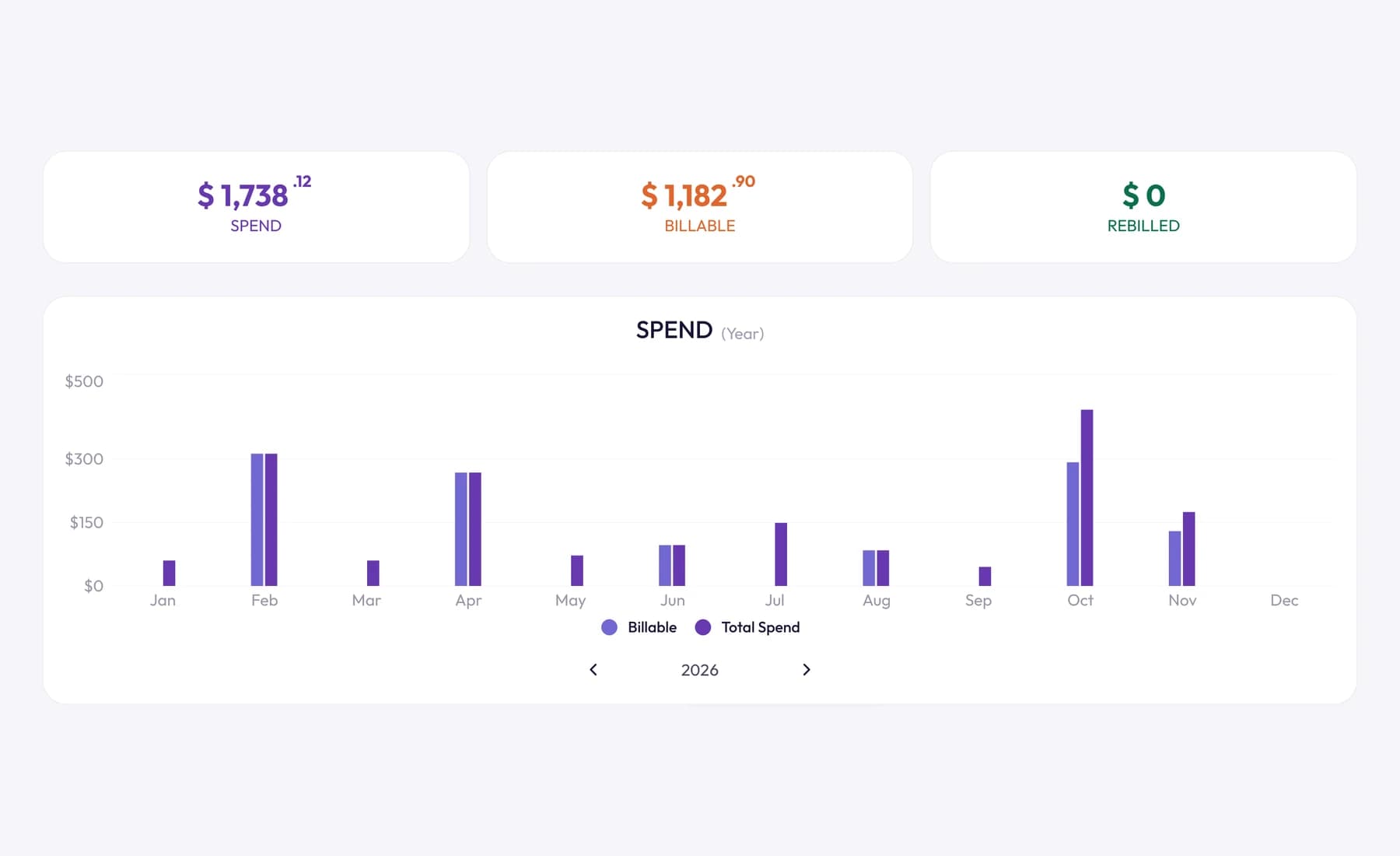
- Totals and exports. See spend, billable and rebilled totals, filter by client, project, category or dates, and export your expenses as a CSV file for your accountant.
Frequently asked questions
Is it normal to charge clients for expenses?
Yes, for costs you incurred specifically for their project, as long as you agreed it in advance. Costs of running your business, like your computer or general software, belong in your rate instead.
How much should I mark up expenses?
There's no standard figure, and many freelancers don't mark up at all. If you do, pick a modest percentage, apply it consistently and put it in the contract. Most clients expect travel to be billed at cost.
Do I need to send receipts with the invoice?
Not always. Many freelancers say "receipts available on request" and send them if asked, while some clients require receipts for every expense. Agree it in the contract, and keep every receipt either way.
Should expenses be on a separate invoice?
Usually not. Put them in their own section on your regular invoice so the client sees fees and costs separately but pays once. A separate invoice makes sense only for large one-off costs or if the client asks for it.
Wrap up
Bill clients for the costs their project caused, not for running your business. Agree the rules in the contract, keep every receipt, list expenses in their own section on the invoice and track which invoice each one went on.
To scan receipts, mark them billable and add them to the next invoice in a click, try Tristiks Grow expense tracking free for 14 days.
Category: Payments
Suraj Rao
Suraj Rao is the founder of Tristiks, the team behind Tristiks Grow and its desktop time tracker OneTrack. He writes about time tracking, client work and getting paid, and about DevOps, cloud and AI from years of building software.