Invoice Numbering: Formats, Rules and Examples
 By Suraj Rao11 min read
What You'll Learn
- An invoice number identifies one invoice and nothing else. Pick a format, keep each series in order, and never reuse, skip or delete a number without a record of why.
- The EU and the UK require a sequential number based on one or more series for VAT invoices, India's GST rules require a consecutive serial number of up to 16 characters that's unique for the financial year, and the US has no federal rule.
- Void mistakes rather than deleting them, give credit notes their own series, and when you start a new year or switch tools, carry the sequence on or start a clearly labeled new series.
An invoice number is a unique reference that identifies one invoice in your records and your client's. You can use almost any format (INV-0042, 2026-042 or ACME-0007), as long as every number is used only once, the numbers in each series run in order, and you never delete or reuse a number you've issued. In the EU, the UK and India, a sequential or consecutive number is a legal requirement for VAT and GST invoices; in the US, it's good practice rather than law.
This guide covers what invoice numbers are for, four common formats with examples, the official rules in the EU, UK, India and US, and how to handle the awkward parts: gaps, voided invoices, credit notes, several series at once, a new year and a mid-year switch to new software. It's general information, not tax advice, so check the rules where you're registered.
What an invoice number is for
An invoice number does four jobs:
- It's the reference everyone uses. "Invoice 0142" is how you and the client's accounts team talk about one bill without mixing it up with another.
- It matches payments to invoices. Ask clients to quote it as the payment reference, and reconciling your bank statement takes minutes.
- It proves your records are complete. An unbroken sequence shows an accountant or tax inspector that no invoice is missing, which is why tax rules care about order, not just uniqueness.
- It stops double payment. Many accounts payable systems flag duplicate numbers, so a repeated number can get an invoice rejected or paid twice.
If you're new to invoicing, our guide on how to write an invoice covers the other fields every invoice needs.
Invoice number formats, with examples
There's no single correct format. These are the common ones:
| Format | Example | Good for | Watch out for |
|---|---|---|---|
| Sequential | INV-0001, INV-0002 | Most freelancers; simplest to keep in order | Says nothing about the date or client |
| Date-based | 2026-0042 or 202611-003 | Seeing the year or month at a glance; a fresh count each year | Two invoices in one period still need different numbers |
| Client-prefixed | ACME-0007 | Agencies with a few large clients | Each client's series must be in order, and the prefix must stay the same |
| Project-based | ACME-WEB-03 | Long projects billed in milestones | Gets long; India caps GST invoice numbers at 16 characters |
You can also combine them. A combined number reads left to right, from the broadest part to the most specific:
2026-ACME-0142
 |    |    |
 |    |    +-- running number (padded to 4 digits)
 |    +------- client code (never changes for this client)
 +------------ year
Three habits make any format easier to live with:
- Pad the number (0042, not 42) so files and spreadsheet rows sort in order.
- Put the running number last. It's the part that changes, and it keeps sorting predictable.
- Keep it short. Clients copy the number into bank transfers, and a long code invites typos.
Which format should you use?
If you're a solo freelancer, use a simple sequence, with a year prefix if you like a fresh count each year. Add client or project codes only if you need to search by them, because every extra part is another series to keep in order.
Whichever you choose, don't number quotes in the same series as invoices: a quote that never becomes an invoice leaves a hole. Give quotes their own prefix (Q-0031). Our guide to quotes, estimates and invoices explains how the three documents differ.
The rules: EU, UK, India and the US
Where rules exist, they're about two things: every number must be unique, and numbers must follow a sequence, though usually you can run more than one sequence.
| Region | What the rules ask for | Source |
|---|---|---|
| EU | A sequential number, based on one or more series, that uniquely identifies the invoice | VAT Directive, Article 226 |
| UK | A sequential number, based on one or more series, that uniquely identifies the document | HMRC, VAT invoice rules |
| India | A consecutive serial number of up to 16 characters, in one or more series, unique for the financial year | CGST Rules, Rule 46 |
| US | No federal rule on invoice numbers | IRS record-keeping guidance |
European Union
Article 226 of the EU VAT Directive (2006/112/EC) lists what a full VAT invoice must contain, and the second item is a sequential number, based on one or more series, which uniquely identifies the invoice. The European Commission's VAT invoicing page lists the same requirement and notes that some member states add their own rules.
National rules can be stricter. Avalara's summary of sequential numbering rules warns that unexplained gaps found in an audit can lead to VAT assessments, so check your national tax authority's guidance. Several countries are also moving to structured e-invoices; see our guide to e-invoicing mandates in Europe.
United Kingdom
HMRC's guidance on what a full VAT invoice must show requires "a sequential number based on one or more series which uniquely identifies the document". The number can be all digits or a mix of letters and digits, as long as it belongs to a unique, sequential series.
On canceled invoices, GOV.UK's guidance on keeping VAT records says you must keep copies of all the sales invoices you issue, even if you cancel them or produce one by mistake. And HMRC's own compliance manual for VAT checks tells officers to look at the sequence of sales invoices, so expect to explain any gaps.
Not VAT registered? GOV.UK's guidance on what invoices must include still asks for a unique identification number.
India
For GST-registered businesses, Rule 46 of the CGST Rules requires a consecutive serial number of no more than 16 characters, in one or more series, using letters, numbers, hyphens or slashes, unique for the financial year. Credit and debit notes need a consecutive serial number of their own under Rule 53.
Because the number must be unique within a financial year, the usual practice is a new series every 1 April. The GST Network's 2019 advisory on invoice series told taxpayers to use a new series, unique for the financial year. Putting the year in the prefix, such as RWS/26-27/001 (13 characters), does that automatically. Our guide to the GST invoice format for freelancers covers the other required fields.
United States
There's no federal rule on invoice numbers. The IRS says you may choose any record-keeping system suited to your business that clearly shows your income and expenses, and lists invoices among the supporting documents to keep. Sequential numbers are still the easiest way to show your records are complete in an audit. See how to invoice as a sole proprietor for the rest of the US basics.
Elsewhere, look up your own tax authority's invoice rules. Most VAT and GST systems ask for something similar to the EU's wording.
Gaps, voided invoices and credit notes
Gaps in the sequence
Gaps usually come from a deleted draft or a test invoice. A gap isn't automatically a problem, but an unexplained one invites the question "where's invoice 0143?" The fix is a short numbering log:
Numbering log 2026

Number      Status    Date        Note
INV-0142    Issued    2026-11-03  Acme Ltd, website retainer
INV-0143    Void      2026-11-05  Wrong client selected; never sent
INV-0144    Issued    2026-11-05  Acme Ltd, design sprint
INV-0145    Void      2026-11-12  Sent with wrong rate; replaced by INV-0146
INV-0146    Issued    2026-11-12  Northwind, replaces INV-0145
CN-0007     Issued    2026-11-20  Credit against INV-0139, 4 hours removed
Your invoice list can double as this log, as long as you void invoices rather than delete them.
Voided invoices
Never delete a sent invoice or give its number to a new one. Mark it void, keep it, note why, and give the replacement the next number with a reference to the original. If the client has paid, or your tax rules require it, use a credit note instead. Our guide on how to correct a sent invoice walks through which fix to use when.
Credit notes
A credit note reduces or cancels an amount you've already invoiced. Give credit notes their own series, such as CN-0001, so they don't interrupt your invoice sequence, and have each one quote the invoice it relates to. In the UK, GOV.UK's VAT record-keeping guidance says a credit note must show the same information as the original VAT invoice plus the reason for it.
Running more than one series
The EU, UK and Indian rules all allow "one or more series", so you can run several sequences at once: one for credit notes, one per business line or location, one per year, or one per client prefix. The rules for each are the same: numbers run in order with no unexplained gaps, the prefix never changes, and the full number (prefix included) is never repeated anywhere in the business. "0007" on its own is ambiguous if three clients each have a 0007; "ACME-0007" and "BETA-0007" are not. Write down which series exist and what each one is for, so your accountant doesn't have to guess.
Restarting numbers each year
You can restart at 1 each year, as long as the year is part of the number. 2026-001 and 2027-001 are different numbers; 001 and 001 are not.
Option A: continuous      INV-0198 (Dec 2026) -> INV-0199 (Jan 2027)
Option B: yearly reset    2026-0087 (Dec 2026) -> 2027-0001 (Jan 2027)
India (financial year)    RWS/25-26/214 (Mar 2026) -> RWS/26-27/001 (Apr 2026)
Option A is simpler and never collides. Option B shows how many invoices you've sent this year. In India, a fresh series each April is the norm. Either way, year-end is a good time to check the sequence for gaps; it's on the list in our freelancer year-end review.
Switching invoicing tools mid-year
A new tool will usually want to start at invoice 1, which gives you two invoice 0001s in one year. Don't let it. You have two clean options:
- Carry the sequence on. If the last invoice in the old tool was INV-0147, set the new tool to start at INV-0148.
- Start a new series with a different prefix, such as G-0001, and note in your records the date of the change and the last number used in the old tool.
Let invoices already sent get paid in the old tool, keep an export, and never re-issue one under a new number without voiding the original. Our guide to switching time tracking and invoicing software covers the whole move, including what to export.
Can you start at 1001 instead of 1?
Yes. None of the rules above set a starting number. What matters is what comes next: count up by one from there, and don't jump ahead to look busier, because a leap from 0104 to 0300 is a gap you'd have to explain.
Common invoice numbering mistakes
- Reusing a number after deleting or voiding an invoice.
- Deleting a sent invoice instead of voiding it.
- Numbering drafts and quotes in the invoice series, then throwing some away.
- Date-only numbers like 20261128, which collide the day you send two invoices.
- Per-client series without a prefix, so three clients each get an invoice 0001.
- Restarting at 1 without a year, which repeats last year's numbers.
- Changing format silently, with no note of where the old series ended.
- Numbers too long for the rules, such as a GST number over 16 characters.
- Not asking clients to quote the number when they pay, or when you chase them. Our payment reminder templates all include it.
How Tristiks Grow helps
Tristiks Grow takes most of the numbering work off your hands:
- Invoice numbering is a setting, so you can line your numbers up with the sequence from your old tool.
- Every invoice in one list, with its client, amount, dates and status, so you can scan the sequence for gaps.
- Invoices built from tracked hours lock the time entries they bill, so the same hours can't land on two invoices.
- CSV export of invoices and the time log, which records the invoice number each entry was billed on.
Tristiks Grow isn't accounting software and doesn't produce structured e-invoices, so if your country requires those, you'll need a compliant tool for that part.
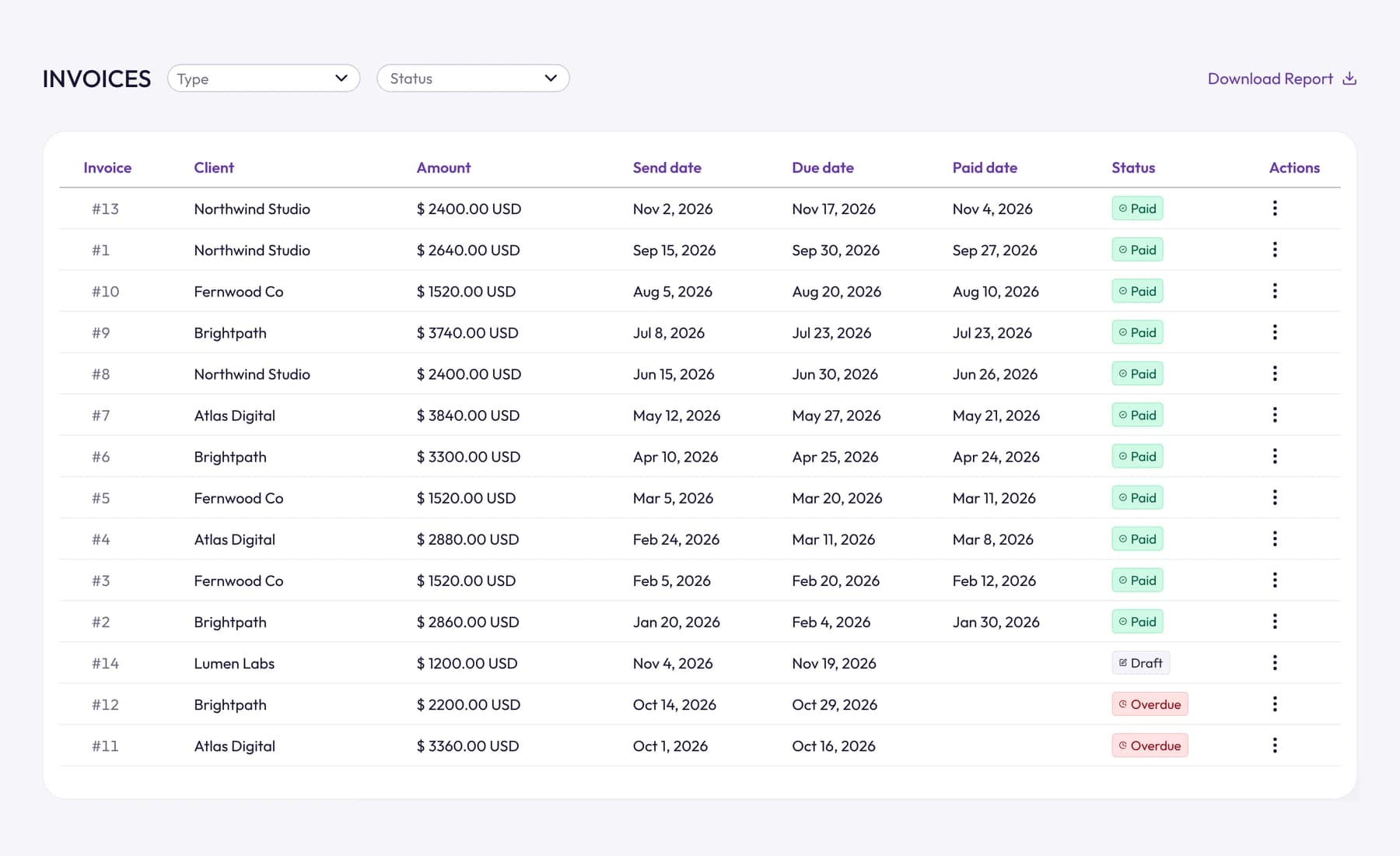
See how numbering, branding and reminders work on our invoicing software page.
Frequently asked questions
Do invoice numbers have to be sequential?
In the EU and the UK, VAT invoices need a sequential number based on one or more series, and in India GST invoices need a consecutive serial number. In the US there's no federal rule, but sequential numbers are still the simplest way to show your records are complete.
Can I have gaps in my invoice numbers?
Avoid them, and explain any you have. Keep voided invoices on file, note why each was canceled, and keep a short log so anyone checking your records can see what happened to every number.
Can I use letters in an invoice number?
Yes. HMRC accepts a mix of numbers and letters, and India's GST rules allow letters, numbers, hyphens and slashes up to 16 characters.
Should I restart invoice numbers every year?
You can, if the year is part of the number, such as 2027-001. Otherwise keep one continuous sequence. In India, start a new series each financial year so numbers stay unique for the year.
Wrap up
Invoice numbering comes down to three rules: every number is unique, each series runs in order, and nothing you've issued is deleted or reused. Pick a simple format, keep credit notes and quotes in their own series, log any voids, and when the year changes or you switch tools, carry the sequence on or start a clearly labeled new one.
To keep your invoice numbers, statuses and the hours behind them in one place, try Tristiks Grow free for 14 days.
Category: Payments
Suraj Rao
Suraj Rao is the founder of Tristiks, the team behind Tristiks Grow and its desktop time tracker OneTrack. He writes about time tracking, client work and getting paid, and about DevOps, cloud and AI from years of building software.