How to Write a Creative Brief (Template and Example)
 By Suraj Rao11 min read
What You'll Learn
- A creative brief is a one or two page agreement on the problem, the audience, the message, the deliverables and how success is judged, written before any creative work starts.
- Whoever writes the first draft, the agency should play it back to the client in writing and get it signed off, because a brief the client hasn't approved can't settle a dispute.
- Use the brief as the source for your proposal and statement of work, list what's out of scope, and judge every draft and every new request against it.

To write a creative brief, answer ten questions on one or two pages before any creative work starts: why the project exists (background), what it must achieve (objective), who it's for (audience), the one thing they should take away (message), what you'll deliver, what's fixed (mandatories), the budget, the timeline, who approves the work and how success will be measured. The client usually supplies the facts. The agency or freelancer shapes them into a brief, plays it back, and gets the client to sign it off.
A good brief points the work at the right problem and gives you both something to check drafts and new requests against. Below: who writes it, the ten sections, a template, a filled-in example, questions for vague clients, common mistakes, and how the brief feeds your proposal and limits scope creep.
What a creative brief is (and what it isn't)
A creative brief sets the direction for a piece of creative work: a website, a brand identity, a campaign, a video. HubSpot describes it as a summary of a project's mission, goals, challenges, audience and messaging. It's easy to confuse with the documents around it:
| Document | Answers | Who it's for | Legally binding? |
|---|---|---|---|
| Creative brief | What problem, for whom, with what message | The people doing and approving the creative work | No |
| Proposal | How you'll solve it and what it costs | The client deciding whether to hire you | Not on its own |
| Statement of work | Exactly what's delivered, when, and how it's accepted | Both sides, during delivery | Usually, as part of the contract |
| Contract | Payment, ownership, liability, termination | Both sides, if things go wrong | Yes |
If the brief is vague, everything built on it is too.
Why briefs matter more than they look
In a 2021 global study of around 1,700 marketers and agency staff, BetterBriefs and the IPA found respondents estimated about a third of marketing budgets could be wasted on poor briefs and misdirected work, and most marketers (69%) and agencies (73%) agreed that rebriefs happen too often. A 2022 UK follow-up of 508 respondents put the waste at 26% and found only 6% of UK agencies were clear on the strategic direction in the briefs they received. These are respondents' estimates, not measured spend.
The brief matters after kickoff too. The 2025 BetterIdeas study from the same group found only 23% of agencies and 15% of marketers consistently use the brief to evaluate ideas, and it typically took five rounds to reach a signed-off idea. Check every draft against the brief and feedback gets less subjective.
Who writes the brief: client or agency?
In big-brand marketing, the client writes the brief. The IPA's guide, The Best Way for a Client to Brief an Agency, written with Mark Ritson and BetterBriefs, is aimed at those client-side marketers. Most small clients have never written one, so freelancers and small agencies usually end up with one of three set-ups:
- The client writes it. Read it critically and ask about every gap.
- You write it from a conversation. The most common set-up: you run a discovery call and turn your notes into a brief. Adobe recommends the account manager meet the client to go through the brief together.
- You write it together. The client fills in the template below before a call and you complete the rest on it.
Either way, finish by sending the brief back in writing for the client to confirm (a "brief back" or "reverse brief"). An unapproved brief is just your notes, and it won't settle a dispute.
The 10 sections of a creative brief
HubSpot lists eleven steps and Wrike adds contact details, but these ten cover what a client project needs:
| Section | What to write | Weak version to avoid |
|---|---|---|
| 1. Background | Who the client is, what's happening, why now | "We need a new website" |
| 2. Objective | The business result, ideally a number and a date | "Raise awareness" |
| 3. Audience | Who it's for, what they think now, what they need | "Everyone aged 25 to 65" |
| 4. Message | The single thing they should take away | Five benefits in a list |
| 5. Deliverables | Each item, format and quantity, plus what's out of scope | "Website and social" |
| 6. Mandatories | Brand rules, legal text, must-use assets, tone | Left blank |
| 7. Budget | A number or range, and what it covers | "Flexible" |
| 8. Timeline | Key dates and what drives them | "ASAP" |
| 9. Approvals | Who gives feedback, who signs off, rounds included | Left blank |
| 10. Success measures | How you'll know it worked | "Client is happy" |
The example below shows strong versions of each.
Two sections do most of the work. The objective stops the project becoming a matter of taste: you ask "Does this help get to 70 bookings?" instead of "Do you like it?". The approvals section stops feedback arriving from six people in six inboxes.
Creative brief template (copy and paste)
Copy this into a doc. Keep it to two pages at most. A blank section is a question to ask, not one to skip.
Creative brief: [Project name]
Client: [Company], [main contact, email]
Prepared by: [You or your agency], [date], version [1]
1. Background: What's happening in the business, and why this project now? [2 to 4 sentences]
2. Objective: What should this work achieve, in numbers if possible? [One main objective, one or two secondary at most]
3. Audience: Who are we talking to? What do they think, feel or do today, and what should change? [1 short paragraph]
4. Key message: The one thing the audience should take away. [One sentence]
Reasons to believe: [2 or 3 facts that back it up]
5. Deliverables:
- [Item, format, quantity]
- [Item, format, quantity]
Out of scope: [What we are not doing]
6. Mandatories: [Brand guidelines, legal text, tone, accessibility, must-use assets]
Avoid: [Styles, words or claims to stay away from]
7. Budget: [Amount or range, and what's included]
8. Timeline: Start [date]. Key milestones [dates]. Final delivery [date], because [reason].
Client feedback time: [X working days per round]
9. Approvals: Feedback from [names]. Consolidated by [name]. Final sign-off by [name]. [Number] rounds of revisions per stage.
10. Success measures: [Metric], measured [when], compared with [baseline].
Client confirmation: I confirm this brief reflects what we need. [Name, date]
Most templates leave out the confirmation line. Keep it.
A filled-in example
A brief for a small website project, written by a freelance designer after a discovery call:
CREATIVE BRIEF: Northside Physio website redesign
Client: Northside Physio, Sam Patel (owner), sam@example.com
Prepared by: Lena Ortiz Design, March 3, version 2

1. Background
Two-clinic practice. Online bookings fell from 55 to 40 a month after
a competitor opened nearby. Most visitors use phones; the site isn't
mobile friendly and the booking link is buried.

2. Objective
Increase online bookings from 40 to 70 a month within three months
of launch. Secondary: cut "how do I book?" phone calls.

3. Audience
Office workers aged 25 to 50 with back, neck or sports injuries,
searching on their phone. They want to know: can I be seen soon,
nearby, and what does it cost?

4. Key message
"Book a physio near your office this week, in under a minute."
Reasons to believe: same-week appointments, two central clinics,
prices shown upfront.

5. Deliverables
- 8-page responsive website
- Booking button on every page, linked to the existing booking system
- 3 social media templates for the launch
Out of scope: copywriting (client supplies text), photography,
booking system changes, paid ads.

6. Mandatories
Existing logo and colors. Regulator registration number in the footer.
Meet WCAG 2.2 AA contrast. Avoid: stock photos of people in gym wear.

7. Budget
$9,500 fixed, including stock images up to $300.

8. Timeline
Start March 10. Design approved April 4. Live by April 28, before the
spring running season. Client feedback within 3 working days.

9. Approvals
Dana (clinic manager) consolidates feedback. Sam signs off.
Two rounds of revisions on design, one on build.

10. Success measures
Online bookings per month, measured 60 and 90 days after launch
against the February baseline.

Client confirmation: Sam Patel, March 4
If Sam asks for blog posts in week four, the brief already says copywriting is out of scope, so you price it as an addition instead of arguing.
Questions to pull a brief out of a vague client
Most clients start with a deliverable ("We need a new logo") rather than a problem. These questions get you to a brief, on a call or as a form beforehand.
Background and objective
- What's prompted this project now?
- If this works brilliantly, what's different in six months? What number moves?
Audience
- Who's your best customer? Describe one real person.
- What do they believe about you today that's wrong or missing?
- Where do they first come across you?
Message
- If they remember one sentence, what should it be?
- Why should they believe it? What proof do you have?
Deliverables and mandatories
- What exactly do you picture receiving at the end?
- What's definitely not part of this?
- What can't change: logo, colors, legal wording, tone?
- Show me three examples you like and one you don't. What's the difference?
Budget, timeline and approvals
- What budget have you set aside?
- What's driving the deadline?
- Who needs to see the work, and who has the final say?
A client who can't name a decision-maker or a budget usually can't approve a brief either; it's one of the client red flags worth noticing early.
Common mistakes
- Several equal objectives. "Build awareness, drive sales and reposition the brand" is three projects. Pick one.
- An audience of everyone. It won't guide a single design decision.
- Five messages instead of one. Put the rest under "reasons to believe".
- No out-of-scope list. Teamwork's guide to briefs that lock scope makes the point that deliverables get written down by default, while the out-of-scope list only exists if someone decides to write it.
- Budget and approvals left blank. Awkward to ask, so they cause the most trouble later.
- No sign-off. Without the client's confirmation, it's your version of events.
- Filing it after kickoff. Asana suggests a kickoff meeting to go through the brief and raise conflicts. Then bring it to every review.
- Never updating it. If the objective or scope really changes, issue version 2 and get it confirmed again.
How the brief connects to the proposal, SOW and change orders
The brief is the first link in a chain:
Discovery call  ->  Creative brief (client confirms)
                ->  Proposal: your approach, options and price
                ->  Statement of work + contract (client signs)
                ->  Delivery: every draft reviewed against the brief
                ->  New request outside the brief  ->  Change order
In practice:
- The proposal reuses the background and objective in the client's words, then adds your approach and price. See how to write a project proposal.
- The statement of work turns the deliverables, out-of-scope list, timeline and approvals into contract terms.
- During delivery, feedback is judged against the objective. "Make the booking button bigger" helps people book. "I've gone off blue" probably doesn't, unless it fits your revision rounds.
- New requests outside the brief become change orders, priced and approved before you start.
Most scope creep isn't one big request. It's a run of small ones nobody checked against anything. With a confirmed brief you can say: "Good idea. It isn't in the brief we agreed, so I'll send a quick quote." That's part of setting client boundaries early.
File the signed brief as part of your client onboarding checklist, and compare results with the success measures in a project post-mortem.
How Tristiks Grow helps
Tristiks Grow has no built-in creative brief form, so write the brief in any doc. It handles what comes next:
- A client profile for each prospect, with notes, files and links, so the signed brief and call notes live with the client, not in an inbox.
- Proposals and contracts with sections, so the brief's objective, deliverables and out-of-scope list carry into the scope section, with a pricing table in the client's currency. The client signs online by typing their name, and the signed version is locked.
- Tasks for each deliverable, with due dates and time tracked against each, so you see whether you're on budget before the final invoice.
- Time tracked by client and project, so extra requests show up as hours you can point to in a change order.
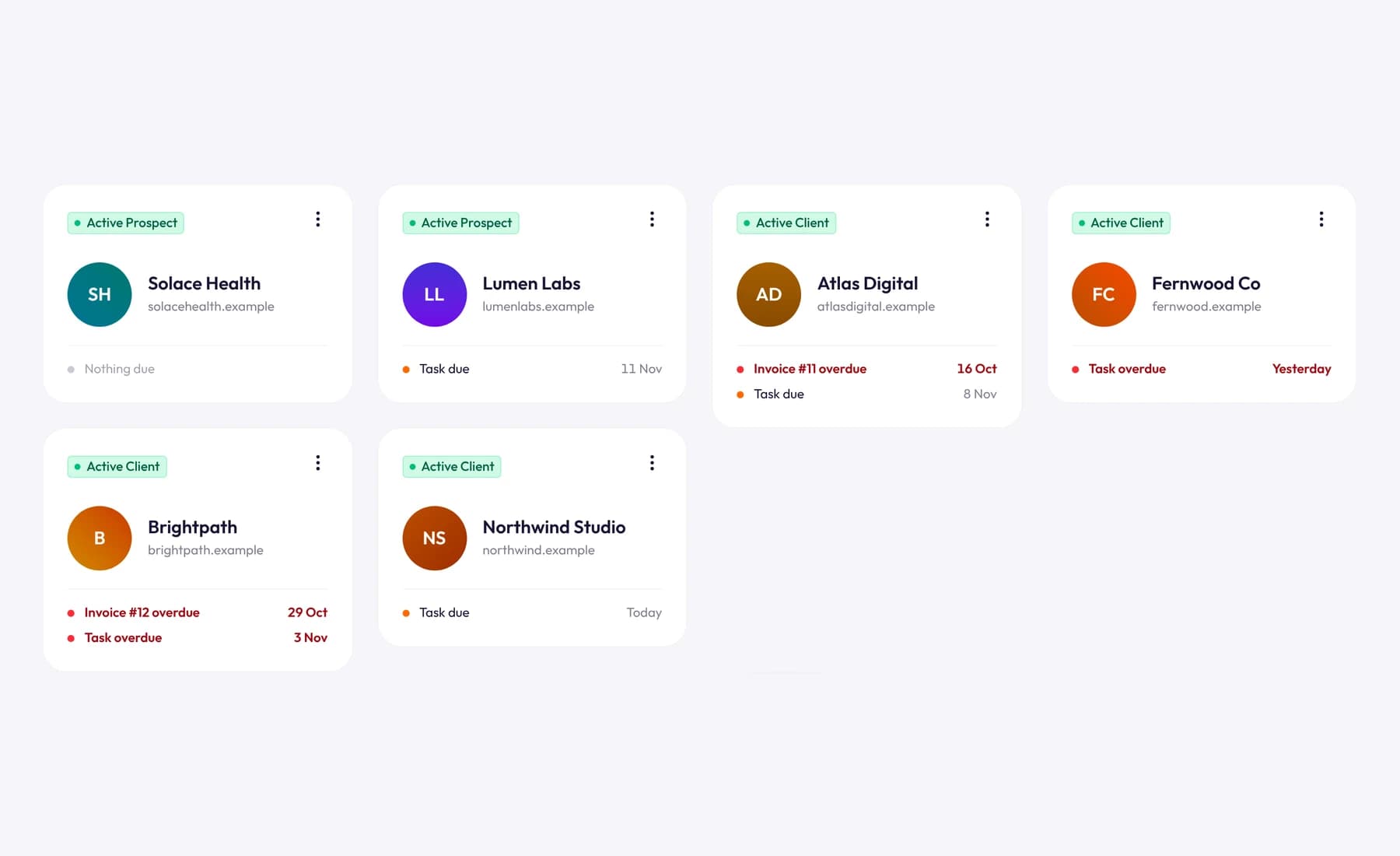
See client management software for how client profiles work, or proposal and contract software for proposals.
Frequently asked questions
How long should a creative brief be?
One page is ideal; two is as long as most projects need. If it runs longer, move research into an attachment or decide what matters most.
Should the client or the agency write the creative brief?
Either can draft it. In freelance and small agency work you usually write it from a discovery call. What matters is that the client confirms it in writing before work starts.
Can I charge for writing the brief?
For a simple project, the brief is part of winning the work. If getting to a clear brief needs research, workshops or strategy, that's a paid discovery phase, which you can credit against the project if the client goes ahead.
Wrap up
A creative brief answers ten questions on one or two pages: background, objective, audience, message, deliverables, mandatories, budget, timeline, approvals and success measures. Write it from a proper discovery conversation, include an out-of-scope list, get the client to confirm it, and use it as the source for your proposal, your statement of work and every review and change order that follows.
To turn a confirmed brief into a proposal your client can sign online, try Tristiks Grow free for 14 days.
Category: Client Management
Suraj Rao
Suraj Rao is the founder of Tristiks, the team behind Tristiks Grow and its desktop time tracker OneTrack. He writes about time tracking, client work and getting paid, and about DevOps, cloud and AI from years of building software.