Can a Small Agency Run a Four-Day Week? A Trial Plan
 By Suraj Rao11 min read
What You'll Learn
- Most companies in the big four-day week trials kept it, with wellbeing up and revenue roughly flat, but the firms chose to take part and the data is mostly self-reported.
- For an agency, the hard parts are client coverage and billable hours. Staggered days solve coverage; cutting meetings and admin, not squeezing people, protects billable time.
- Measure four to six weeks of time data first, run a three-month trial with clear success criteria, and decide on the numbers, not the mood.

Yes, many small agencies and freelancers can run a four-day week, but only if client coverage and billable hours are planned, not hoped for. In the largest trial, 56 of 61 UK companies kept the four-day week after six months, with wellbeing up and revenue roughly flat. The agencies that make it work cut meetings and admin rather than billable time, stagger days off so clients always reach someone, and run a measured trial before committing.
This guide covers what the trials found and their limits, the main four-day week models, how to keep client response times steady, the utilization and billing math with a worked example, what to measure before and during a trial, a step-by-step three-month plan and the risks to watch.
What the trials found
The 2022 UK pilot
The best-known trial ran from June to December 2022, organized by 4 Day Week Global with the think tank Autonomy and researchers at the University of Cambridge and Boston College. About 2,900 employees at 61 UK organizations cut working time by 20% with no cut in pay. Autonomy's results report and coverage of it found:
- 56 of 61 companies continued the four-day week after the trial, and 18 made it permanent (UKRI).
- More than two-thirds of employees reported lower burnout.
- Revenue rose 1.4% on average over the trial, weighted by company size, among the 23 companies that supplied usable data (PBS NewsHour).
- Sick days fell 65% (4 Day Week Global) and staff departures fell 57% (pilot results) compared with the same period a year earlier.
A year later, Autonomy's follow-up found at least 54 of the 61 (89%) still ran the policy and at least 31 (51%) had made it permanent.
The larger study
A 2025 paper in Nature Human Behaviour analyzed 2,896 employees at 141 organizations in six countries, compared with about 290 employees at 12 companies that didn't change. Trial employees worked about five fewer hours a week, and burnout fell while job satisfaction and mental and physical health improved. Those who cut their hours the most reported the biggest gains, which matters if you're tempted by a "four-day week" that's really five days squeezed into four.
Public services
Client-facing work can cope. South Cambridgeshire District Council ran a trial from January 2023 to March 2024 with independent analysis from the universities of Cambridge and Salford; the council reports most of its 24 monitored services held steady or improved, and it voted to make the four-day week permanent in July 2025. Earlier, Iceland's trials of 35 to 36 hour weeks for about 2,500 workers found service provision stayed the same or improved in most workplaces.
The limits
Companies chose to take part, so they likely expected it to work. Most measures were surveys, revenue data was patchy and six months is short. The evidence says a four-day week can work for many organizations, not that it will work for yours. That's why you trial it.
The main models
"Four-day week" covers several different schedules. Pick the one that fits your clients, not the one with the best headline.
| Model | Hours | How it works | Good for | Watch out for |
|---|---|---|---|---|
| 100-80-100 | 32 | 100% pay, 80% time, 100% output | Teams with room to cut meetings and admin | Needs real process changes |
| Compressed hours | 40 | Four 10-hour days | Keeping hours and billing the same | Fatigue; overtime rules |
| Staggered days | 32 or 40 | Half the team off Monday, half off Friday | Client-facing agencies | Scheduling and handovers |
| Nine-day fortnight | 72 per fortnight | One extra day off every two weeks | A gentler first step | Smaller wellbeing gain |
| Seasonal | 32 in summer | Fridays off for a few months | Testing with low risk | Doesn't build lasting habits |
The 100-80-100 model is the one 4 Day Week Global promotes: full pay for 80% of the time in exchange for keeping full output. Compressed hours keep the same 40 hours, and they carry legal risk in some places. California, for example, requires daily overtime over eight hours unless an alternative workweek is adopted through a formal employee vote. Check the rules where your people work before you schedule 10-hour days.
Productive.io, which makes agency software, ran four-day weeks over a summer as a low-risk test.
Keeping clients covered
Clients care whether someone answers and whether work arrives on time, not which day you take off.
Stagger the day off. For a team of four or more, split days off so every weekday has someone on each account. A two-person team can alternate Mondays and Fridays.
Set a response-time promise and keep it. Most clients are fine with "replies within one business day" if it's written down and kept. A same-day promise is harder on four days.
Name a backup for each client. Each account gets a primary contact and a backup with enough context to answer routine questions. Keep notes, files and status in one shared place so the backup isn't guessing.
Define emergencies. Agree what counts (the site is down, a launch is today) and who's on call. Everything else waits.
Tell clients before you start. Frame it around service, not perks:
Subject: A change to our working week, and what stays the same
Hi [Name],
From [date], our team is moving to a four-day week as a three-month trial. Here's what that means for you:
- You'll always reach someone Monday to Friday. [Primary contact] works [days]; [backup] covers [day].
- Response times stay the same: we'll reply within one business day, and the same day for anything urgent.
- Deadlines don't change. Your timeline for [project] is unaffected.
If anything slips, tell me directly and we'll fix it. I'll share how it's gone at the end of the trial.
[Your name]
Our guide to setting client boundaries covers how to hold a response-time promise without being on call all week, and client status update templates help keep clients informed without extra meetings.
The billing and utilization math
This is where agency four-day weeks succeed or fail. If you bill by the hour and simply work fewer hours, revenue falls. The question is how much of the lost time was billable.
Worked example: a five-person agency
Before (five-day week)
Team:                    5 people x 40 hours = 200 hours a week
Billable utilization:    65% = 130 billable hours
Non-billable:            70 hours (meetings, admin, internal, pitching)
Average billed rate:     $110 an hour
Weekly billed revenue:   130 x $110 = $14,300

After (100-80-100, four days)
Team:                    5 people x 32 hours = 160 hours a week
To keep 130 billable:    130 / 160 = 81% utilization
Non-billable allowed:    160 - 130 = 30 hours (down from 70)
Cutting non-billable time from 70 to 30 hours a week is a 57% cut. Some is realistic: shorter meetings, fewer internal check-ins, async status updates, templates for repeat admin. All of it rarely is. Say you cut non-billable time to 45 hours:
Billable hours:          160 - 45 = 115 a week (72% utilization)
Lost billable hours:     130 - 115 = 15 a week
Lost revenue:            15 x $110 = $1,650 a week, about $85,800 a year

Ways to close the gap:
Raise rates 13%:         115 x $124 = $14,260 a week
Improve realization:     bill hours that were being written off
Move to fixed fees:      price by deliverable, so fewer hours cost you less
Two lessons. First, 81% utilization across a whole agency is very high; our guide to agency utilization rate explains why most agencies run well below it. Second, the four-day week works best alongside pricing that isn't tied to hours: retainers or fixed-price projects, and a rate increase timed with the change.
For solo freelancers
The same math, simpler:
Five days:  40 hours at 60% billable = 24 billable hours
Four days:  32 hours at 75% billable = 24 billable hours
To keep your income, you need to cut eight hours of non-billable time, not billable work. Batch admin into one block, automate invoicing and reminders, and stop taking calls that should have been emails. If you're already near your limit, our post on freelance burnout shows the warning signs in your hours.
What to measure, before and during
Agree the numbers before you start, or the trial ends in a debate about feelings. Collect four to six weeks of baseline data, then track the same measures weekly during the trial.
| Measure | How to get it | Guardrail during the trial |
|---|---|---|
| Hours worked per person | Time tracking | No creep back toward five days |
| Billable utilization | Billable hours / available hours | Within 5 points of target |
| Non-billable hours by type | Tags or projects for meetings, admin, internal | Meetings and admin falling |
| Realization | Hours billed / billable hours worked | Not falling |
| Revenue and margin by client | Invoices and tracked cost | Within your agreed tolerance |
| Response time | Email or helpdesk timestamps | Promise kept 95% of the time |
| On-time delivery | Deadlines met / deadlines due | At or above baseline |
| Evening and day-off work | Time entries by day and hour | Near zero |
| Wellbeing | Short monthly survey | Improving or stable |
Hours on the day off are the measure most trials miss: if people quietly work Fridays, you've moved the work, not reduced it. Our guides to billable vs non-billable hours and agency KPIs cover how to set these up.
A three-month trial plan
Weeks minus 6 to 0: prepare
- Collect baseline data for every measure in the table above. If your team doesn't track time consistently yet, start now; getting a team to track time covers how.
- Pick the model and the day-off pattern. Draw a coverage calendar for every client.
- Write success criteria, for example: billable revenue within 5% of baseline, response-time promise kept, on-time delivery at baseline, day-off hours under one per person per week.
- Cut before you start. Audit recurring meetings, cancel or shorten at least a third, and move status updates to writing.
- Agree the rules: what happens with client emergencies, holidays that fall on a working day and part-time staff.
- Tell clients two to four weeks ahead with the email above.
Month 1: run it
- Review the numbers weekly in a 15-minute meeting.
- Expect a dip in the first two weeks.
- Fix coverage gaps immediately.
Month 2: adjust
- Look at non-billable hours by type and cut the biggest remaining category.
- Rebalance workloads if one role, often account management, is carrying the coverage.
- Check capacity against next quarter's pipeline.
Month 3: decide
- Compare each measure against baseline and your success criteria.
- Ask clients for a one-line view: did anything change for them?
- Choose: continue, continue with changes (for example, a nine-day fortnight), or stop. Stopping on the numbers is a valid result.
Risks to watch
- Hidden overtime. People answer email on the day off or work longer days. Watch the time data, not just the calendar.
- Intensity. Cramming five days into four leads back to burnout.
- Uneven roles. Client-facing staff may find it harder than designers or developers. Plan their coverage first.
- Client perception. One missed reply on a Friday can undo goodwill. Over-communicate during the trial.
- Revenue dip. Model the worst case before you start, and know how many weeks of reserves you have.
- Compressed-hours rules and contracts. Check overtime law and employment contracts before changing hours, and remember subcontractors set their own schedules; see hiring your first subcontractor.
How Tristiks Grow helps
Tristiks Grow gives you the time data a four-day week trial needs:
- Time tracking with a desktop app for macOS, Windows and Linux and a web timer, with each entry tagged by client, project, task and billable status.
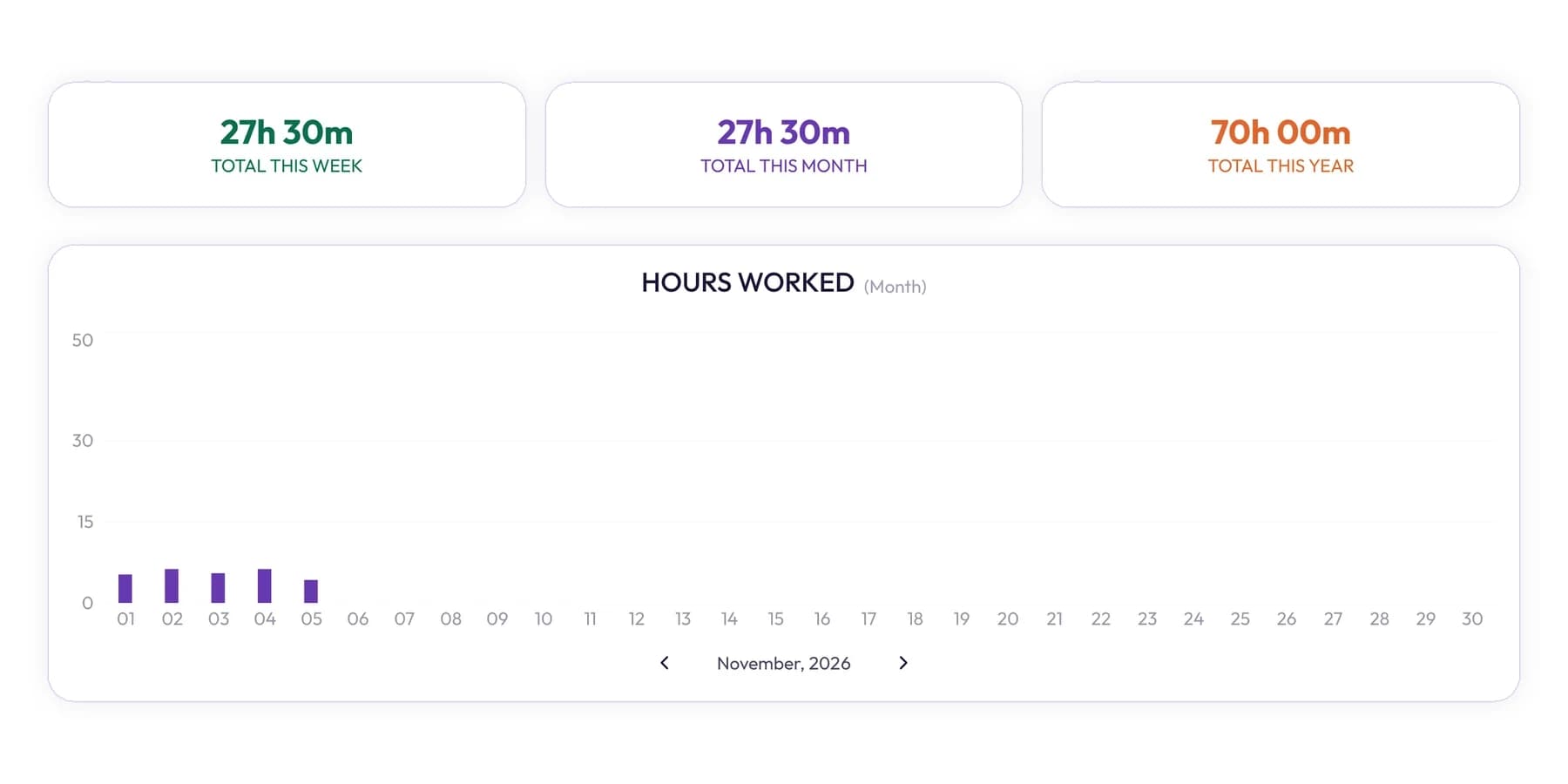
- Hours this week, month and year, with a chart of hours per day, so work creeping onto the day off shows up straight away.
- Reports by client and project, with client rates showing what the hours earned, so you can compare revenue against your baseline.
- A task board with Overdue, Today, This Week and Upcoming columns, so handovers before a day off don't get lost.
See time tracking for agencies for how teams use it.
Frequently asked questions
Is a four-day week the same as compressed hours?
No. A true four-day week, such as 100-80-100, cuts hours to about 32 with no pay cut. Compressed hours fit 40 hours into four longer days. The research on wellbeing gains mostly covers reduced hours.
Will clients accept it?
Most clients care about response times and deadlines, not which day you're off. Stagger days off, put your response-time promise in writing and tell clients before you start.
Can a solo freelancer work four days?
Yes, if non-billable time falls enough to keep billable hours steady, or if you price by project or retainer. Track a month of hours first to see how much admin you can cut.
How long should the trial be?
Three months is a practical minimum: the first few weeks are disrupted while habits change, and you need at least two normal months to compare against your baseline.
Wrap up
A four-day week can work for a small agency or freelancer, and most companies in the big trials kept it. The ones that succeed stagger days for client coverage, cut meetings and admin instead of billable work, adjust pricing and decide based on time data collected before and during a three-month trial.
To measure your baseline and track every hour of the trial by client and project, try Tristiks Grow free for 14 days.
Category: Productivity
Suraj Rao
Suraj Rao is the founder of Tristiks, the team behind Tristiks Grow and its desktop time tracker OneTrack. He writes about time tracking, client work and getting paid, and about DevOps, cloud and AI from years of building software.