The 30-Minute Weekly Review for Freelancers
 By Suraj Rao10 min read
What You'll Learn
- A weekly review is a fixed 30-minute appointment with your business: close the week, check each project against its budget, plan next week and look at pipeline and cash.
- It works because planning ahead with specific if-then plans helps people follow through, and because writing a plan down takes unfinished work off your mind.
- Use the copy-paste checklist and the thresholds table, keep the same day and time every week, and extend it with a monthly and quarterly look at rates, clients and capacity.

A weekly review for freelancers is a fixed 30-minute session, once a week, where you close out the week that's ending and plan the next one. In four parts: fix your time log and invoice unbilled hours, check every active project against its budget, plan next week's hours against your real capacity, and look at your pipeline and cash. Done every week, it catches lost hours, overruns and late payments while they're still small.
Below: why weekly reviews work, the four-part routine, a checklist to copy, the numbers to watch, a worked example, how to make it stick and a monthly and quarterly extension.
Why a weekly review works
The weekly review comes from David Allen's Getting Things Done (GTD). His official weekly review checklist has three phases: get clear (process inboxes and notes), get current (review calendar, actions and projects) and get creative (look at new ideas). Doist's weekly review guide suggests borrowing from Allen's list and adding items for your own goals, and Trello's version boils it down to routine, reflect and plan at a fixed time.
A freelancer needs a narrower version, because the week's loose ends are mostly money: hours not billed, invoices not paid, budgets running out. The research backs the habit:
- Specific plans get carried out more often. Peter Gollwitzer showed that if-then plans ("when situation X arises, I'll do Y"), which he called implementation intentions, help close the gap between intending and doing. A 2006 meta-analysis by Gollwitzer and Sheeran of 94 independent tests with more than 8,000 participants found a medium-to-large effect on reaching goals (d = 0.65). "Tuesday 9:00 to 12:00, Atlas homepage" is that kind of plan.
- A written plan quiets unfinished work. In Masicampo and Baumeister's 2011 experiments, unfinished goals kept interfering with people's performance on other tasks, but letting people make a specific plan for those goals removed the effect. Once the invoice is on Monday's list, you can stop thinking about it.
- We underestimate our own work. In the original planning fallacy study, Buehler, Griffin and Ross found people consistently predicted they'd finish their own tasks sooner than they did. Comparing last week's plan with tracked hours corrects for that.
Allen's checklist covers every inbox and project you have, so it's thorough rather than quick. Tiago Forte's one-touch weekly review aims for clear priorities in 30 minutes, which is the right target here: long enough to check the numbers, short enough to keep doing. Your first few will run longer.
The 30-minute weekly review in four parts
| Part | Time | What you finish with |
|---|---|---|
| 1. Close the week | 10 min | A complete time log, unbilled hours invoiced, overdue invoices followed up |
| 2. Review clients and projects | 7 min | Every project checked against its budget, problems flagged |
| 3. Plan next week | 8 min | A realistic plan, in time blocks, within your capacity |
| 4. Business check | 5 min | Pipeline, cash and one improvement for next week |
Do the parts in this order. Planning before you've closed the week means planning on wrong numbers.
Part 1: Close the week (10 minutes)
Fix the time log. Look for empty days, timers left running, entries without a client or project and wrong billable status. Check your calendar for missed client calls. Our time tracking best practices keep this step short.
Find unbilled hours. Add up billable hours not yet on an invoice, by client. Work finished over a week ago and not invoiced is a free loan to the client. Our guide to tracking time for multiple clients keeps each client's hours separate.
Invoice and check payments. Invoice finished milestones and hourly work now, not at month end. Mark what's paid, and send the next reminder for anything overdue. Our payment reminder email templates cover each stage.
Part 2: Review clients and projects (7 minutes)
For each active project, answer three questions:
- Budget used vs work done. If you've used 70% of the budget and done 50% of the work, you're behind. Our guide to project budgets shows how to estimate where it'll land.
- What's the next action? Every project needs a concrete next step with a date. No next action means it's stalled.
- What's waiting on the client? Feedback, content, approvals. Send one message per client asking for all of it.
Then note who's gone quiet, who's asking for out-of-scope work and who's due a status update.
Part 3: Plan next week (8 minutes)
Capacity: the hours you'll work next week, minus time off, admin, sales and internal meetings.
Demand: every commitment with an hour estimate: deadlines, retainer hours, calls, revisions. If last week's estimates ran over, adjust.
Fit them: if demand exceeds capacity, decide now what moves: a date, internal work or a new request. Don't plan to 100%; something always turns up.
Block the time: put the big pieces in your calendar with the client and task named, so each block is a specific if-then plan. Our time blocking guide shows how to lay out a week. Agencies planning for a team can follow our capacity planning guide.
Part 4: Business check (5 minutes)
- Pipeline: How much work is confirmed for the next four weeks? Which proposals and leads need a follow-up?
- Cash: What's in the account, what's owed to you and what's due out before next week? Our freelance cash flow guide shows how big a buffer to keep.
- Energy: How many hours did you work, including evenings and weekends? Long weeks in a row are an early sign of freelance burnout.
- One improvement: a template to write, a reminder to switch on. One, not five.
Copy-paste weekly review checklist
Paste this into your notes app, task manager or a recurring calendar event:
Weekly review: [date]
1. Close the week (10 min)
- ☐ Time log complete, every entry with client, project and billable status
- ☐ Calendar checked for missed calls
- ☐ Unbilled hours older than 7 days invoiced
- ☐ Payments marked; overdue invoices followed up
2. Clients and projects (7 min)
- ☐ Each project: budget used [x]% vs work done [y]%
- ☐ Each project has a dated next action
- ☐ Waiting-on-client requests sent; scope changes raised
3. Plan next week (8 min)
- ☐ Capacity [hours] vs demand [hours]; gap resolved
- ☐ Big tasks blocked in the calendar
4. Business check (5 min)
- ☐ Confirmed work ahead [weeks]; proposals to chase [list]
- ☐ Cash [amount]; owed to me [amount]; due out [amount]
- ☐ Hours worked [hours], evenings and weekends [hours]
- ☐ One improvement: [one thing]
The numbers to look at, and when to act
These thresholds are our suggested starting points, not industry benchmarks. Adjust them after a month or two.
| Number | Healthy | Act when |
|---|---|---|
| Unbilled billable hours older than 7 days | Zero | Any are left after the review |
| Overdue invoices | None | Any is 7+ days overdue without a personal follow-up |
| Budget used vs work done | Within 10 points | Budget used is more than 10 points ahead |
| Billable share of tracked hours | At your own target | 10+ points under target two weeks running |
| Planned client hours vs capacity | About 80% or less | Next week is planned at 100% |
| Confirmed work ahead | 4 weeks or more | Less than 2 weeks |
| Cash buffer | At your target in months of costs | Below target, or heading there this month |
Set your billable target from your own rate math. Our post on billable vs non-billable hours explains what counts, and agency utilization rate covers published benchmarks and where they disagree.
A worked example: one week's review
Maya is a freelance web designer who bills $90 an hour and has three clients. It's Friday at 4 pm.
PART 1: CLOSE THE WEEK
Tracked (after adding a missed 1 h call): 38.5 h, 27 billable
Billable share: 27 / 38.5 = 70%  (target 70%)
Unbilled: Northwind 12 h (retainer, invoiced monthly on Monday)
          Bright Dental 9 h (milestone not finished)
          Atlas 6 h (finished last week)  -> invoice today: 6 x $90 = $540
Payments: Northwind #1063 $1,800 paid, marked
          Bright Dental #1061 $2,400, 8 days overdue
          -> second reminder sent, call booked Monday 10:00

PART 2: CLIENTS AND PROJECTS
Bright Dental: 42 of 60 h used = 70%; work done about 55%
  15 points behind: two extra page templates requested
  -> send a change order before doing more
Northwind retainer: 16 of 20 h used, one week left. On track.

PART 3: PLAN NEXT WEEK
Capacity: 40 h - 8 h admin, sales and calls = 32 h
Demand:   Bright Dental 12 h + Northwind 4 h + new Kite project 8 h = 24 h
Planned:  24 / 32 = 75%  (under her 80% limit)
Blocks:   Bright Dental Mon-Tue mornings, Kite Wed-Thu mornings,
          Northwind Thu afternoon, admin Fri morning

PART 4: BUSINESS CHECK
Pipeline: about 3 weeks confirmed; $6,000 proposal out -> chase Tuesday
Cash:     $11,500 / $4,600 monthly costs = 2.5 months (target 3)
          Paying the $2,400 and $540 takes her to 3.1 months
Hours:    38.5, 3 of them on Sunday
Improve:  switch on the 7-days-overdue automatic reminder
Thirty-two minutes. She found $540 she'd have forgotten until month end, caught an overrun early and has a week that fits her hours. Notice the review didn't include any client work or writing the change order: the review decides, and the work happens in the blocks it creates.
How to make it stick
Weekly reviews usually fail by being skipped, not by being done badly.
- Same time every week. Friday afternoon suits most freelancers; Monday morning works if Fridays fill with deadlines. Make it a recurring calendar event.
- Make it an if-then plan: "When I close my last client task on Friday, I'll open the checklist."
- Have a short version. On a bad week, do Part 1 and the capacity check, so the money and the plan never get skipped.
- Don't work during it. Anything over two minutes becomes a task for next week.
- Agencies: split it. The owner does Parts 1 and 4; the team does Parts 2 and 3 in a short Monday meeting.
Monthly and quarterly extensions
Once a month, add 30 minutes to the last weekly review:
- Profit by client: your client profitability and effective hourly rate on fixed-price work.
- Estimates vs actuals on finished projects, to estimate better next time.
- Non-billable time by type, and receipts filed for your accountant.
Once a quarter, take two hours for bigger questions: are you due a rate increase? Does one client bring in too much of your revenue? Are you turning work away, and is it time to hire a subcontractor? At year end, our freelancer year-end review covers the six reports to run.
How Tristiks Grow helps
Tristiks Grow keeps the numbers for Parts 1 and 2 in one place:
- A time log with billable status: every entry has a client, project, task and note, from the desktop app (which keeps tracking offline), the web timer or manual entries.
- Reports by client and project, with hours per day, week, month and year, and client rates showing what those hours earned.
- Invoices from tracked hours, with billed entries locked so nothing is billed twice.
- Paid, due and overdue at a glance, plus payment reminders 3 days before the due date, on the day, and 7, 14 and 30 days after, each switched on individually.
- A task board with Overdue, Today, This Week and Upcoming columns for planning next week.
It doesn't forecast cash or track a sales pipeline, so keep Part 4 in a spreadsheet or notes page.
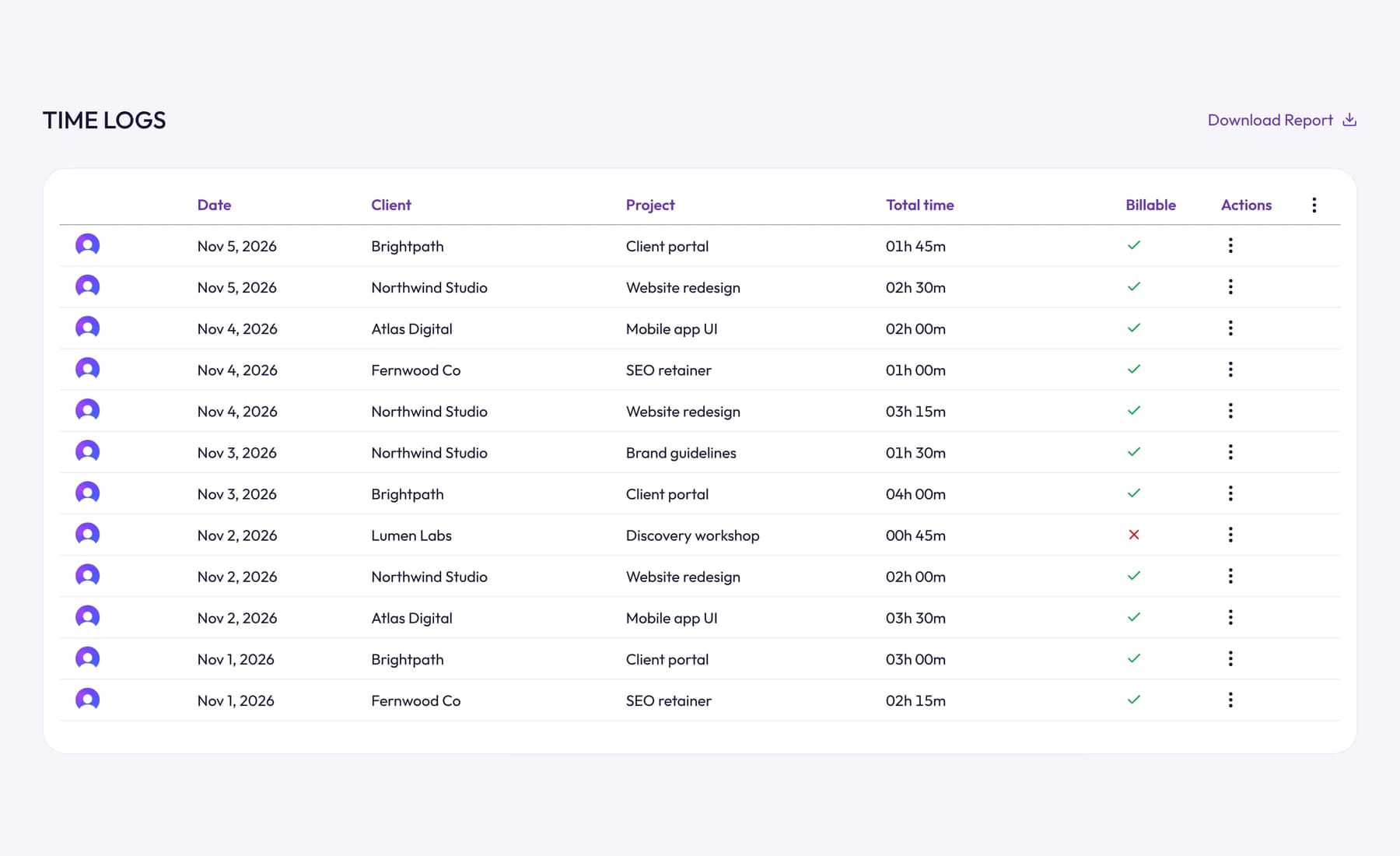
See how it works on our time reporting software page.
Frequently asked questions
What day should I do my weekly review?
Friday afternoon, while the week is fresh, so Monday starts with a plan. Monday morning is a good second choice. Keeping the same day matters more than which day.
How long should a weekly review take?
Aim for 30 minutes. The first few take longer while you clear the backlog. If it regularly runs past 45 minutes, you're probably doing work during the review instead of planning it.
Should agencies do a weekly review as a team?
Partly. The owner closes the week and does the business check alone. Project review and capacity planning work better as a short team meeting, because the people doing the work know where each project stands.
Wrap up
A weekly review is 30 minutes to close the week, check projects against budgets, plan next week within your capacity and look at pipeline and cash. The research on specific plans backs it, and the checklist and thresholds make it a routine. Keep the same slot every week and add a monthly and quarterly layer.
To have your time log, project hours and overdue invoices ready for your next review, try Tristiks Grow free for 14 days.
Category: Productivity
Suraj Rao
Suraj Rao is the founder of Tristiks, the team behind Tristiks Grow and its desktop time tracker OneTrack. He writes about time tracking, client work and getting paid, and about DevOps, cloud and AI from years of building software.