Freelance Burnout: How to Spot It in Your Own Hours
 By Suraj Rao7 min read
What You'll Learn
- The WHO describes burnout as the result of chronic workplace stress that hasn't been managed: exhaustion, distance or cynicism about the work, and feeling less effective.
- Freelancers have no manager watching their workload, so the early signs show up first in their hours: long weeks, no days off, late nights, more admin and lower effective rates.
- The fixes are mostly structural: a weekly hours cap, fewer clients, higher rates, boundaries in writing and time off planned into your pricing.

Freelance burnout is the exhaustion, cynicism and loss of effectiveness that builds up when the stress of running your own business goes unmanaged for months. Freelancers are especially exposed because nobody else sees their workload: there's no manager to notice the 60-hour weeks, and every extra project feels like income you can't turn down. The earliest warning signs usually appear in your own time records, as long weeks, no full days off, more late-night and weekend work, a growing share of unpaid admin and an effective hourly rate that keeps falling.
This guide covers what burnout is, seven signs to look for in your hours, a monthly check you can run in 15 minutes and the changes that deal with the cause rather than the symptoms. It's not medical advice. If you're struggling, talk to a doctor or a mental health professional; burnout overlaps with other conditions that need proper care.
What burnout is
The World Health Organization includes burnout in its classification of diseases as an occupational phenomenon, not a medical condition. It defines it as a syndrome resulting from chronic workplace stress that has not been successfully managed, with three dimensions:
- Exhaustion: feeling drained and depleted.
- Mental distance: cynicism or negativity about your work.
- Reduced professional efficacy: feeling, or being, less effective.
Notice the word "managed". For an employee, workload is partly the employer's job to manage. For a freelancer, it's entirely yours, which is why the warning systems have to be yours too.
Why freelancers are exposed
- Income feels fragile, so saying no to work feels risky even when you're full.
- Work and home blur, especially when you work from home.
- Admin is invisible: proposals, invoices, email and chasing payments eat hours that aren't on any project.
- Many clients means constant switching, and each one expects you to be responsive.
- No paid holidays: a week off costs a week of income, so it gets postponed.
Long hours are a risk in their own right: a WHO and ILO study found working 55 or more hours a week was associated with a higher risk of stroke and death from heart disease compared with 35 to 40 hours.
Seven warning signs in your hours
Feelings are a late signal. Your time log is an early one. Look for these:
1. Your weekly total keeps climbing
One long week before a launch is normal. Six in a row isn't. Look at your weekly total for the last three months and see whether it's trending up.
2. No full days off
Count the days in the last month with zero tracked time. If the answer is fewer than four, you haven't had a real weekend in a month.
3. More late-night and weekend entries
Entries after 9pm or on Saturdays and Sundays tell you work is spilling into rest time. Some freelancers prefer odd hours; the warning is when it's increasing, not when it's planned.
4. Admin is taking a bigger share
Non-billable time on email, proposals, invoicing and chasing payments grows quietly. If it was 15% of your week six months ago and it's 30% now, you're working more for the same income. Our guide to billable vs non-billable hours covers what to count.
5. Your effective hourly rate is falling
Divide what you earned in a month by every hour you worked, billable or not. If that number falls while your rates stay the same, projects are taking longer than they pay for. Our post on the effective hourly rate shows the calculation.
6. You're switching between clients constantly
A day split across five clients in 30-minute chunks is more tiring than the same hours on one or two. Count how many different clients you tracked time against each day. Our guide to tracking time across multiple clients covers why switching costs so much and how to batch.
7. Utilization above what's sustainable
Billable hours divided by available hours. Published benchmarks vary, but targets for delivery roles often sit around 70% to 80%; running well above that for months leaves no time for admin, learning or recovery. See our post on utilization rate benchmarks.
A 15-minute monthly check
On the first working day of each month, pull last month's time report and fill this in:
Monthly workload check: [month]

Total hours worked:                  ___   (last month: ___)
Longest week:                        ___ h
Days with no work at all:            ___
Entries after 9pm or at weekends:    ___
Non-billable share of hours:         ___ %
Effective hourly rate:               $___  (last month: $___)
Average clients worked on per day:   ___

Red flags (any two = act this month):
[ ] Longest week over 50 hours
[ ] Fewer than 4 full days off
[ ] Late or weekend entries up on last month
[ ] Non-billable share over 30%
[ ] Effective rate down two months in a row
The thresholds are a starting point. Adjust them to what's sustainable for you, but decide them in advance, not when you're already exhausted.
What to change
Rest helps, but if the cause is still there, the exhaustion comes back. These changes deal with the cause.
Set a weekly hours cap, and plan to it
Decide your maximum weekly hours and plan projects against it, as an agency plans capacity. When the week is full, new work starts next week. Our guide to capacity planning is written for agencies but works for one person.
Take on fewer clients
Fewer clients at higher value means less switching, less admin and fewer people expecting replies. Find out which clients actually make you money, and consider letting go of the ones that take the most time for the least return. Our guide to firing a client politely has scripts.
Raise your rates
Long hours are often a pricing problem: you're working more because each hour pays too little. Even a 15% increase with a few fewer clients can mean less work for the same income. See how to raise your rates.
Put boundaries in writing
Working hours, response times and how urgent requests are handled belong in your contract and onboarding, not just in your head. Our guide to setting client boundaries includes templates.
Protect focus time
Group meetings and client calls on set days, and keep blocks of deep work free of email and chat. Time blocking helps you plan it.
Cut admin
Automate what repeats: recurring invoices, payment reminders, proposal templates. Our post on automating freelance admin lists what's worth automating.
Price time off into your rate
If your rate assumes 48 working weeks a year, you can afford four weeks off. If it assumes 52, every holiday is a loss. Our guide to calculating your hourly rate, and the hourly rate calculator, build holidays and sick days in from the start, and a cash buffer (see freelance cash flow) makes taking them possible.
How Tristiks Grow helps
Tristiks Grow gives you the numbers for the monthly check:
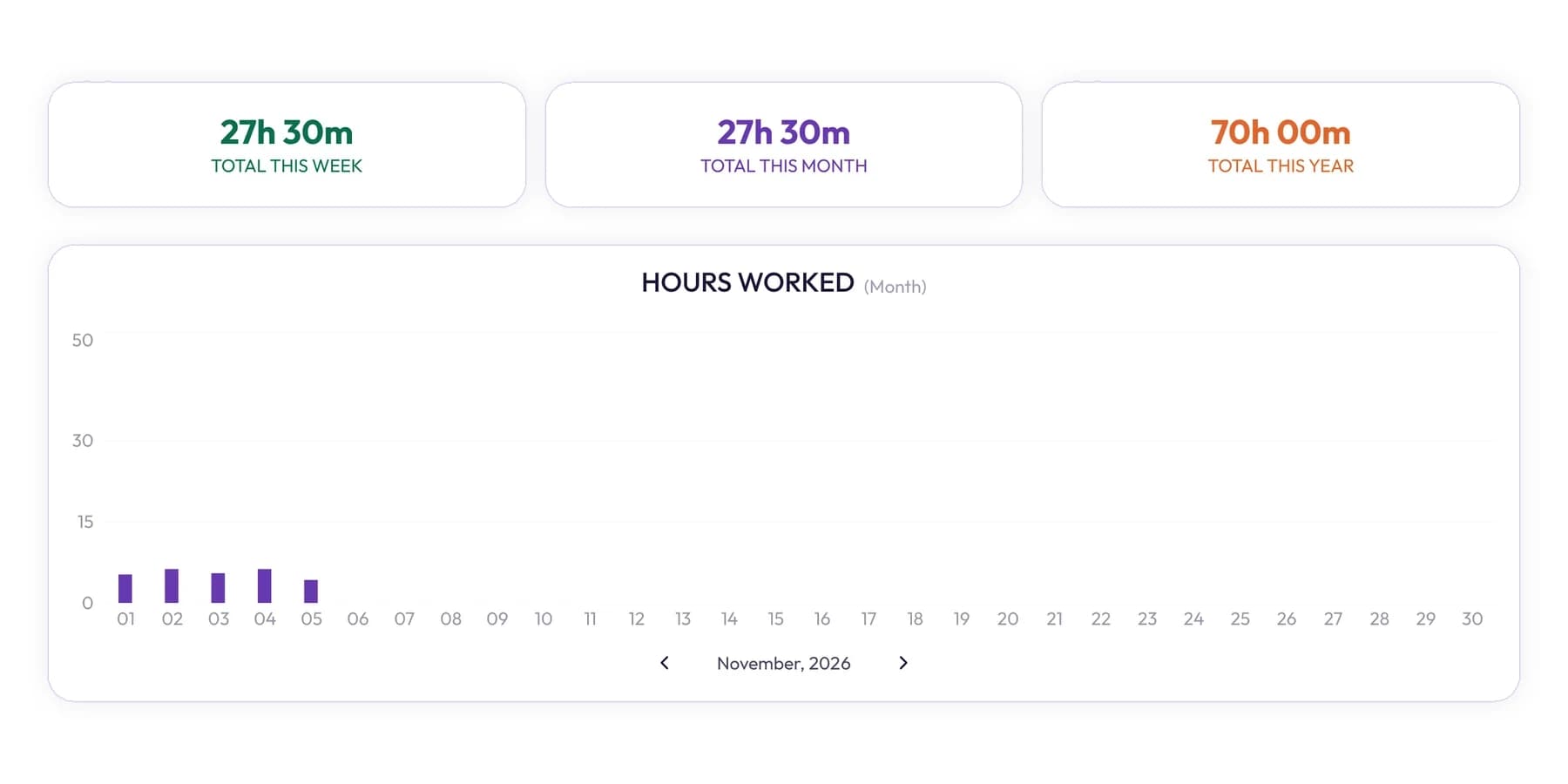
- Hours this week, this month and this year, above a chart of hours worked each day, so long weeks and days without a break stand out.
- A time log with every entry's date, client, project and billable status, to count late and weekend work and see your non-billable share.
- Reports by client, to compare the hours each client takes with what they pay.
- Recurring invoices and automatic payment reminders, to take repeat admin off your plate.
See time reporting software for how the reports work.
Frequently asked questions
Is burnout the same as being tired?
No. Tiredness goes away with rest. Burnout is a longer-term state that includes cynicism about your work and a sense of being less effective, and a weekend off doesn't fix it.
How many hours a week should a freelancer work?
There's no single right number, but planning for 35 to 45 hours, of which 25 to 30 are billable, is common and leaves room for admin and recovery. Long stretches above 55 hours carry health risks, according to the WHO and ILO.
Can time tracking itself cause stress?
It can if it feels like surveillance. Tracking your own time for your own decisions is different: the goal is to see your workload clearly, not to fill every hour.
Wrap up
Burnout builds slowly, and for freelancers nobody else is watching. Your hours show it first: climbing weekly totals, no days off, late nights, more admin and a falling effective rate. Check them every month against thresholds you set in advance, and fix the cause with a weekly cap, fewer clients, better rates and boundaries in writing.
To see your weekly hours, days off and non-billable time at a glance, try Tristiks Grow free for 14 days.
Category: Productivity
Suraj Rao
Suraj Rao is the founder of Tristiks, the team behind Tristiks Grow and its desktop time tracker OneTrack. He writes about time tracking, client work and getting paid, and about DevOps, cloud and AI from years of building software.